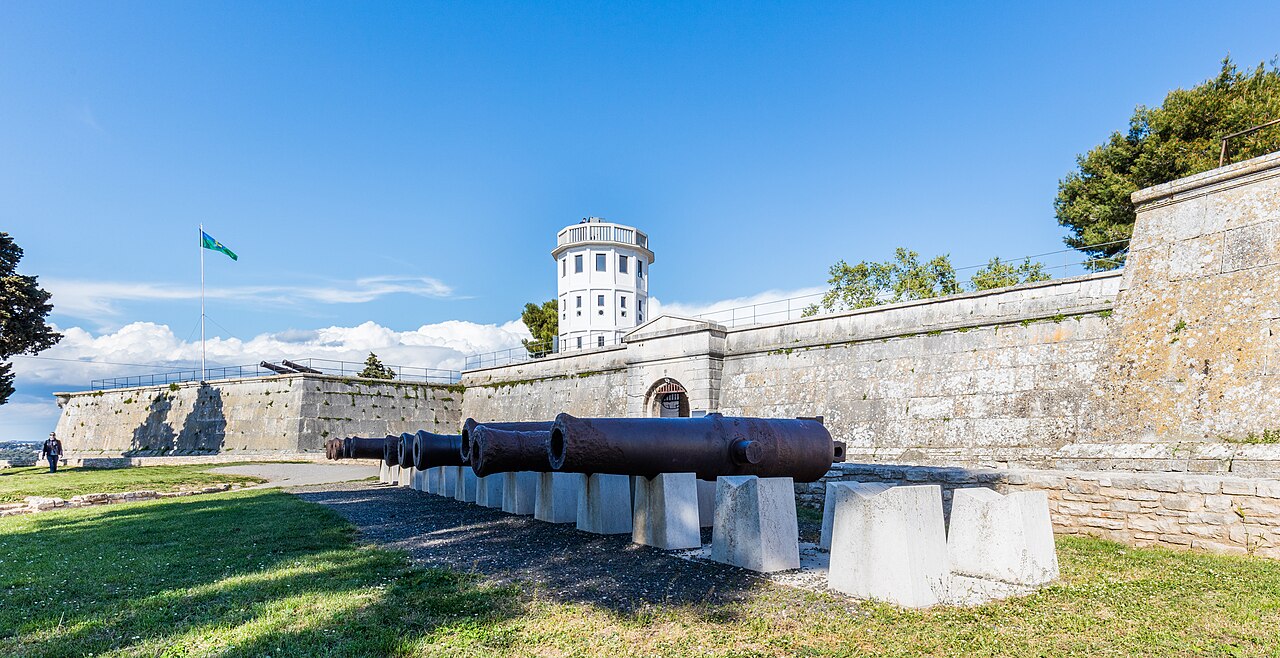
The Verudela Fortress stands as one of the best-preserved examples of Austro-Hungarian military architecture in the region of Pula, Croatia. Constructed between 1866 and 1881, this fortress was a crucial component of the extensive defensive network established by the Austro-Hungarian Monarchy as it transformed Pula into its maritime center. The fortress was part of a larger fortification system that included numerous artillery batteries, barracks, and support structures spread across Pula and its surrounding villages such as Medulin and Fažana.
The strategic importance of Verudela Fortress
During the late 19th century, the Austro-Hungarian Empire recognized the need to protect its naval assets and the vital harbor of Pula Bay. The Verudela Fortress was strategically positioned on the Verudela Peninsula, commanding views over the entrance to Pula Bay and the adjacent sea routes. Its location allowed for effective control of maritime traffic and defense against potential naval threats. The fortress formed part of a defensive ring that included other significant fortifications such as the Punta Christo Fortress on the nearby Štinjan peninsula, which was the largest Austro-Hungarian fortress in the area.
Architectural features and design
The fortress is an excellent example of 19th-century military engineering, incorporating the latest developments in fortification design of the period. It features robust stone and brick walls, surrounded by a deep trench that served as a moat, with access controlled through a limited number of fortified entrances. The design emphasized both defense and operational functionality, with interior courtyards providing access to underground chambers and storage areas. These subterranean spaces were used for ammunition storage, troop quarters, and command posts, protected from artillery fire.
The fortress’s layout was adapted to the natural topography of the peninsula, maximizing its defensive capabilities. Its bastions and artillery placements were arranged to cover all approaches by land and sea, creating overlapping fields of fire. The walls were equipped with battlements and embrasures for cannons, reflecting the military technologies of the late 19th century.
The broader fortification system of Pula
Between 1881 and 1918, the Austro-Hungarian Monarchy constructed a total of 31 military structures around Pula, including artillery batteries and support facilities. This network was designed to protect the naval base and the growing infrastructure such as the arsenal, hospital, and the Hydrographic Institute. The fortifications extended beyond Pula to nearby villages, creating a comprehensive defensive perimeter.
The Punta Christo Fortress, built on the Štinjan peninsula, was the largest of these fortifications, covering over 10,000 square meters and containing approximately 270 rooms. It was similarly fortified with trenches and controlled access points, overseeing the entrance to Pula Bay and nearby islands like Muzil and the Brijuni archipelago.
Post-military use and preservation
After World War II, the Verudela Fortress, along with other Austro-Hungarian fortifications in the area, was abandoned and fell into disrepair. Years of neglect left the fortress dilapidated until restoration efforts began to clear and preserve the site. Today, the Verudela Fortress serves as a cultural venue, hosting concerts, exhibitions, and various public events. Its well-preserved state offers visitors a glimpse into the Austro-Hungarian Empire’s military heritage and the strategic importance of Pula as a naval center.
Visitors can explore the fortress’s courtyards, underground chambers, and ramparts, gaining insight into the defensive strategies of the late 19th and early 20th centuries. The site’s preservation contributes to the cultural and historical landscape of Pula and Croatia’s coastal region.
Frequently asked questions (FAQ)
- When was Verudela Fortress built and by whom?
- Verudela Fortress was constructed between 1866 and 1881 by the Austro-Hungarian Monarchy as part of their efforts to fortify Pula's maritime defenses.
- What is the architectural style of Verudela Fortress?
- The fortress reflects 19th-century military engineering with robust stone and brick walls, bastions, trenches, and underground chambers designed for artillery defense.
- Can visitors explore the interior of Verudela Fortress?
- Yes, visitors can access the fortress's courtyards, underground chambers, and ramparts, which have been preserved and adapted for cultural events.
- What was the strategic role of Verudela Fortress?
- Verudela Fortress was strategically located to control the entrance to Pula Bay and protect the Austro-Hungarian naval base from maritime threats.
- Is Verudela Fortress open to the public?
- The fortress is currently used for concerts, exhibitions, and cultural events, making it accessible to the public during these occasions.
Information
Loading map...
Visitor reviews
No reviews yet. Been here? Write the first review and help other travelers!
Write the first reviewVisited this castle? Share your experience
Your review helps other travelers and adds first-hand knowledge to our encyclopedia.