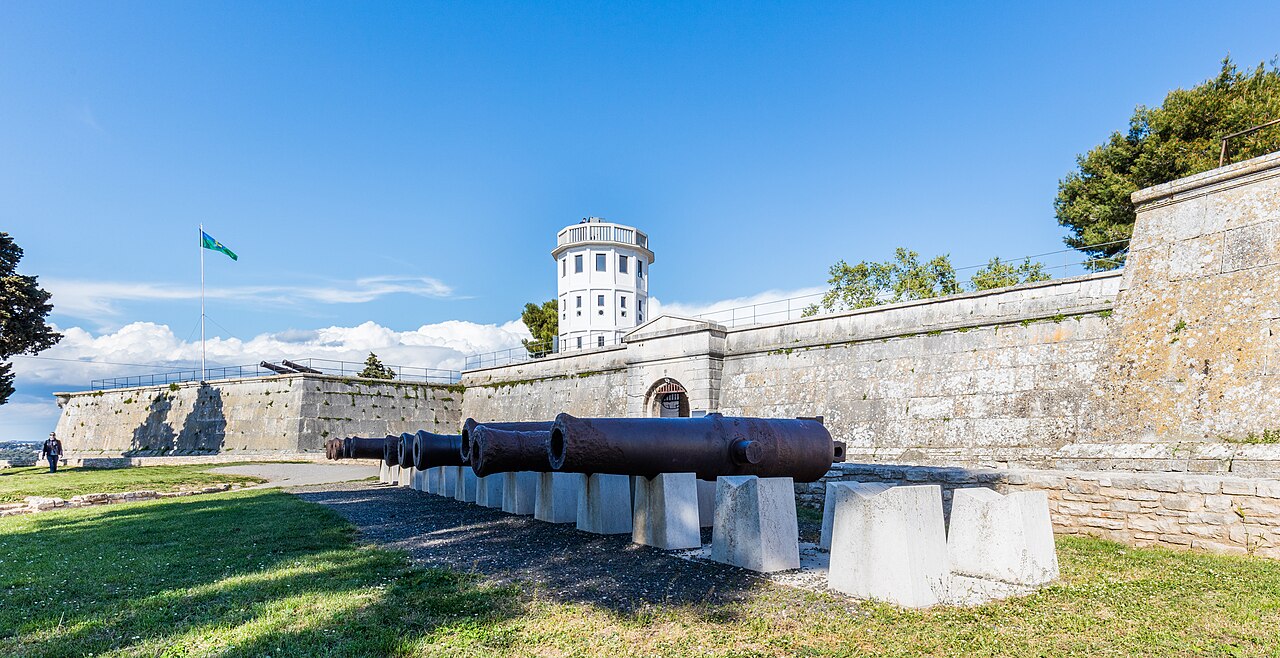
Fort Punta Christo
Fort Punta Christo is a significant coastal fortress constructed in the late 19th century by the Austro-Hungarian Monarchy to protect the strategic naval port of Pula, Croatia. This fortification was part of a broader system of defenses designed to secure the Austro-Hungarian Empire's maritime interests along the Adriatic Sea. Positioned on a small peninsula approximately 45 meters above sea level, the fort commands a commanding view of the entrance to the Bay of Pula, including the bay's breakwater and the nearby Brijuni National Park Islands.
Strategic location and defensive design
The choice of location for Fort Punta Christo was driven by its natural elevation and proximity to the bay's entrance, making it an ideal site for monitoring and controlling naval traffic. The fortress is surrounded by a deep defensive ditch that enhances its protection against potential land assaults. Access to the fort is controlled through three main entrances, each designed to facilitate movement while maintaining strong defensive capabilities.
Architectural layout and features
Inside the fort, visitors can explore three courtyards that serve as central open spaces within the complex. These courtyards provide access to extensive underground areas, including tunnels, storage rooms, and possibly ammunition depots, reflecting the military engineering practices of the period. The entire fortress comprises approximately 270 individual spaces, covering an area exceeding 10,000 square meters. This vast network of rooms and corridors was designed to support a sizeable garrison and accommodate the logistical needs of a coastal defense installation.
Historical context and military significance
Constructed during the modern period of fortification development, Fort Punta Christo exemplifies the transition from traditional medieval castles to more complex military structures adapted to advances in artillery and naval warfare. As part of the Austro-Hungarian Empire's defensive strategy, the fort played a crucial role in securing Pula, which was the empire's primary naval base on the Adriatic Sea. The fort's robust construction and strategic positioning helped deter enemy naval forces and protected vital maritime routes.
Role in regional defense network
Fort Punta Christo was integrated into a network of fortifications around Pula, including other forts and coastal batteries. This network created overlapping fields of fire and comprehensive surveillance, enhancing the overall security of the bay. The fort's artillery placements were designed to cover both sea approaches and landward access points, reflecting its dual defensive purpose.
Preservation and current status
Today, Fort Punta Christo stands as a well-preserved example of 19th-century military architecture. Its extensive underground chambers and courtyards remain accessible, offering insight into Austro-Hungarian military engineering. The fort is used for various cultural and recreational events, capitalizing on its dramatic location and historical ambiance. Visitors can explore the fortress and enjoy panoramic views of the bay and surrounding landscapes.
Architectural style and construction techniques
The fortress exhibits characteristics typical of modern coastal fortifications of its era, combining robust masonry with earthworks designed to absorb and deflect artillery fire. Its design reflects advances in military architecture that prioritized low-profile, heavily armored structures with extensive underground facilities to protect personnel and materiel from bombardment.
Visitor information and accessibility
Fort Punta Christo is accessible to the public, with pathways leading through its courtyards and underground passages. While the site retains much of its original military infrastructure, safety measures have been implemented to accommodate visitors. The fort's location offers opportunities for hiking and photography, making it a popular destination for those interested in military history and coastal landscapes.
Frequently asked questions (FAQ)
- How do I get to Fort Punta Christo in Pula?
- Fort Punta Christo is located on a peninsula near Pula and can be reached by car or on foot from the city center. There are walking paths and local transport options available for visitors.
- What is the historical significance of Fort Punta Christo?
- Fort Punta Christo was built by the Austro-Hungarian Monarchy in the late 19th century to defend Pula's naval port, reflecting the region's strategic maritime importance.
- Can visitors explore the underground areas of the fort?
- Yes, visitors can access the fort's three courtyards, which lead to extensive underground chambers and tunnels, showcasing Austro-Hungarian military engineering.
- Is Fort Punta Christo suitable for families and children?
- The fort is suitable for families, but some underground areas may have limited accessibility. Visitors should exercise caution and supervise children in these spaces.
- When is the best time to visit Fort Punta Christo?
- The best time to visit is during the warmer months when the weather is favorable for walking and exploring outdoor and underground areas comfortably.
Information
Loading map...
Visitor reviews
No reviews yet. Been here? Write the first review and help other travelers!
Write the first reviewVisited this castle? Share your experience
Your review helps other travelers and adds first-hand knowledge to our encyclopedia.