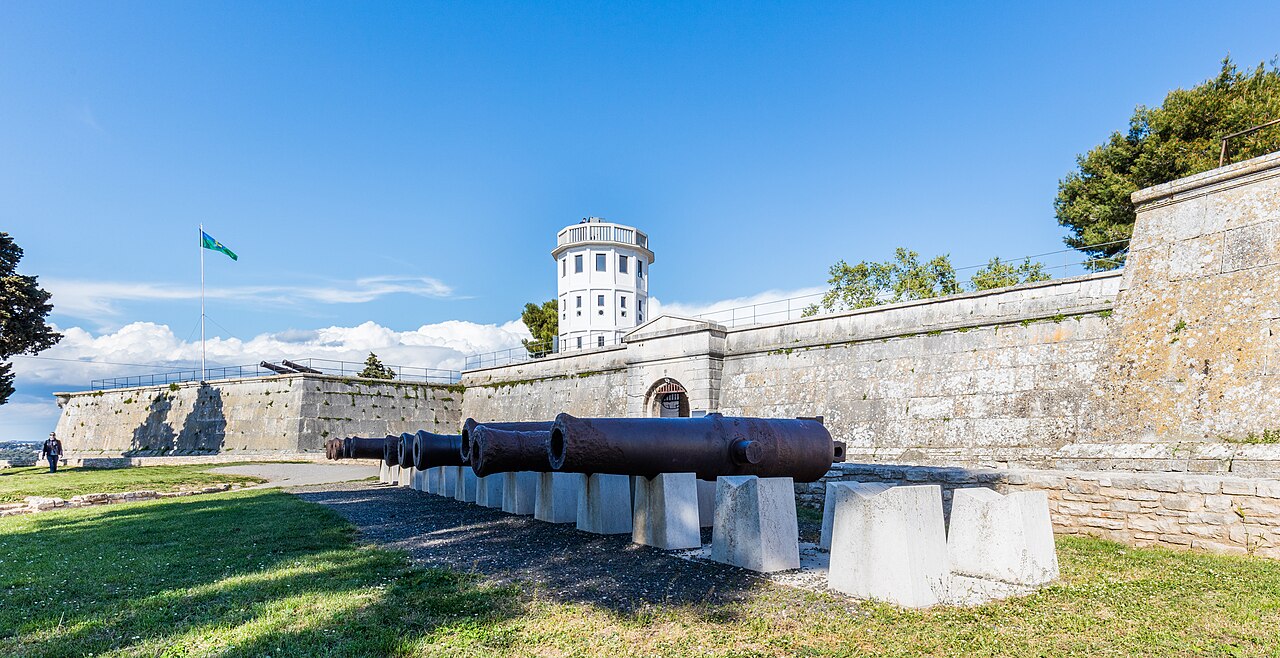
Fort Bourguignon, also known as Fort Monsival, stands as a significant example of 19th-century military architecture in Pula, Croatia. Constructed between 1861 and 1866 by the Austrian Empire, this fortress was part of a strategic network designed to protect the important naval port of Pula. It was named after Austrian admiral Anton Bourguignon von Baumberg, reflecting its military heritage and the influence of notable figures in Austrian naval history.
The fortress was inspired by the earlier 1820 fortress design developed by Archduke Maximilian of Austria-Este for the defense of Linz, Austria. However, Fort Bourguignon and other Pula fortresses built in the 1860s are distinguished by their larger scale and enhanced fortifications compared to older fortresses constructed in the early 1850s. These fortresses form an arc of inner fortification rings within a radius of approximately 2.5 kilometers, strategically positioned to safeguard the harbor from potential naval threats.
Architectural design and features
The structure of Fort Bourguignon is notable for its two-story circular design centered around a small circular courtyard. This layout was practical for defense, allowing for efficient movement and communication within the fortress. The fortress walls are reinforced by 20 casemates that form the outer shell, each originally divided into two floors supported by massive oak beams. While only a few of these beams remain today, they highlight the robust construction methods used.
The fortress includes several defensive elements: three embrasures on the lower floor designed for rifles and one embrasure on the upper floor intended for a cannon. The roof was an iron platform capable of rotating 360 degrees, serving as a mobile artillery position. This feature, likely added toward the end of the 19th century, enhanced the fortress's ability to defend against attacks from multiple directions.
Access to the fortress was protected by a drawbridge over a moat and two caponiers, which are fortified structures projecting into the moat to provide flanking fire. The fortress walls also include a gallery with embrasures for riflemen, further strengthening its defensive capabilities.
Historical context and military use
Fort Bourguignon played a role during the Third Italian War of Independence in 1866, shortly after its completion. Although the exact date when it ceased functioning as an active fortification is unclear, evidence suggests it was still used during the First World War as an army shelter. Damage to the roof supports this, indicating the fortress's continued military relevance beyond its initial construction period.
Originally, the fortress was armed with the standard 305 mm Austrian cannons, which were among the most powerful artillery pieces used by the Austrian military during World War I. This armament underscores the fortress's importance in the coastal defense system of the Austro-Hungarian Empire.
Post-military history and cultural significance
In the decades following its military use, Fort Bourguignon underwent significant changes. By the 1970s, the protective moat was partially filled with trash, reflecting a period of neglect. However, in the 1980s, a group of young activists revitalized the site, transforming it into one of the most popular venues for rave parties along the southern Adriatic coast. This unexpected cultural adaptation highlights the fortress's ongoing relevance and ability to serve new social functions.
Preservation and current condition
Today, Fort Bourguignon remains a well-preserved example of modern 19th-century military architecture. While some structural elements like the oak beams have deteriorated, the fortress's overall form and key defensive features are intact. Its preservation offers valuable insight into the Austro-Hungarian Empire's coastal defense strategies and architectural innovations of the period.
Significance within pula's fortification system
Fort Bourguignon is part of a larger ensemble of fortifications built by the Austrian Empire in Pula during the 19th century. These fortresses were designed to work in concert, creating overlapping fields of fire and layered defenses to protect the naval base. Fort Bourguignon's position within this arc of fortresses demonstrates the strategic planning behind Pula's military infrastructure.
Overall, Fort Bourguignon offers a detailed case study in the evolution of fortress design during a period of rapid technological and military change. Its combination of traditional defensive elements with innovative features like the rotating iron roof reflects the transitional nature of military architecture in the modern era.
Frequently asked questions (FAQ)
- How do I get to Fort Bourguignon?
- Fort Bourguignon is located in Pula, Croatia, and is easily accessible by car or public transport. There are local buses that connect the castle with the city center, and ample parking is available for those driving. Walking from the city center offers a scenic route along the coastline.
- What is the historical significance of Fort Bourguignon?
- Fort Bourguignon was built in the 19th century as a part of the Austro-Hungarian military defenses. It played a crucial role in protecting the naval base in Pula and showcases the military architecture of that era. Today, it stands as a testament to the area's rich history and military heritage.
- When was Fort Bourguignon constructed?
- Construction of Fort Bourguignon began in 1856 and was completed in 1866. The fort was designed to enhance the defense capabilities of the Pula harbor during a time of military expansion in the Austro-Hungarian Empire. Its strategic location made it a key asset in the region.
- Can I visit Fort Bourguignon year-round?
- Yes, Fort Bourguignon is open to visitors throughout the year, though hours may vary seasonally. It’s advisable to check the official website for the most accurate information on opening times. Guided tours are often available to enhance your experience.
- Why is Fort Bourguignon an important architectural site?
- Fort Bourguignon is considered an important example of 19th-century military architecture, featuring robust stone walls and strategic design elements. Its layout reflects the military innovations of the time and provides insight into the historical military practices of the Austro-Hungarian Empire. The fort's preservation allows visitors to appreciate its architectural significance.
- Is it possible to take guided tours at Fort Bourguignon?
- Yes, guided tours are available at Fort Bourguignon, providing visitors with in-depth knowledge about its history and architecture. These tours often include access to areas that are not open to the general public. It is recommended to book in advance, especially during peak tourist seasons.
- What are the ticket prices for visiting Fort Bourguignon?
- Ticket prices for Fort Bourguignon are generally affordable, with discounts available for students and seniors. Children under a certain age may enter for free. For the most current pricing, it’s best to check the official website or inquire at the ticket office upon arrival.
- What is the best time to visit Fort Bourguignon?
- The best time to visit Fort Bourguignon is during the spring and early autumn months when the weather is pleasant and ideal for outdoor exploration. Summer can be hot and crowded, while winter may have limited access due to weather conditions. Visiting during the shoulder seasons can enhance your experience.
- Are there any nearby attractions to Fort Bourguignon?
- Yes, Fort Bourguignon is close to several attractions in Pula, including the Roman Arena and the Temple of Augustus. Additionally, the scenic coastal paths offer beautiful views and opportunities for photography. Exploring the nearby beaches can also complement your visit to the fort.
Information
Loading map...
Visitor reviews
No reviews yet. Been here? Write the first review and help other travelers!
Write the first reviewVisited this castle? Share your experience
Your review helps other travelers and adds first-hand knowledge to our encyclopedia.