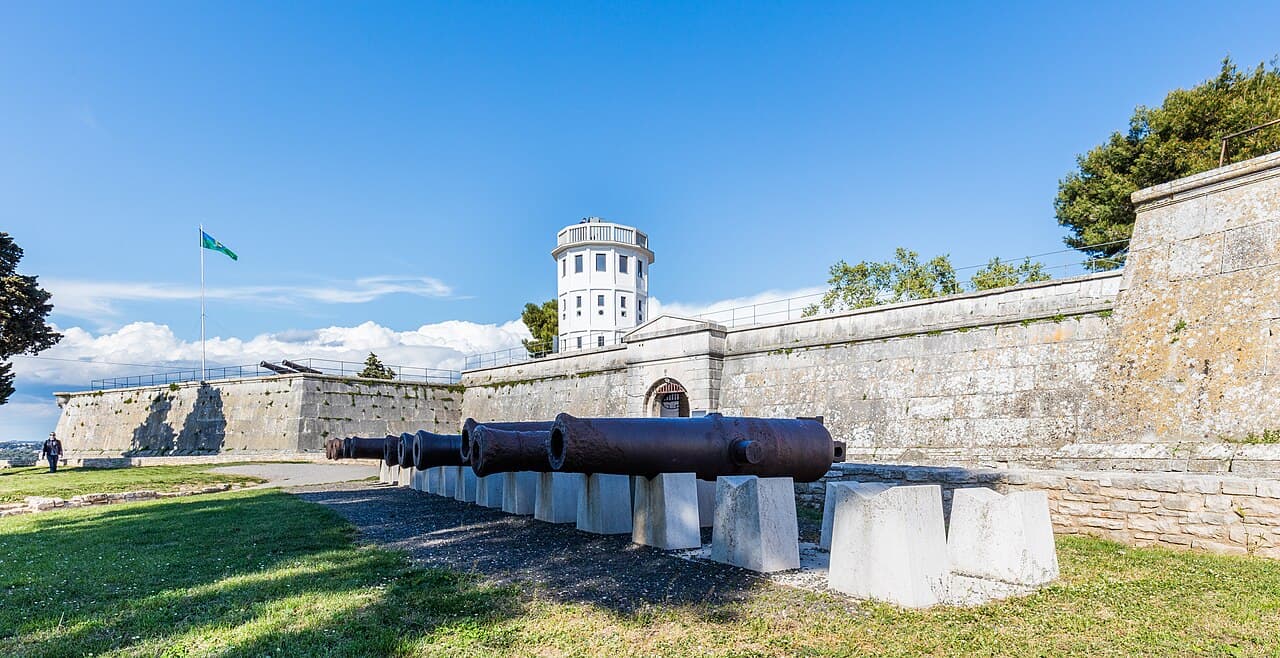
Pula Fortress
Pula Fortress stands prominently on a hill in the center of Pula, Croatia, serving as a significant example of a Renaissance bastioned fortress built during the Venetian period. Constructed between 1630 and 1633, the fortress was designed by the French military engineer Antonio De Villa, reflecting the French style of fortification that emphasized angular bastions for enhanced defense.
Historical context and strategic importance
The site of Pula Fortress has a long history of military significance, with archaeological evidence suggesting that an ancient hill fort belonging to the Histri tribe once occupied the same location. The fortress's elevated position allowed it to dominate the city, the bay, and the port, making it a vital defensive structure for controlling access to the Adriatic Sea. Throughout its history, it played a crucial role in the Venetian Republic's efforts to maintain naval and territorial dominance in the region.
Architectural design and construction
The fortress's design is characterized by a rectangular central core surrounded by four pentagonal bastioned towers, which together create a distinctive flower-like shape when viewed from above. This layout was typical of bastioned fortresses of the period, designed to provide overlapping fields of fire and eliminate blind spots. The use of local stone was a notable feature of the construction; much of the material was quarried from the nearby ancient Roman amphitheater and other local sources, reflecting a practical reuse of historic resources.
Fortification features
The fortress walls are thick and robust, designed to withstand artillery bombardment. The bastions allowed defenders to cover the curtain walls with crossfire, enhancing the fortress's defensive capabilities. Inside, the fortress housed various military buildings, including barracks, armories, and guardhouses, which were expanded and modernized over the centuries, especially during the Austro-Hungarian period.
Modifications and later use
Although the fortress was originally built in the early 17th century, it underwent several reconstructions and upgrades. Notably, in the 19th century under Austro-Hungarian rule, the fortress was known as Hafen Kastell and received new armaments, a penitentiary, and additional military facilities. Despite a sign at the entrance marking the year 1840, the original construction predates this by over two centuries.
Role in the 20th century and museum conversion
After World War I, the fortress lost its military importance as advances in warfare and political changes rendered such fortifications obsolete. However, it found a new purpose as the home of the Historical Museum of Istria. The museum contains several departments, including the Department of the history of Pula, the Department of medieval Istrian history, and the Department of modern Istrian history. Its extensive collection includes over 40,000 artifacts, with particularly notable holdings of old postcards, maps, arms, uniforms, and maritime equipment, providing a comprehensive insight into the region's cultural and military heritage.
Architectural significance and preservation
Pula Fortress remains a well-preserved example of Renaissance military architecture adapted to the specific needs of coastal defense in the Adriatic. Its bastioned design illustrates the evolution of fortification techniques in response to the development of artillery. The fortress's continued preservation and adaptive reuse as a museum ensure that it remains a key cultural and historical landmark in Istria.
Visitor experience and cultural importance
Today, visitors to Pula Fortress can explore its imposing walls and bastions, gaining insight into the military strategies of the Venetian Republic and later Austro-Hungarian Empire. The museum's rich collections offer a deep dive into the history of Pula and the wider Istrian region, making the fortress not only a monument of military history but also a center for cultural education and heritage preservation.
Frequently asked questions (FAQ)
- What are the opening hours of Pula Fortress?
- Pula Fortress is typically open to visitors daily from 9:00 AM to 6:00 PM, though hours may vary seasonally. It is advisable to check the official museum website for the most current visiting hours before planning your visit.
- Can I explore the bastions and towers of Pula Fortress?
- Yes, visitors can explore the fortress's bastions and towers, which offer panoramic views of Pula and the Adriatic Sea. The well-preserved fortifications provide a tangible experience of Renaissance military architecture.
- What exhibits are featured in the Historical Museum of Istria housed in the fortress?
- The museum features extensive collections including the history of Pula, medieval and modern Istrian history, old postcards, maps, arms, uniforms, and maritime equipment, showcasing the region's cultural and military heritage.
- Is Pula Fortress accessible for visitors with mobility issues?
- While efforts have been made to improve accessibility, some areas of the fortress involve uneven terrain and stairs. Visitors with mobility concerns should contact the museum in advance to inquire about accessible routes and assistance.
- Why was Pula Fortress built on this particular hill?
- The hill's strategic position allowed the fortress to dominate the city, bay, and port, providing a crucial defensive advantage for controlling maritime access and protecting Pula from naval threats.
Photo gallery

Information
Current owner
Historical Museum of Istria
Loading map...
Visitor reviews
No reviews yet. Been here? Write the first review and help other travelers!
Write the first reviewVisited this castle? Share your experience
Your review helps other travelers and adds first-hand knowledge to our encyclopedia.



