Vellore Fort
Vellore Fort is a prominent 16th-century bastioned fortress located in the heart of Vellore city, within the southern Indian state of Tamil Nadu. Constructed under the auspices of the Vijayanagara Empire during the Renaissance period, the fort exemplifies the military architecture of the era, combining robust masonry with strategic defensive features. It served as a significant seat of power, notably as the imperial capital for the Aravidu Dynasty, the last ruling dynasty of the Vijayanagara Empire.
Historical context and succession of rulers
The fort's history reflects the turbulent political landscape of South India from the 16th century onward. Originally built by the emperors of Vijayanagara, the fort subsequently came under the control of several prominent powers. These included the Bijapur sultans, the Marathas, and the Carnatic Nawabs, before finally falling under British colonial rule. Each ruling entity left its mark on the fort's structure and function, adapting it to their military and administrative needs.
During the British era, Vellore Fort gained notoriety as a prison for significant political prisoners, including the family of Tipu Sultan and the last king of Sri Lanka, Sri Vikrama Rajasinha. The fort also witnessed tragic events such as the massacre of the Vijayanagara royal family under Sriranga Raya.
Architectural features and defensive design
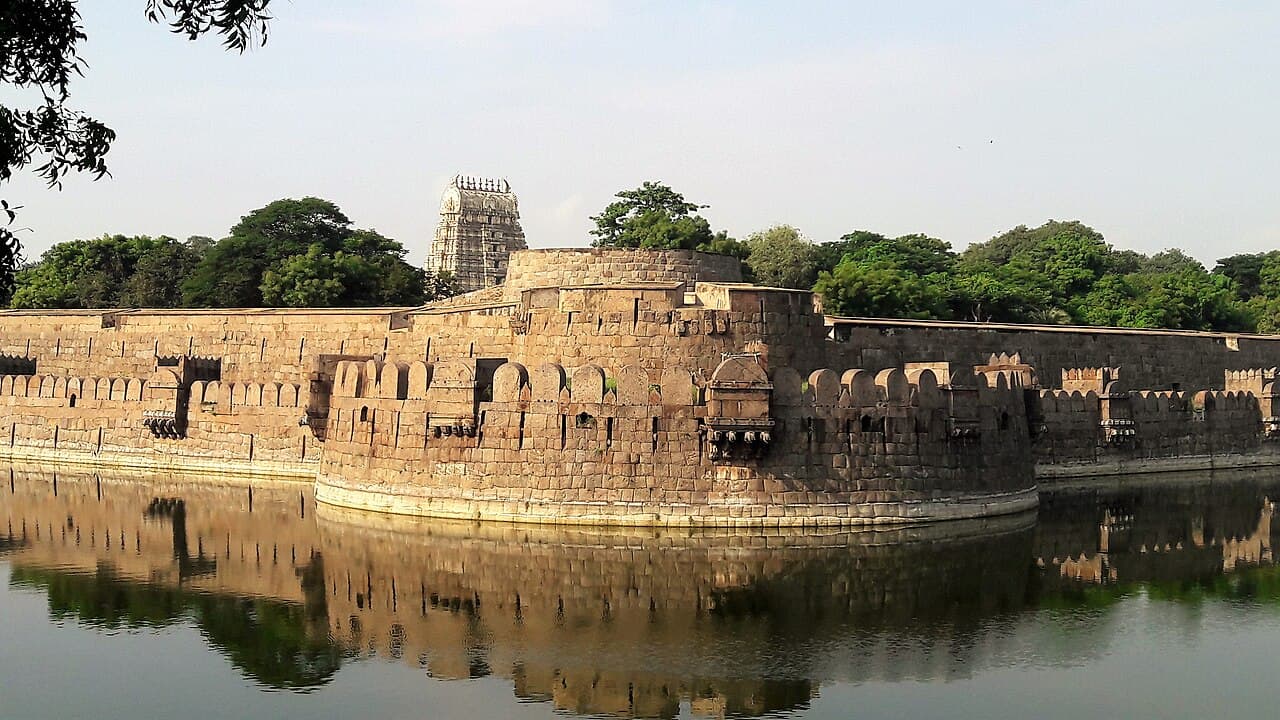
Vellore Fort is renowned for its extensive ramparts and a wide moat that encircles the fortress, designed to thwart enemy advances. The fort's walls are constructed from granite, notable for their thickness and strength, reflecting the military engineering knowledge of the period. The fortress incorporates bastions—projecting parts of the walls used for defensive artillery placement—characteristic of a bastioned fortress style that was innovative in Indian fortifications at the time.
The layout includes multiple gates, each fortified and designed to control access effectively. The fort's interior contains a range of structures, including barracks, granaries, and water reservoirs, which supported prolonged sieges.
Religious structures within the fort
Within the fort complex are several significant religious buildings, reflecting the diverse cultural influences over the centuries. The Jalakanteswarar Temple is particularly notable for its intricate carvings and Dravidian architectural elements, dedicated to Lord Shiva. This temple stands as a masterpiece of religious art and architecture within the fort.
Additionally, the fort houses a Christian church, known as St. John's Church, and a Muslim mosque, illustrating the coexistence of different religious communities during various periods of the fort's occupation.
The vellore mutiny of 1806
The Vellore Mutiny was a significant uprising against British rule that erupted within the fort in 1806. It is considered one of the earliest military rebellions against the British East India Company in India. The mutiny was sparked by cultural and religious grievances among Indian soldiers, highlighting the tensions under colonial administration.
Although the mutiny was suppressed quickly, it marked a critical point in the history of Indian resistance to British rule and foreshadowed later, larger-scale uprisings.
Current status and tourism
Today, Vellore Fort is maintained by the Archaeological Survey of India and stands as a well-preserved monument attracting numerous visitors. Its combination of military architecture, historical significance, and religious sites makes it a major tourist destination in Tamil Nadu.
The fort offers visitors a glimpse into the complex history of South India, the evolution of fortification techniques, and the cultural diversity of the region through its centuries of occupation.
Visitor experience and accessibility
The fort is accessible year-round, with guided tours available to explore the extensive ramparts, temples, and other structures. Visitors can learn about the fort's role in regional history, including detailed accounts of the Vellore Mutiny and the various dynasties that ruled from its walls.
Frequently asked questions (FAQ)
- How do I get to Vellore Fort?
- Vellore Fort is located in the city of Vellore, Tamil Nadu, India. It is easily accessible by road, and there are regular bus services and taxis available from major nearby cities like Chennai and Bangalore. The nearest railway station is Vellore Cantonment, which is just a short distance away from the fort.
- What is the historical significance of Vellore Fort?
- Vellore Fort, built in the 16th century, is an important historical site that showcases the rich heritage of the Vijayanagara Empire. It has witnessed many historical events, including the 1806 Vellore Mutiny against British rule. The fort is known for its impressive architecture and strategic importance in the region.
- When was Vellore Fort built?
- Construction of Vellore Fort began in 1566 during the rule of the Vijayanagara Empire and was completed in 1606. The fort's design reflects the military architecture of that era, featuring massive walls and a unique star-shaped layout. Its enduring structure has made it one of the finest examples of Indian fort architecture.
- Can I visit Vellore Fort during the monsoon season?
- Yes, Vellore Fort is open to visitors during the monsoon season, but it is advisable to check weather conditions before planning your visit. The fort's lush surroundings are particularly beautiful during this time, although heavy rains can sometimes affect accessibility. Always carry an umbrella or raincoat just in case.
- Why is Vellore Fort famous for its architecture?
- Vellore Fort is renowned for its unique architectural features, including its massive granite walls, intricate carvings, and a moat that surrounds the fort. The fort's design incorporates elements from both Indian and Islamic architectural styles, making it a fascinating study for architecture enthusiasts. Its well-preserved structures and strategic layout add to its historical allure.
- Is it possible to take guided tours of Vellore Fort?
- Yes, guided tours of Vellore Fort are available, and they provide visitors with in-depth knowledge of its history and architecture. Hiring a local guide is recommended to fully appreciate the stories behind its walls and significant events that took place there. Group and individual tours can be arranged upon request.
- What are the opening hours for Vellore Fort?
- Vellore Fort is open to visitors from 9:00 AM to 5:00 PM every day. It is advisable to visit during the daytime to fully explore the fort's expansive grounds and various structures. Make sure to allocate enough time to enjoy the sites and take photographs.
- What are the ticket prices for visiting Vellore Fort?
- As of the latest information, the entry fee for Vellore Fort is quite nominal, usually around INR 5 for Indian citizens and INR 100 for foreign tourists. There may be additional charges for photography and guided tours, so it's wise to check for any updates before your visit. This makes it an affordable destination for history enthusiasts and casual visitors alike.
- What are some nearby attractions to Vellore Fort?
- In addition to Vellore Fort, visitors can explore the nearby Jalakandeswarar Temple, known for its beautiful architecture and intricate sculptures. The Vellore Christian Medical College and the Archaeological Museum are also close by, offering more insights into the region's history and culture. These attractions make for a well-rounded visit to Vellore.
Photo gallery

Information
Loading map...
Visitor reviews
No reviews yet. Been here? Write the first review and help other travelers!
Write the first reviewVisited this castle? Share your experience
Your review helps other travelers and adds first-hand knowledge to our encyclopedia.