Velhartice Castle
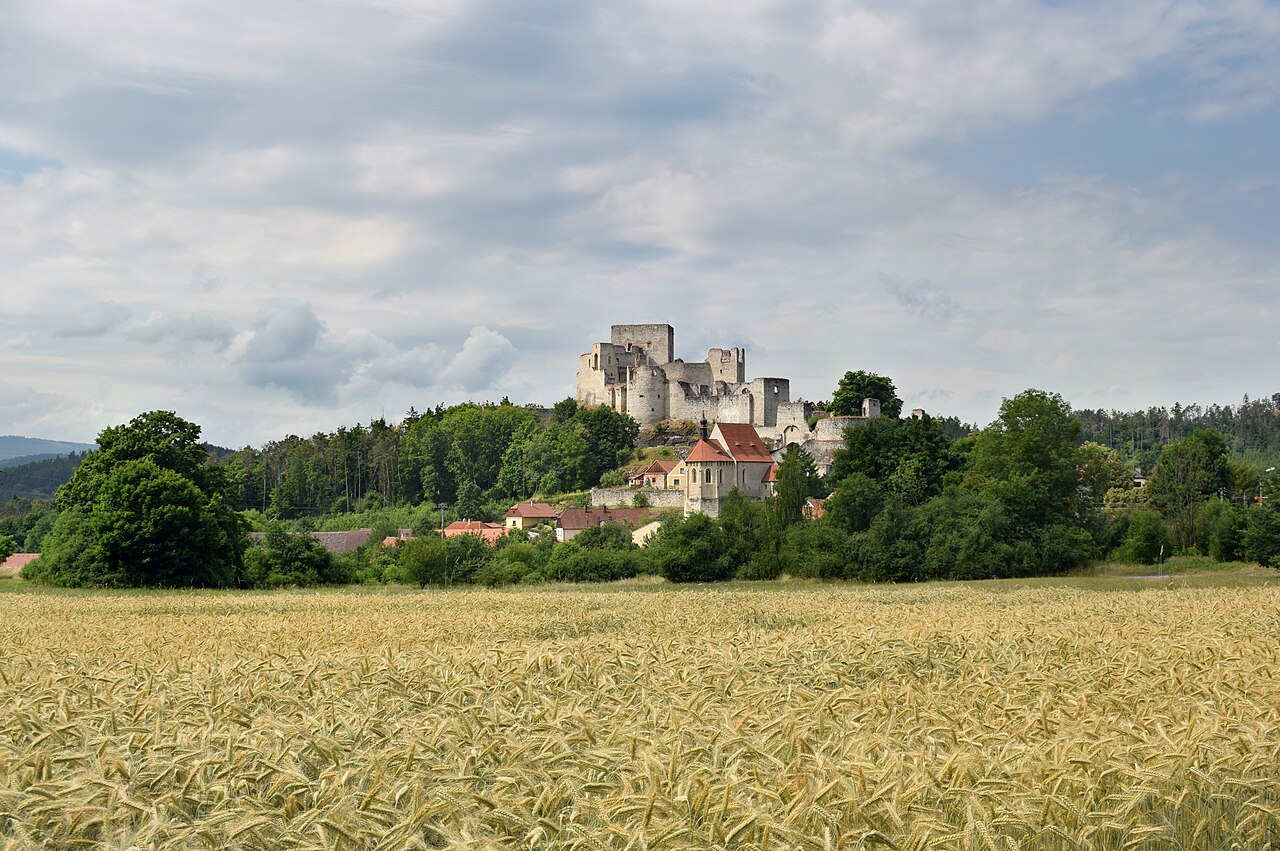
Velhartice Castle stands as a remarkable example of a Gothic hill castle in the Czech Republic, embodying centuries of architectural evolution and historical significance. Constructed between 1290 and 1310, it was initially established by the Lords of Velhartice, a noble family closely tied to the medieval Bohemian kingdom. The castle's strategic location on a rocky ridge overlooking the Ostružná River allowed it to control important trade routes from the Šumava Mountains towards Bavaria, underscoring its military and economic importance during the High Medieval period.
The castle's early history is intertwined with the reign of Emperor Charles IV, who had close ties with the founding noble family. The castle was built by Bušek I the Elder, a trusted vassal of the emperor, and completed by his son Bušek II the Younger before 1370. Throughout the 14th century, Velhartice served as the family seat and a symbol of feudal power. The castle's significance is further highlighted by episodes such as the brief seizure by the German knight Hertvík Degenberg von Weißenstein and the abduction of Anna of Velhartice, events that culminated in military conflict and mediation led by Oldřich I of Rožmberk in 1387.
Medieval origins and feudal significance
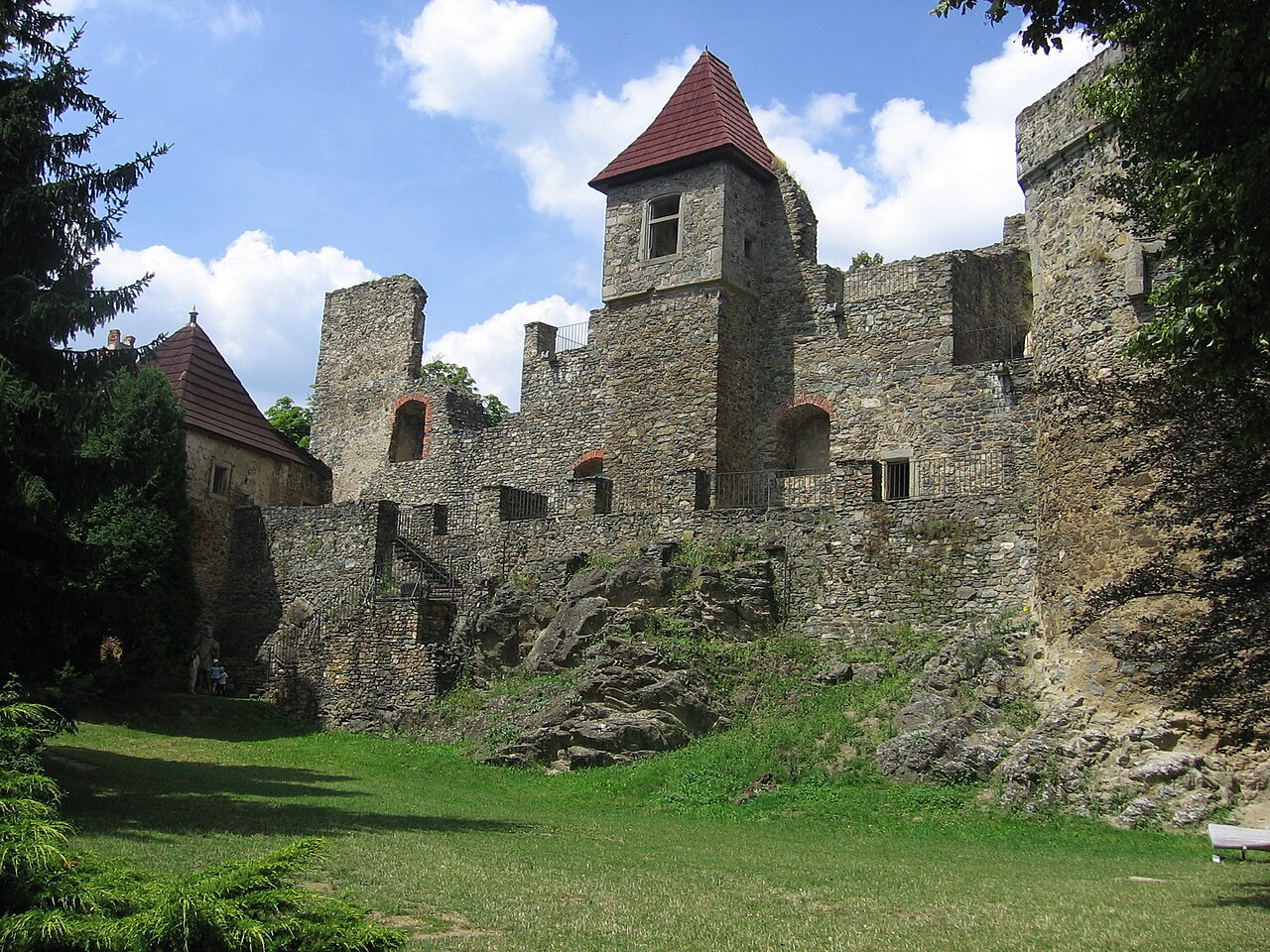
The castle's original design reflects the typical two-palace layout of late medieval fortresses, with a strong emphasis on defense and residential comfort. The northern palace, known as the "Rajský dům" or Paradise House, occupies the highest point of the castle rock and features a distinctive D-shaped ground plan. It includes three floors with a second-floor arcade corridor, a banquet hall, and an open terrace offering panoramic views of the eastern slopes. The southwestern defensive wall retains a large Gothic stone portal, marking the entrance from the lower courtyard.
The southern palace complements the northern structure, and between them lies the Huerta wing, a two-story Renaissance addition built in the 17th century by Martin de Hoeff-Huerta. This wing is notable for its narrow embrasured windows designed for defense and a small Gothic portal accessing the ramparts. The Renaissance wing was later adapted for residential use, housing salons, bedrooms, and leisure rooms, and now serves as a museum space illustrating Renaissance leisure.
Defensive features and architectural innovations
Velhartice Castle is distinguished by its robust defensive architecture. The main gate on the northwest side of the lower courtyard was originally protected by a moat and drawbridge, guarded by a small fortress tower. The massive Putna tower, a donjon with walls 2.5 meters thick, served both defensive and residential purposes. Access to this tower was originally via a drawbridge linking its third floor to the northern palace, emphasizing security.
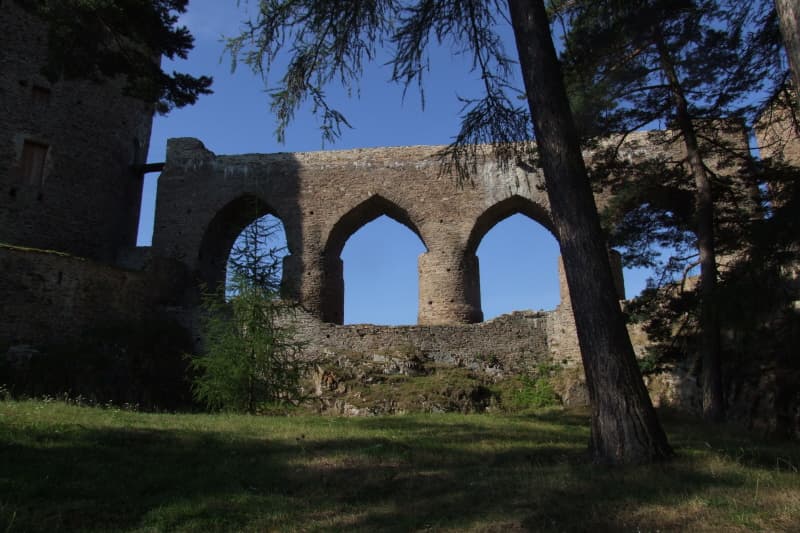
One of the castle's most extraordinary features is the stone bridge connecting the Putna tower to the northern palace. This bridge, approximately 32 meters long and 3 meters wide, is supported by five heavy cylindrical stone columns forming four pointed Gothic arches. This architectural solution is unique in medieval Central European castle construction and exemplifies the castle's blend of military ingenuity and aesthetic consideration.
The castle's fortifications were enhanced in the 15th century with irregularly arranged walls, including a double bastion and two semi-circular bastions. A covered shooting gallery was added to improve defensive tactics. The Putna tower's side facing the most vulnerable approach was reinforced with a thick, windowless wall to increase its resilience against attacks.
Historical transitions and ownership
After the Velhartice family line ended in 1453, the castle passed to the Lords of Schwig, who fortified the site further and expanded the lower courtyard with economic buildings such as a brewery. The castle changed hands multiple times during the 16th century, including ownership by Zdeněk Lev of Rožmitál, Adam I of Šternberk, and Jindřich Plánský of Žeberk. Its strategic importance declined as warfare evolved, particularly after the Thirty Years' War.
In 1628, the castle was sold to Martin de Hoeff-Huerta, a Spanish colonel who undertook significant renovations, including the construction of the late Renaissance palace wing connecting the northern and southern palaces. Under his ownership, efforts were made to restore Catholicism in the region. Subsequent owners included a Carmelite convent and noble families such as the Račín, Kolowrat, Bechyně of Lažany, and Perglar families, during which the castle's condition deteriorated.
Modern history and preservation efforts
In the 19th century, restoration work was initiated by Karl Sturmfelder von Oppenweiler on the southern palace, but these efforts remained incomplete. The castle's last private owner before state acquisition was lawyer Josef Windischgrätz, who left the country in 1946. Under Czechoslovak state stewardship, the castle served as a recreational site for the Revolutionary Trade Union Movement.
Since 1999, Velhartice Castle has been open to the public, with part of the Renaissance wing dedicated to exhibitions on Renaissance leisure activities. It was officially designated a national cultural monument of the Czech Republic in 2001, recognizing its architectural and historical importance.
Architectural remains and cultural significance
Velhartice Castle's remains include the robust stone walls with crenellations, the two palaces, the Renaissance Huerta wing, and the defensive Putna tower. The lower courtyard houses restored economic buildings such as a Gothic brewery with vaulted cellars, now used for exhibitions. Remnants of the castle's water supply system, including a conduit from the Ostružná stream, highlight the ingenuity of medieval infrastructure.
The castle's blend of Gothic military architecture and Renaissance residential enhancements offers valuable insight into the evolution of castle design in Central Europe. Its unique features, such as the elevated stone bridge and fortified palaces, underscore the castle's role as both a defensive stronghold and noble residence.
Today, Velhartice Castle stands as a testament to the rich history of the Bohemian kingdom, reflecting the complex interplay of feudal power, military strategy, and cultural development over several centuries.
Frequently asked questions (FAQ)
- How do I get to Velhartice Castle?
- Velhartice Castle is located in the town of Velhartice in the Plzeň Region of Czechia. It is accessible by car and public transport, with local bus services connecting from nearby larger towns. The castle is situated on a rocky ridge overlooking the Ostružná River.
- What are the opening hours of Velhartice Castle?
- Velhartice Castle is generally open to visitors from April to October, with typical visiting hours from 9:00 AM to 5:00 PM daily. It is advisable to check the official website or local tourist information for seasonal variations and special closures.
- Can I take guided tours at Velhartice Castle?
- Yes, guided tours are available at Velhartice Castle, providing detailed insights into its history, architecture, and cultural significance. Tours are offered in Czech and sometimes in English, and can be booked in advance or on-site depending on availability.
- What architectural styles are represented at Velhartice Castle?
- Velhartice Castle primarily showcases Gothic architecture from its original construction in the late 13th and early 14th centuries, with significant Renaissance additions from the 17th century. The castle features defensive Gothic elements such as crenellated walls and embrasured windows alongside Renaissance residential wings.
- Is Velhartice Castle suitable for families and children?
- Yes, Velhartice Castle is family-friendly, offering spacious courtyards, exhibitions, and accessible paths suitable for children. Educational programs and interactive displays are sometimes available to engage younger visitors.
- Are there nearby attractions to visit along with Velhartice Castle?
- Visitors to Velhartice Castle can explore the scenic Šumava Mountains nearby, as well as other historic sites in the Plzeň Region. The town of Klatovy, with its own rich history and architectural landmarks, is also within driving distance.
Photo gallery

Information
Sources & official resources
Verify the information above using these authoritative references.
Loading map...
Visitor reviews
No reviews yet. Been here? Write the first review and help other travelers!
Write the first reviewVisited this castle? Share your experience
Your review helps other travelers and adds first-hand knowledge to our encyclopedia.