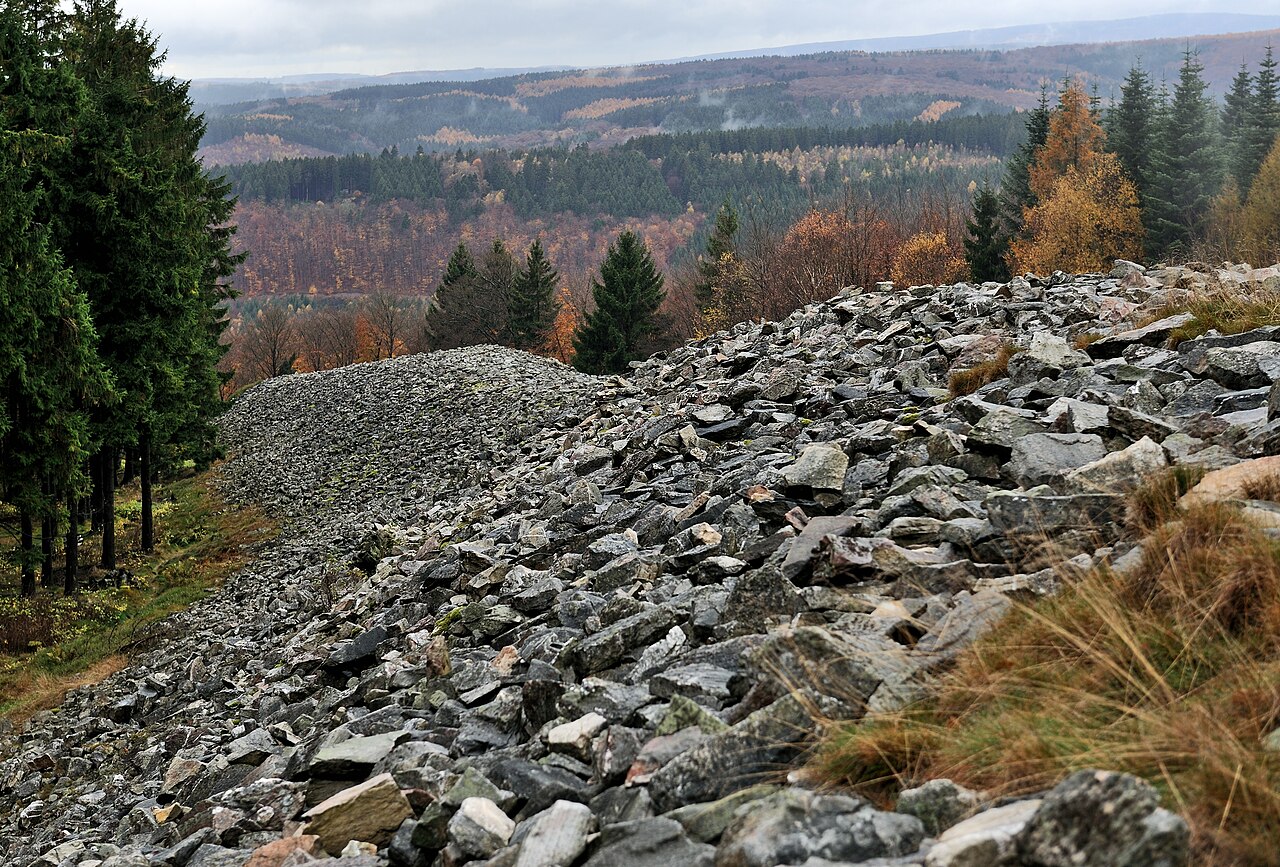
Veldenz Castle
Veldenz Castle is a significant medieval fortress located on a prominent spur above the village of Nohfelden in Germany. Established in the 13th century, this hill castle served as a strategic stronghold and administrative center throughout the High Medieval period. Its imposing ruins today reflect a turbulent history marked by feudal conflicts, noble intrigues, and military engagements spanning several centuries.
Early history and foundation
The earliest documented mention of Veldenz Castle dates back to 1285, although some sources suggest the castle existed slightly earlier, potentially in the mid-12th century. The castle was originally built by Count William Bossel II of Stein from Oberstein an der Nahe. A notable early record stipulates that he was obligated to allow his liege lord, the Count of Veldenz, to use the castle in times of war or feuds, indicating its military importance from the outset.
Historically, the castle and its surrounding lands were under the feudal authority of the Counts of Veldenz, who established the site as the center of their county. In 1156, Emperor Frederick I Barbarossa confirmed the holding of Veldenz Castle and its lands by Bishop Albert I of Verdun, reinforcing the castle's significance in regional power structures. By 1286, the nearby town of Veldenz was granted city and market charters by Rudolf von Habsburg, underscoring the castle's role in local governance and commerce.
Ownership and political significance
In the mid-15th century, the castle and the Lordship of Nohfelden came under the control of the Dukes of Palatinate-Zweibrücken. This transition occurred after the extinction of the male line of the Counts of Veldenz. The Palatinate-Zweibrücken dynasty retained possession of Veldenz Castle and its territories until the late 17th century.
One of the most notable episodes in the castle's history occurred in 1490, following the death of Duke Louis the Black. His sons, Kaspar and Alexander, initially ruled jointly. However, Alexander imprisoned Kaspar in Veldenz Castle, alleging insanity. Kaspar remained confined in the castle until his death in 1527, even surviving Alexander himself. This event marks a dark chapter in the castle's legacy and reflects the intense dynastic struggles typical of the period.
Architectural features and layout
The castle's grounds extend approximately 100 meters in length and about 30 meters in width, situated on a steep hill spur that drops sharply on three sides. This natural topography provided strong defensive advantages. The castle is classified as a hill castle, designed primarily for defense and control over the surrounding territory.
Significant portions of the castle's surrounding curtain walls remain intact, enclosing the complex. The 21-meter-high keep (bergfried) still stands prominently, though its roof is missing. This tower served as the last line of defense and a lookout point. The castle also features a palas with a distinctive stepped gable, which has been restored and repurposed as a restaurant, allowing visitors to experience the historic ambiance.
Defensive bastions are located on the northern and southern flanks of the castle, strategically positioned to protect the main entrance and vulnerable approaches. The castle's basement was made accessible to the public in 1971, offering insight into the medieval construction techniques and daily life within the fortress.
Construction materials and style
Veldenz Castle exhibits typical High Medieval architectural features, with robust stone masonry walls designed to withstand sieges. The style reflects functional military architecture rather than ornate aesthetics, prioritizing thick walls, narrow windows for archers, and elevated towers for surveillance.
Wars, damage, and restoration
The castle endured significant damage during the numerous conflicts of the 17th century, including the Thirty Years' War and the Palatinate Succession War. It was occupied at different times by Swedish, Spanish, and French troops, reflecting the strategic importance of the site in regional power struggles.
In 1681, Veldenz Castle was largely destroyed. Subsequently, the owners relocated, and the castle fell into ruin. Over the following decades, it was used as a quarry for building materials, accelerating its decay. The French state nationalized the property in 1804, and it was sold to private owners who continued to dismantle parts of the structure.
Despite this decline, parts of the castle were underpinned and partially rebuilt in the 19th century. Today, the ruins are well-preserved relative to many other medieval castles, with ongoing conservation efforts led by the municipality of Nohfelden, which currently owns the site.
Cultural significance and tourism
Veldenz Castle holds a prominent place in the cultural heritage of the Central Moselle region. In the 15th century, it was considered the largest castle in this area, reflecting its importance as a political and military center. The German term "Schloss" used in some contexts for Veldenz hints at its status not only as a fortress but also as a noble residence.
Today, the castle is accessible to the public, with the keep open from April to October. Visitors can explore the accessible basement and climb the tower to enjoy panoramic views of the surrounding landscape. Guided tours are available through the local tourist office, providing historical context and architectural insights.
The castle's palas, now functioning as a restaurant, offers a unique opportunity to dine within a historical setting, blending cultural tourism with local gastronomy. The site is a popular destination for history enthusiasts, architecture students, and travelers interested in medieval fortifications.
Visitor information
- The castle is open seasonally, typically from April through October.
- Guided tours can be arranged via the Nohfelden tourist office, enhancing the visitor experience with expert commentary.
- The palas restaurant provides refreshments and meals within the historic castle walls.
- Access to the tower requires moderate physical ability due to stairs and uneven surfaces.
Frequently asked questions (FAQ)
- When was Veldenz Castle first mentioned in historical records?
- Veldenz Castle was first mentioned in a document in 1285, though it likely existed slightly earlier in the 12th century.
- What is the architectural style of Veldenz Castle?
- Veldenz Castle exemplifies High Medieval military architecture with robust stone walls, a tall keep, and defensive bastions.
- Is Veldenz Castle open to visitors year-round?
- The castle is open to visitors seasonally from April to October, with the keep and basement accessible during this period.
- Can I arrange guided tours at Veldenz Castle?
- Yes, guided tours can be arranged through the local tourist office in Nohfelden, offering detailed historical and architectural information.
- What notable historical events took place at Veldenz Castle?
- The castle was the site of the imprisonment of Kaspar, Duke of Palatinate-Zweibrücken, from 1490 until his death in 1527, a significant episode in regional history.
Information
Opening hours
April to October, daily
Current owner
Municipality of Nohfelden
Loading map...
Visitor reviews
No reviews yet. Been here? Write the first review and help other travelers!
Write the first reviewVisited this castle? Share your experience
Your review helps other travelers and adds first-hand knowledge to our encyclopedia.