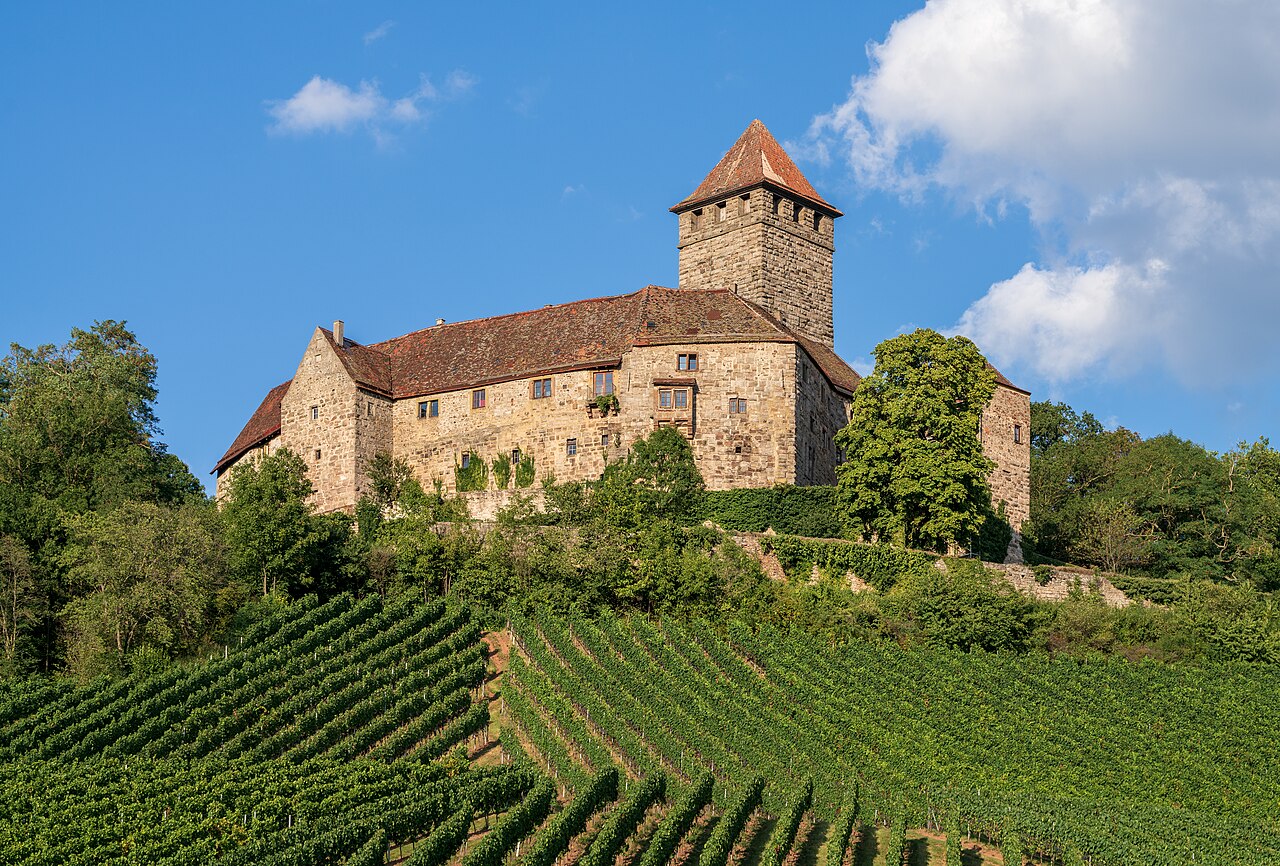
Frauenburg Castle
Frauenburg Castle stands as a remarkable example of a late medieval hill castle located in the municipality of Frauenberg near Baumholder, Germany. Constructed before 1327 by the influential Counts of Sponheim, this fortress played a significant role in the region's feudal history. Its strategic position on a narrow mountain ridge between the Aubach and Ellenbach streams, near the Nahe River, exemplifies medieval military architecture designed to maximize natural defenses.
The castle's origins trace back to the early 14th century when the Counts of Sponheim established it as part of their rear county, a subdivision of their extensive domain. Shortly after its completion, Frauenburg Castle gained historical prominence in 1331 as the residence of Countess Loretta of Sponheim following the death of her husband. Her residence marked a transitional phase for the castle, shifting from a noble stronghold to a widow's domicile while her son, Johann III, assumed governance of the county.
Historical significance and ownership
Beyond its residential function, Frauenburg Castle evolved into an administrative center. It served as the seat of a Sponheim bailiff (Amtmann), responsible for managing the local territory on behalf of the counts. This administrative role underscored the castle's importance in regional governance throughout the medieval period until its destruction in the late 17th century.
The castle met its demise in 1673 during the Wildfangfehde, a local feud in which troops from Lorraine launched an attack, leading to significant destruction. This event marked the end of the castle's active military and administrative use. It is important to distinguish Frauenburg Castle from another nearby fortress built in 1328 by Balduin of Luxembourg near Birkenfeld, which followed a separate historical trajectory.
Architectural features and layout
Frauenburg Castle exhibits a classic rectangular layout typical of spur castles, adapted to the topography of the ridge it occupies. The castle's defensive design included multiple round towers positioned strategically at each corner and along the northeastern side, enhancing its fortification against potential attackers.
Of particular note are the two well-preserved round towers facing the most vulnerable side of the castle. These towers, constructed using traditional medieval masonry techniques, stand nearly at their original height and were integral to the castle's surveillance and defense system. A neck ditch (Halsgraben) lies before these towers, a defensive trench carved into the terrain to impede enemy advances.
The southern tower is especially prominent, rising approximately 33 meters and remaining a dominant feature in the landscape. This tower can be ascended by visitors through prior arrangement, offering panoramic views reminiscent of the castle's original lookout function.
Construction materials and techniques
The castle's masonry reflects typical late medieval craftsmanship, utilizing locally sourced stone and mortar. The robustness of the walls and towers has contributed to the preservation of key structural elements despite centuries of decay and conflict.
Destruction and preservation efforts
The destruction wrought by the 1673 Wildfangfehde left the castle in ruins, halting its role as a noble residence and administrative center. Over the centuries, the site remained a ruin, with natural weathering further impacting the structure.
Preservation efforts began in earnest in the late 20th century. In 1988, initial restoration work focused on stabilizing the remaining structures, although some interventions diverged from the castle's original medieval design. A more comprehensive restoration commenced in 2013, aiming to protect and stabilize the ruins for future generations. This phase culminated in a public celebration on August 30, 2015, marking a significant milestone in the castle's conservation.
Current condition and visitor experience
Today, Frauenburg Castle stands as a partially preserved medieval ruin that offers valuable insights into 14th-century castle architecture and feudal history. Visitors can explore the castle's rectangular layout, examine the surviving towers, and appreciate the strategic defensive features such as the neck ditch.
The opportunity to climb the southern tower provides a unique perspective on the castle's original military purpose and the surrounding landscape. The site is accessible with prior arrangement, and ongoing conservation ensures that the ruins remain stable and safe for public visitation.
Architectural and cultural legacy
Frauenburg Castle exemplifies the architectural and historical characteristics of late medieval hill castles in the Rhineland-Palatinate region. Its combination of residential, administrative, and military functions reflects the complex role castles played in medieval society.
The castle's preservation and restoration underscore the cultural value placed on such historic structures in Germany. It remains a significant landmark for understanding the feudal history of the Counts of Sponheim and the broader regional conflicts that shaped the area's development.
As a heritage site, Frauenburg Castle continues to attract historians, architecture enthusiasts, and tourists interested in medieval fortifications and the legacy of noble families in Germany.
Frequently asked questions (FAQ)
- When was Frauenburg Castle built and by whom?
- Frauenburg Castle was built before 1327 by the Counts of Sponheim, a noble family influential in the region during the late medieval period.
- What led to the destruction of Frauenburg Castle?
- The castle was destroyed in 1673 during the Wildfangfehde when troops from Lorraine attacked, causing significant damage that ended its active use.
- Can visitors climb the towers at Frauenburg Castle?
- Yes, the southern tower, which stands about 33 meters tall, can be ascended by visitors through prior arrangement, offering panoramic views of the surrounding landscape.
- What architectural features are notable at Frauenburg Castle?
- The castle features a rectangular layout with multiple round towers, including two well-preserved towers on the vulnerable northeastern side and a defensive neck ditch.
- What restoration efforts have been made at Frauenburg Castle?
- Restoration began in 1988 with initial repairs, followed by a major stabilization project starting in 2013 and completing in 2015, aimed at preserving the ruins and preventing further decay.
Information
Current owner
Municipality of Frauenberg
Loading map...
Visitor reviews
No reviews yet. Been here? Write the first review and help other travelers!
Write the first reviewVisited this castle? Share your experience
Your review helps other travelers and adds first-hand knowledge to our encyclopedia.