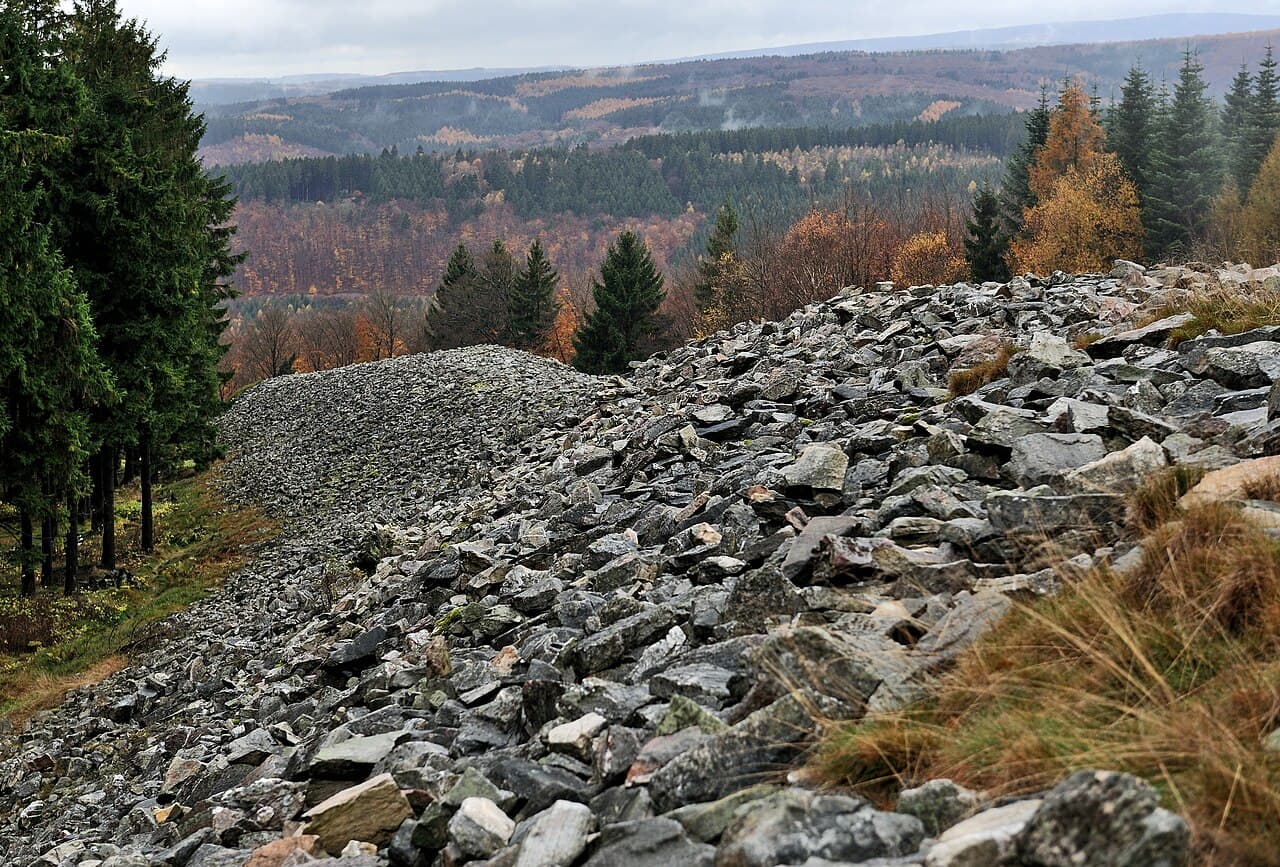
Otzenhausen Celtic Hillfort
The Celtic hillfort of Otzenhausen stands as one of the largest and most impressive fortifications built by the Celts in Europe. Located on the Dollberg hill near the village of Otzenhausen in Germany's Saarland region, this ancient stronghold was constructed by the Treveri tribe, a Celtic people inhabiting the area north of the site. The hillfort's strategic position at around 695 meters above sea level provided extensive views over the surrounding landscape, making it a formidable defensive site.
The initial fortifications at Otzenhausen date back to the 5th or 4th century BC, placing its origins in the Early Iron Age. However, the most significant construction and expansion occurred during the 2nd and 1st centuries BC, a period marking the height of Celtic power in the region. The fort was subsequently abandoned shortly after this major development phase for reasons that remain unclear.
Architectural design and fortifications
The Otzenhausen hillfort is remarkable for its massive stone ramparts that enclose the site in a roughly triangular shape with rounded ends. The main rampart extends approximately 2,500 meters in length, enclosing an area measuring about 460 meters from west to east and 647 meters from north to south. The ramparts contain an estimated 240,000 cubic meters of stone, signifying an enormous effort in construction and engineering.
These ramparts are not merely earthen embankments but were reinforced with thousands of wooden beams. These beams likely supported a vertical stone wall facing outward, creating a formidable defensive barrier. The fortification system includes a primary entrance on the western side, designed to control access securely.
In front of the main rampart on the southern side lies a second embankment, situated about 40 meters ahead. This outer rampart nearly meets the main wall at its ends but does not connect directly. The purpose of this secondary fortification remains uncertain, especially since the main gate is on the opposite side of the fort. There is speculation about a possible second gate on the eastern side, but no archaeological evidence has conclusively confirmed this.
Structural features and materials
The ramparts were constructed primarily from local stone, including quartzite rubble and sandstone blocks. The use of these durable materials contributed to the fort's longevity and the preservation of its remains. The wooden beams embedded within the walls would have provided additional strength and stability, as well as a vertical façade that would have been difficult to scale.
Historical context and usage
The Treveri tribe played a significant role in the Celtic cultural landscape of what is now western Germany and parts of modern-day Luxembourg and Belgium. Otzenhausen served as a major center for them, likely functioning as both a refuge and a symbol of tribal power.
Following the Celtic period, the site saw intermittent use during the Roman era. A small temple dating from the 2nd or 3rd century AD was constructed within the fort, made of quartzite rubble and brick-shaped sandstone. This indicates that the Romans recognized the site's strategic or religious significance.
In the 4th century AD, during the period of Germanic invasions into Roman territories, the fort was reused as a defensive refuge. This reuse underscores the enduring military value of the location and its fortifications.
Centuries later, during the Thirty Years' War (1618–1648), local villagers once again sought shelter within the remains of the ancient fortifications, demonstrating the site's continued importance as a place of refuge in times of conflict.
Archaeological investigations and preservation
Excavations at Otzenhausen began in the late 19th century, with significant archaeological work conducted between 1936 and 1939. These studies uncovered much about the fort's construction techniques, layout, and phases of occupation.
Today, the site is characterized by its partially preserved state, with the two large circular earth ramparts still visible and covered with stones. While the wooden elements have long since decayed, the stone foundations and embankments provide valuable insights into Celtic fortification methods.
Otzenhausen remains an important cultural heritage site, offering a tangible connection to the Celtic past of the region. Its size and complexity make it a key example of ancient hillfort architecture in Central Europe.
Visitor experience and significance
Visitors to Otzenhausen can explore the extensive ramparts and enjoy panoramic views from the hilltop. Informational displays help contextualize the site's historical and architectural importance. The hillfort's imposing remains invite reflection on the engineering skills and social organization of the Celtic people who built it.
As one of the largest Celtic hillforts, Otzenhausen provides a unique window into the prehistoric period of Europe, illustrating the transition from simple tribal settlements to complex fortified centers.
Frequently asked questions (FAQ)
- How do I get to Otzenhausen Celtic hillfort?
- Otzenhausen Celtic hillfort is located near the village of Otzenhausen in Saarland, Germany. It is accessible by car and local roads; parking is available nearby. Public transport options are limited, so driving is recommended for visitors.
- What is the historical significance of Otzenhausen hillfort?
- Otzenhausen hillfort is one of the largest Celtic fortifications in Europe, built by the Treveri tribe during the Early Iron Age. It served as a defensive stronghold, a tribal center, and was reused during Roman times and later conflicts.
- Can I walk along the ramparts of the hillfort?
- Yes, visitors can walk along the visible ramparts of Otzenhausen hillfort. The site features extensive earthworks and stone embankments that are accessible for exploration, offering panoramic views of the surrounding landscape.
- When is the best time to visit Otzenhausen hillfort?
- The best time to visit Otzenhausen hillfort is during the late spring to early autumn months when the weather is mild and the site is more accessible. Avoid visiting in winter due to potential snow and slippery conditions on the hill.
- Are there guided tours available at Otzenhausen hillfort?
- Guided tours are occasionally offered by local heritage organizations and during special events. Visitors should check with local tourist information centers in Saarland for current tour availability and schedules.
Photo gallery

Information
Website
Visit websiteSources & official resources
Verify the information above using these authoritative references.
Loading map...
Visitor reviews
No reviews yet. Been here? Write the first review and help other travelers!
Write the first reviewVisited this castle? Share your experience
Your review helps other travelers and adds first-hand knowledge to our encyclopedia.



