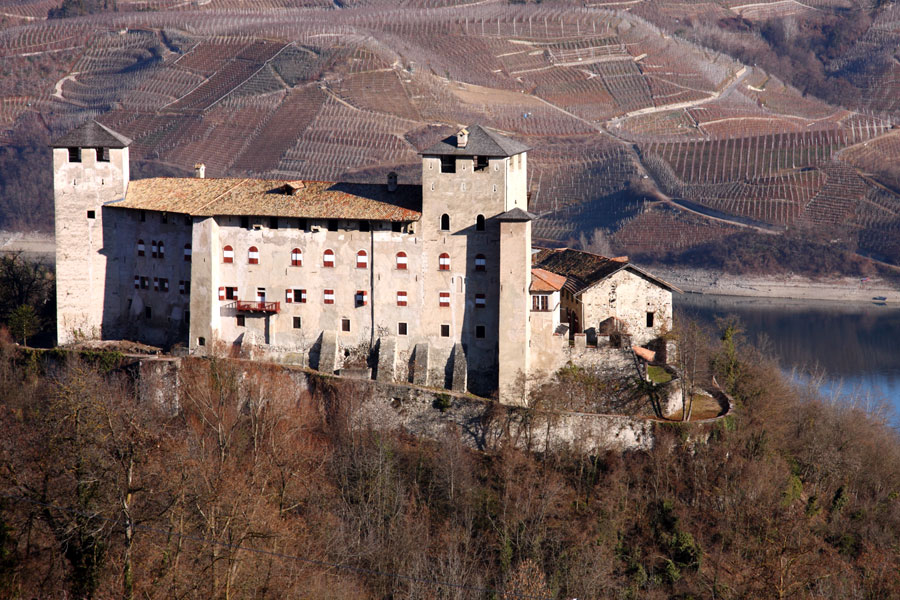
Valer Castle
Valer Castle stands prominently near Tassullo in the Non Valley of northern Italy, commanding panoramic views from its strategic hilltop position. This medieval hill castle is renowned for its distinctive octagonal bergfried tower, elegant Renaissance additions, and richly frescoed chapel dedicated to Saint Valerius. The castle complex reflects centuries of architectural evolution and noble lineage, embodying the region's turbulent history and cultural heritage.
Historical background and ownership
The origins of Valer Castle trace back to the late 13th century, during a period marked by the consolidation of noble power in the region. While some sources mention the castle as early as 1211, the first definitive documentary record dates to 1297, linking it to the Counts of Flavon and the influence of Meinhard II, Count of Tyrol. The castle was a symbol of imperial authority, connected to the Staufer dynasty and the Italian campaign of Conradin in 1266.
Ownership passed through several notable families, including Heinrich II of Schenna and Ulrich I of Coreth, before becoming part of the Counts of Tyrol's domain. In the mid-14th century, it was sold to Ludwig the Brandenburger, and later incorporated into the Habsburg territories in 1363. From 1427, the castle was divided between two branches of the Spaur family, who maintained control for over 400 years until 2021. In 2023, stewardship passed to the Autonomous Province of Trento.
Architectural features and layout
The bergfried tower
The castle's centerpiece is its imposing octagonal bergfried tower, rising over 30 meters with walls exceeding two meters in thickness. Constructed from a blend of multicolored limestone, porphyry, tonalite, and partially imported granite, the tower is unique in Trentino for its shape and scale. Originally built in the 14th century, the tower was heightened and fortified in the 15th century with battlements and crossbow slits, serving both as a lookout and last refuge.
Lower castle
The Lower Castle forms a semicircular enclosure northeast of the bergfried. It is the oldest section, featuring a courtyard with a deep, vaulted well and the Wappensaal (Coat of Arms Hall), which displays heraldic emblems of allied noble families. The preserved Gothic kitchen includes original furnishings, and the Ulrich Hall is a grand reception room with a 1552 wooden ceiling adorned with over 150 family portraits and coats of arms. Tradition holds that Wolfgang Amadeus Mozart played a harpsichord here during his 1796 Italian tour.
Upper castle
The Upper Castle, developed during the Renaissance in the 15th century, contains residential quarters with elegant features such as a loggia supported by pink limestone columns and triforia windows. Stucco decorations and family emblems embellish this section, reflecting the refined tastes of the Spaur family.
Religious and artistic heritage
The castle chapel, dedicated to Saint Valerius of Trier, is located at the northern edge within the zwinger — a narrow defensive enclosure designed to trap attackers. The chapel has a rectangular nave and presbytery covered by ribbed vaults. Its walls are adorned with vibrant frescoes painted in 1473 by the Baschenis brothers, Giovanni and Battista, artists from Bergamo. These frescoes depict biblical scenes, saints including Saint Fabiano and Saint Sebastiano, and heraldic symbols, though some have suffered damage from structural changes over time.
Defensive structures and modifications
Valer Castle is protected by at least two concentric curtain walls, though parts have been modified to accommodate gardens. A stone bridge spans the moat on the northeast side, leading to a gate fortified by a ravelin and a rounded-arch entrance. Historically, a wooden bridge connected the bergfried to the east wing of the Lower Castle, designed to be destroyed in case of attack, with a secondary gateway linking to the Upper Castle.
Preservation and current condition
The castle has endured natural challenges, including landslides caused by the flooding of the Rio Paglia in 1706, which damaged parts of the structure. Subsequent repairs in the 18th century and modern stabilization efforts between 2001 and 2005 have helped preserve the complex. Today, the castle is well preserved, with many original furnishings intact, such as historic tiled stoves from nearby Sfruz and the medieval kitchen, providing valuable insights into the domestic life of its noble inhabitants.
Artistic treasures and interior highlights
The interior boasts numerous artistic and historical treasures, including frescoes by Marcello Fogolino in the Lower Castle's loggia and the Madruzzo Rooms, which feature allegorical and heraldic decorations from the 16th century. The Ulrich Hall and the Wappensaal remain focal points of the castle's cultural heritage, showcasing the lineage and alliances of the Spaur family.
Valer Castle stands as a remarkable example of a medieval fortress adapted through Renaissance refinement, embodying the historical narrative of the Trentino region and the legacy of its noble families.
Frequently asked questions (FAQ)
- How do I get to Valer Castle?
- Valer Castle is located in Ville d’Anaunia, Italy, and is accessible by car or public transport. The nearest major city is Trento, from which you can take a bus or drive approximately 30 minutes to reach the castle.
- What is the historical significance of Valer Castle?
- Valer Castle dates back to the 13th century and is an important example of medieval architecture in the region. It served as a defensive fortress and residence for noble families, reflecting the history and culture of the area.
- When was Valer Castle built?
- Construction of Valer Castle began in the early 13th century, with significant expansions and renovations occurring over the centuries. Its architecture showcases various styles, indicating the changes in design preferences over time.
- Can I take guided tours of Valer Castle?
- Yes, guided tours are available at Valer Castle, providing visitors with in-depth knowledge of its history and architecture. It is recommended to book in advance, especially during peak tourist seasons.
- Why is Valer Castle a popular tourist attraction?
- Valer Castle is popular for its stunning architecture, rich history, and beautiful surrounding landscape. Visitors are drawn to its picturesque views and the opportunity to explore a well-preserved medieval fortress.
- Is it possible to visit Valer Castle year-round?
- Valer Castle is open to visitors year-round, but hours may vary seasonally. It's advisable to check the official website for current opening hours and any seasonal events that may be taking place.
- What are the ticket prices for Valer Castle?
- Ticket prices for Valer Castle vary depending on age and whether you choose a guided tour. Discounts may be available for children, students, and seniors, so it's best to check the official website for the most accurate pricing.
- What is the best time to visit Valer Castle?
- The best time to visit Valer Castle is during the spring and early fall when the weather is mild, and the landscape is particularly beautiful. These seasons also tend to have fewer crowds, allowing for a more enjoyable experience.
- Are there any nearby attractions to visit while at Valer Castle?
- Yes, nearby attractions include the charming village of Ville d’Anaunia and the scenic Monte Roen. Visitors can also explore local hiking trails and other historical sites in the area, making it a great day trip destination.
Information
Website
Visit websiteSources & official resources
Verify the information above using these authoritative references.
Loading map...
Visitor reviews
No reviews yet. Been here? Write the first review and help other travelers!
Write the first reviewVisited this castle? Share your experience
Your review helps other travelers and adds first-hand knowledge to our encyclopedia.