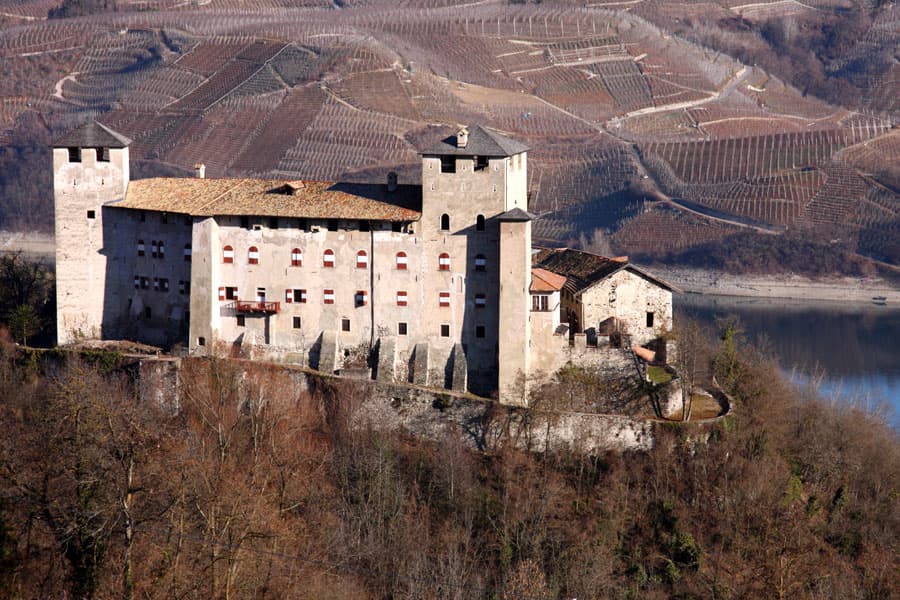
Cles Castle, located near the town of Cles in the Non Valley of northern Italy, is a prominent example of a high medieval hill castle that evolved into a Renaissance residence. Perched on an isolated hill at an elevation of 616 meters, the castle overlooks terraced apple orchards and vineyards, with the Santa Giustina reservoir reshaping the landscape in the 20th century. The castle's strategic position was originally chosen to control the nearby Roman road crossing the Stream Noce via a wooden bridge, highlighting its military and administrative importance through centuries.
Early history and medieval origins
Archaeological evidence confirms continuous human presence on the site since Roman times, with early fortifications or watchtowers predating the medieval castle. The first documented mention of the castle dates to 1124, when it served as the hereditary residence of the noble von Cles family. The initial construction was a stone tower built by Vitale von Cles, designed as both a defensive stronghold and noble residence. By the mid-13th century, the castle had expanded into a well-fortified complex featuring ring walls and a central bergfried or main tower. Ownership transferred to Egno von Eppan, the Bishop of Trento, reflecting the castle's significance in regional power dynamics.
Renaissance transformation under prince-bishop bernard von cles
The castle underwent significant transformation in the 15th and early 16th centuries under the direction of Bernhard von Cles, a Renaissance cardinal and Prince-Bishop of Trento and Brixen born at Castel Cles in 1485. He commissioned extensive renovations that converted the medieval fortress into a lavish residence while maintaining its defensive capabilities. These renovations introduced Renaissance architectural elements and artistic decorations, including the notable Saletta delle Metamorfosi, a small hall adorned with frescoes by the court artist Marcello Fogolino. These frescoes depict scenes from Ovid's Metamorphoses, illustrating the cultural refinement brought to the castle during this period.
The peasant rebellion and subsequent restorations
In 1525, the castle suffered heavy damage during the Peasant Rebellion, a widespread uprising affecting much of the region. The fortress was promptly rebuilt and remodeled in Renaissance style, with completion marked by a stone plaque dated 1535 above the courtyard entrance. Further expansions were carried out later in the 16th century under Aliprando von Cles, enhancing the castle's residential and defensive structures.
Architectural features and layout
Cles Castle has a roughly triangular layout protected by two successive ring walls. The main entrance is located on the northern side, historically accessed via a drawbridge over a defensive moat. Additional fortifications such as bastions and a forecourt or vorburg were added to strengthen the gatehouse defenses.
The castle originally included three towers. Two large square towers flank the eastern side of the main residential building, a five-story stone palace with tiled roofs surrounding a small inner courtyard. This palace served as the administrative and domestic center of the castle.
The Saletta delle Metamorfosi within the palace remains a highlight for visitors, showcasing the 16th-century frescoes by Marcello Fogolino. These artworks reflect the Renaissance cultural influences and the patronage of Bernhard von Cles.
Later history and preservation
During the 17th century, Castel Cles gradually lost its military role but remained an administrative center. In 1609, Hildebrand Reimbert von Cles was confined within the castle after being declared legally incapacitated by Habsburg authorities, illustrating the castle's continued importance as a noble residence.
A major fire in 1825 destroyed the southern wing and one tower, along with archival records, but subsequent restoration efforts preserved much of the castle's medieval and Renaissance character. The castle survived the turmoil of the World Wars without significant damage.
The construction of the Santa Giustina dam in the 20th century transformed the surrounding landscape, altering the castle's commanding views but leaving the structure largely intact. Today, Cles Castle remains the private property of the Barons von Cles and is generally closed to the public except for special events during summer.
Cultural and historical significance
Cles Castle stands as a testament to the layered history of northern Italy, illustrating the transition from medieval fortification to Renaissance noble residence. Its architectural evolution reflects broader political and cultural changes in the region, particularly under the influence of the powerful Prince-Bishop Bernhard von Cles. The preservation of Renaissance frescoes and defensive structures offers valuable insight into the artistic and military practices of the period.
The castle's location on a hilltop surrounded by orchards and vineyards also highlights the integration of defensive sites within the agricultural landscape of the Non Valley. While access is limited, the castle's enduring presence contributes to the historical identity and heritage of the region.
Frequently asked questions (FAQ)
- How do I visit Cles Castle?
- Cles Castle is privately owned and generally closed to the public. It opens only for special summer events, so visitors should check local listings for these occasions.
- What is the historical significance of Cles Castle?
- Cles Castle served as a medieval fortress controlling a Roman road and later became a Renaissance residence under Prince-Bishop Bernhard von Cles, reflecting regional political and cultural shifts.
- When was Cles Castle built?
- The castle dates back to the 12th century, with initial construction by Vitale von Cles and significant expansions during the 15th and 16th centuries.
- Can I see the frescoes inside Cles Castle?
- The castle houses 16th-century frescoes by Marcello Fogolino in the Saletta delle Metamorfosi, but public access is limited to special events.
- Is Cles Castle accessible by public transport?
- Cles Castle is located near the town of Cles, which is accessible by regional buses and trains. From the town, the castle is visible on the hilltop but requires private transport or hiking to reach.
Photo gallery

Information
Sources & official resources
Verify the information above using these authoritative references.
Loading map...
Visitor reviews
No reviews yet. Been here? Write the first review and help other travelers!
Write the first reviewVisited this castle? Share your experience
Your review helps other travelers and adds first-hand knowledge to our encyclopedia.



