Ursino Castle
Ursino Castle, also known as Castello Ursino or Castello Svevo di Catania, stands as a monumental symbol of medieval military architecture and royal power in the heart of Catania, Sicily. Constructed between 1239 and 1250 by the renowned military architect Riccardo da Lentini under the commission of Emperor Frederick II, this imposing fortress was originally designed to serve both as a coastal defense structure and a royal residence. Its strategic position on a rocky promontory overlooking the sea and connected to the city by an isthmus made it a formidable stronghold for controlling the surrounding territory and safeguarding the coastline.
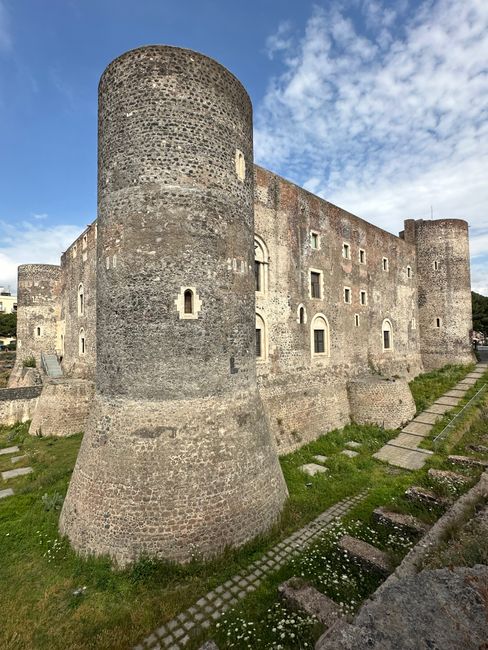
The castle's architectural design is characteristic of the late medieval period, featuring a robust square plan with four circular corner towers enclosing a spacious open courtyard. This design exemplifies the military ingenuity of the era, combining defensive functionality with the symbolic assertion of Swabian royal authority. Ursino Castle's thick stone walls, battlements, and towers were crafted to withstand sieges and assaults, reflecting the turbulent political climate of 13th-century Sicily.
Historical significance and political role
Throughout its history, Ursino Castle played a pivotal role in Sicilian political and military affairs. During the Sicilian Vespers uprising, the castle hosted the Sicilian Parliament in 1295, where the deposition of James II of Aragon and the election of Frederick III as King of Sicily marked a critical turning point. The following year, the castle was seized by Robert, King of Naples, only to be reclaimed by the Aragonese shortly thereafter. It subsequently became the residence of the Aragonese kings, including Frederick III, Peter II, Louis, and Frederick IV the Simple, cementing its status as a center of royal power.
The castle also witnessed dramatic events such as the 1397 abduction of Maria, daughter of Frederick III, orchestrated by Guglielmo Raimondo Moncada, Count of Augusta, to prevent a politically motivated marriage. Furthermore, the 1392 rebellion of Catania forced the royal garrison to retreat within Ursino's walls, enduring a prolonged and devastating siege that underscored the fortress's defensive capabilities.
Architectural evolution and military adaptations
Over the centuries, Ursino Castle underwent various transformations reflecting changes in military technology and political needs. In the 16th century, the castle's military importance declined with the advent of gunpowder artillery, leading to its gradual conversion into a prison. The castle was maintained by castellans, notably from the influential Statella family, who often clashed with the city magistrates over jurisdictional authority.
The castle's resilience was notably tested during the catastrophic 1669 eruption of Mount Etna. Despite the lava flows threatening to engulf the fortress and the city, the castle's robust ramparts and moats successfully diverted the lava to the sea, preserving the structure. This event dramatically altered the surrounding landscape, moving the shoreline approximately 500 meters away and raising the ground level by about 10 feet, transforming Ursino from a coastal fortress to an inland stronghold. The 1693 earthquake further damaged the castle, but it remained one of the few buildings in Catania to survive this devastating event.
Later uses and preservation
In the 19th century, efforts were made to restore Ursino Castle's military function, including modifications after 1837. Following the unification of Italy, the castle was repurposed as a military barracks. The 20th century brought significant restoration work, culminating in the castle's acquisition by the city of Catania in 1932. Restored and adapted for public use, Ursino Castle was inaugurated as the Museo Civico on 20 October 1934.
Today, Ursino Castle serves as a prominent municipal museum, housing an extensive collection of artifacts and artworks that span from the Classical era through various periods of Sicilian history. The museum's exhibits reflect the island's rich cultural heritage and the diverse influences that have shaped its identity. Additionally, the castle frequently hosts temporary exhibitions, theatrical performances, and concerts, making it a vibrant cultural hub in modern Catania.
Architectural features and layout
The structure of Ursino Castle is a testament to medieval military architecture. Its square layout is fortified by four circular towers at each corner, each equipped with battlements and arrow slits for defense. The central courtyard provided open space for troop assembly and daily activities within the fortress walls. Thick stone walls and a surrounding moat enhanced the castle's defensive capabilities, while the elevated position on a rocky promontory offered commanding views of the surrounding landscape and sea.
The castle's entrance is marked by a robust gatehouse, designed to withstand assaults and control access. Inside, the castle contained residential quarters, administrative rooms, and storage areas, reflecting its dual role as a military fortress and royal residence. Over time, modifications accommodated changing functions, including prison cells and barracks.
Cultural importance and tourism
Ursino Castle remains a significant cultural landmark in Sicily, attracting visitors interested in medieval history, military architecture, and Sicilian heritage. Its survival through natural disasters and political upheavals makes it a unique monument embodying resilience and historical continuity. The castle's museum offers educational opportunities and insights into the complex history of Sicily, from ancient times through the medieval period to the modern era.
Visitors to Ursino Castle can explore its well-preserved architectural features, enjoy exhibitions of archaeological finds and artworks, and participate in cultural events held within its historic walls. Its location in the heart of Catania makes it accessible and an essential stop for those seeking to understand the island's rich past.
Frequently asked questions (FAQ)
- What is the historical significance of Ursino Castle?
- Ursino Castle was built by Emperor Frederick II in the 13th century and served as a royal residence and military fortress. It hosted important events such as the Sicilian Parliament during the Sicilian Vespers and was a center of political power in medieval Sicily.
- Can visitors explore the interior of Ursino Castle?
- Yes, Ursino Castle functions as a municipal museum open daily from 10:00 to 18:00. Visitors can explore its medieval architecture and view artifacts spanning Sicily's history.
- How did the 1669 eruption of Mount Etna affect Ursino Castle?
- The castle survived the 1669 Mount Etna eruption thanks to its ramparts and moats, which diverted lava flows away from the structure. However, the surrounding landscape changed, moving the castle inland from the coast.
- Is Ursino Castle accessible for visitors with mobility issues?
- The castle has some areas with uneven surfaces and stairs, which may present challenges for visitors with mobility impairments. Assistance and information are available at the museum entrance.
- When is the best time to visit Ursino Castle?
- The castle is open year-round, but spring and autumn offer pleasant weather for exploring Catania and the castle grounds with fewer crowds.
- Are there any special events held at Ursino Castle?
- Yes, Ursino Castle hosts temporary exhibitions, theatrical performances, and concerts, making it a vibrant cultural venue in Catania.
Information
Opening hours
10:00-18:00, daily
Ticket prices
€5 adult, €3 child
Current owner
Municipality
Address
Piazza Federico II di Svevia, Catania, Italy
Loading map...
Visitor reviews
No reviews yet. Been here? Write the first review and help other travelers!
Write the first reviewVisited this castle? Share your experience
Your review helps other travelers and adds first-hand knowledge to our encyclopedia.