Castello Ursino
Castello Ursino, also known as the "Bear Castle," stands as a monumental symbol of medieval power and architectural prowess in Catania, Sicily. Constructed in the 13th century under the auspices of the Holy Roman Emperor Frederick II of the Hohenstaufen dynasty, this imposing fortress was originally designed to consolidate imperial authority over the Kingdom of Sicily and to protect the strategic coastal city of Catania. Today, it remains one of the best-preserved examples of high medieval military architecture in the region and functions as a public museum, offering visitors a rich glimpse into Sicily's layered history.
Historical context and construction
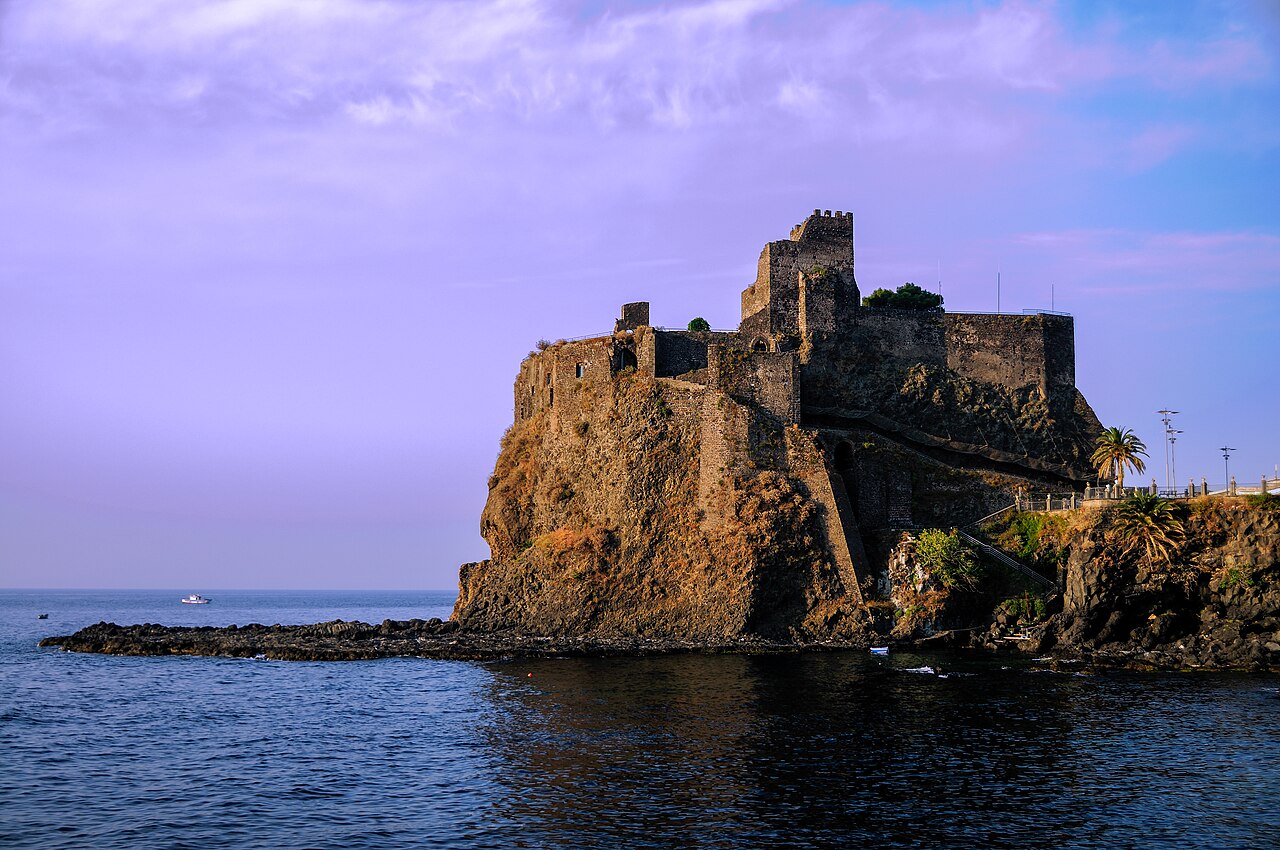
The construction of Castello Ursino began in 1239 and was completed around 1250, guided by the military architect Riccardo da Lentini. It was part of a broader network of fortifications along eastern Sicily’s coast intended to secure the kingdom against both maritime threats and internal rebellions. Built on a cliff overlooking the Ionian Sea, the castle's location was carefully chosen for its defensive advantages and its role in overseeing the city and sea routes.
Frederick II’s vision for the castle combined the functions of a royal residence and a fortress. The use of local lava stone and the opus incertum masonry technique, which involved fitting irregular stones together to form thick, resilient walls, ensured the castle's durability. The walls, approximately 2.5 meters thick and set on scarped foundations, were designed to resist siege engines and later artillery, although the advent of gunpowder would eventually diminish their defensive effectiveness.
Role in sicilian political history
Castello Ursino played a pivotal role during the Sicilian Vespers uprising in the late 13th century, a significant rebellion against Angevin rule. In 1295, the castle hosted the Sicilian Parliament, where the deposition of James II of Aragon was declared and Frederick III was proclaimed king. This event marked a crucial turning point in Sicilian history, emphasizing the castle’s importance not only as a military bastion but also as a seat of governance.
The castle continued to serve as a royal residence for successive rulers, including Peter II, Louis, Frederick IV, and King Martin I. Notably, in 1392, it was the site of the dramatic abduction of Queen Maria to prevent her politically significant marriage to Gian Galeazzo Visconti. These events underscore the castle's centrality in the dynastic and political struggles of medieval Sicily.
Architectural features and layout
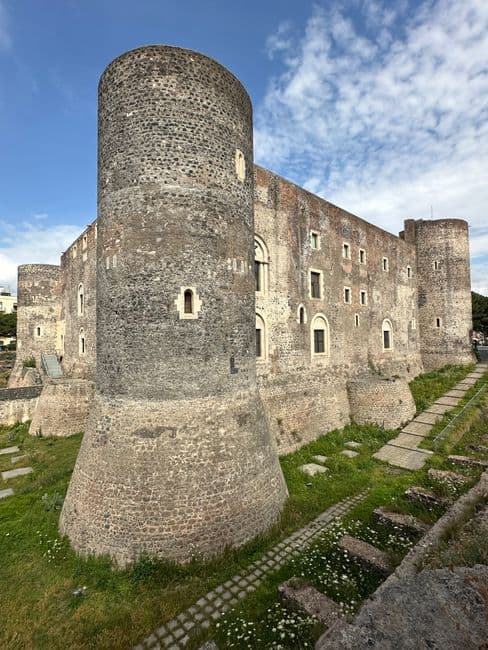
The castle is laid out on a nearly square plan, each side measuring about 50 meters, with four massive circular corner towers approximately 30 meters tall and 10 meters in diameter. These towers provided overlapping fields of fire and strong defensive positions. Originally, four smaller towers stood between the corners, of which two remain today. The walls and towers were originally devoid of battlements; these were added later during Renaissance modifications, along with additional bastions such as San Giorgio and Santa Croce, a moat, and a connecting curtain wall.
The northern entrance, once accessed by a drawbridge over a moat, is flanked by defensive walls and features a niche with a sculpture of a Swabian eagle clutching a hare, symbolizing Emperor Frederick II’s authority. On the southern side, a smaller "false door" led to a ramp descending to a former sea landing, illustrating the castle’s original coastal proximity before volcanic activity altered the landscape.
Inside, a central open courtyard is surrounded by four large halls arranged symmetrically. These halls are divided into three sections covered by ribbed cross vaults supported by semi-columns adorned with leaf motifs, evoking the atmosphere of a Gothic temple. Spiral staircases in the northern and southern semi-towers facilitated vertical movement while maintaining defensive integrity. This architectural design reflects the dual role of the castle as both a royal residence and a fortress.
Impact of natural disasters and landscape changes
The castle's history is closely intertwined with the volatile natural environment of eastern Sicily. The devastating 1693 earthquake that destroyed much of Catania left Castello Ursino largely intact, a testament to its robust construction. However, volcanic activity from Mount Etna, especially the massive eruption of 1669, dramatically altered the castle’s setting. Lava flows pushed the shoreline nearly one kilometer away and filled the castle’s moat with volcanic rock, effectively moving the fortress inland and changing its strategic maritime role.
These natural events have not only shaped the physical context of the castle but also contributed to its preservation by burying some of its external fortifications under layers of lava, protecting them from later destruction.
Later uses and preservation
As military technology evolved and the political center shifted away from Catania, Castello Ursino lost its strategic importance and was repurposed as a prison. The ground floor walls still bear hundreds of prisoner inscriptions and graffiti in Sicilian, Latin, and Spanish, dating back to the early 16th century. These markings provide a unique historical record of the castle’s use as a detention facility and the personal stories of its inmates.
In the 20th century, the city of Catania acquired the castle in 1932 and initiated restoration efforts. It was reopened as a civic museum in 1934, housing extensive collections that span from Classical antiquity through the Renaissance and beyond. Further restorations completed in 2009 enhanced both the preservation of the castle’s structure and the display of its diverse artifacts.
Museum collections and cultural significance
The museum within Castello Ursino showcases a remarkable array of artifacts reflecting Sicily’s rich cultural heritage. Highlights include Roman mosaics, statues such as a figure of Hercules, and mythological friezes. Marble reliefs, including a 5th-century BC depiction of Demeter and Kore, underscore the classical roots of the region.
Additional exhibits feature Byzantine icons, medieval architectural elements like keystones, and Renaissance paintings by masters such as El Greco and Pietro Novelli. The museum also houses a rare surviving copy of Caravaggio’s "Nativity with St. Francis and St. Lawrence," 19th-century portraits, 18th-century Chinese ceramics, historic violins crafted by Andrea Amati, and traditional Sicilian ceramics from Caltagirone.
Through its architecture, history, and collections, Castello Ursino offers visitors a comprehensive insight into the complex tapestry of Sicilian history, from medieval monarchy and military defense to cultural and artistic flourishing.
Frequently asked questions (FAQ)
- How do I get to Castello Ursino?
- You can reach Castello Ursino by taking public transportation to Catania's city center, where it is conveniently located. Various bus lines serve the area, and it is also within walking distance from major landmarks in Catania.
- What is the historical significance of Castello Ursino?
- Castello Ursino was built in the 13th century and served as a royal residence for the Aragonese kings of Sicily. It is an important symbol of Catania's medieval history and has witnessed numerous historical events, including the 1693 earthquake.
- When was Castello Ursino constructed?
- Construction of Castello Ursino began in 1239 under the orders of Emperor Frederick II. It was completed in 1250 and has since been a pivotal structure in both the architectural and political history of Sicily.
- Can I take photographs inside the castle?
- Yes, visitors are welcome to take photographs inside Castello Ursino, but it is advisable to be respectful of the exhibits and other guests. Remember to check for any specific photography restrictions during special exhibitions.
- Why is Castello Ursino famous for its architecture?
- Castello Ursino is renowned for its unique blend of medieval and Renaissance architectural styles, featuring robust stone walls and elegant towers. Its construction techniques and design reflect the historical context of its time, making it a fascinating study for architecture enthusiasts.
- Is it possible to access Castello Ursino with a wheelchair?
- Yes, Castello Ursino is accessible for visitors with mobility challenges. Ramps and elevators have been installed to ensure everyone can enjoy the castle and its exhibits.
- What are the opening hours for Castello Ursino?
- Castello Ursino is generally open to visitors from Tuesday to Sunday, with specific hours from 9 AM to 7 PM. It is advisable to check the official website for any changes in hours, especially during holidays.
- What are the ticket prices for visiting Castello Ursino?
- Ticket prices for Castello Ursino are typically around €6 for adults, with discounts available for students and seniors. Children under 12 often enter for free, making it an affordable destination for families.
- When is the best time to visit Castello Ursino?
- The best time to visit Castello Ursino is during the spring and fall months when the weather is mild and pleasant. This allows for a more enjoyable exploration of the castle and its surroundings, avoiding the summer heat and tourist crowds.
- Are there any nearby attractions to visit after Castello Ursino?
- Yes, after visiting Castello Ursino, you can explore nearby attractions such as the Piazza del Duomo and the Catania Cathedral. The vibrant Mercato del Pesce and the beautiful Via Etnea are also within walking distance and offer a taste of local culture.
Photo gallery

Photo by Sergei Gussev
Information
Website
Visit websiteSources & official resources
Verify the information above using these authoritative references.
Loading map...
Visitor reviews
No reviews yet. Been here? Write the first review and help other travelers!
Write the first reviewVisited this castle? Share your experience
Your review helps other travelers and adds first-hand knowledge to our encyclopedia.