Aci Castle
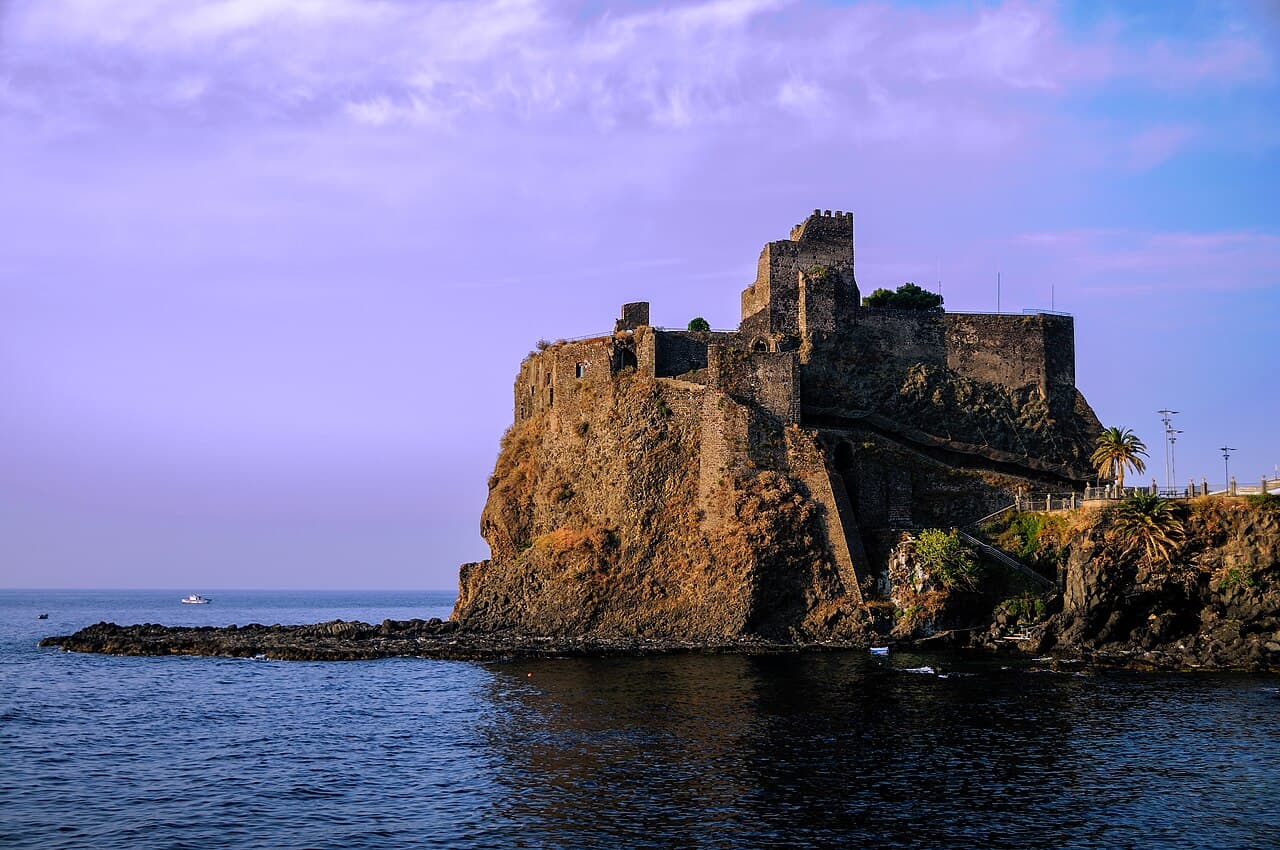
Aci Castle, locally known as Castello di Aci, is a remarkable Norman fortress perched on a basalt promontory overlooking the sea in the coastal town of Aci Castello, in the province of Catania on the island of Sicily, Italy. This castle’s strategic location on a rocky outcrop formed by ancient submarine lava flows about 500,000 years ago has made it a critical defensive site since antiquity. Its layered history spans from Roman and Byzantine fortifications through Arab rule to the Norman conquest and subsequent medieval conflicts, reflecting the turbulent history of Sicily.
The origins of the site trace back to a Roman fortification dating to around 38 AD, later rebuilt by the Byzantines in the 6th or 7th century. This early fortress, known as Castrum Jacis, served to protect the local population from raids. During the Muslim conquest of Sicily, the fortress was surrendered in 902 AD to Emir Ibrahim II, who destroyed the fortress but spared the town. Under Arab rule in the 10th century, the site was rebuilt and integrated into a defensive network, becoming an important center known as Al-Yâg or Lî-Yâg.
The castle as it stands today was primarily constructed by the Normans in the late 11th century, following their conquest of Sicily. The earliest documented mention of the Norman castle dates to 1092 when it was granted to Ansgerio da Sant’Eufemia, the Bishop of Catania, by Count Roger I of Sicily. This marked the beginning of the castle’s role as a feudal stronghold and administrative center. The surrounding territory included what is now Aci Castello and neighboring municipalities.
Medieval development and strategic importance
Throughout the High Medieval period, Aci Castle underwent several significant events and renovations. In 1169, a major eruption of Mount Etna partially engulfed the castle’s cliff with lava, which until then had isolated the castle from the mainland. This geological event contributed to the expansion of the adjacent settlement, which grew in importance.
In the early 13th century, the castle was incorporated into the royal domain by Emperor Frederick II, Holy Roman Emperor and King of Sicily. Frederick II initiated renovations that enhanced the castle’s fortifications, reflecting its increasing military and administrative significance.
During the Sicilian Vespers revolt of 1282, the castle changed hands multiple times. It was granted by King Peter III of Aragon to the admiral Roger of Lauria as a reward for his naval successes. However, when Roger sided with the Angevins, King Frederick III of Sicily besieged the castle using siege towers, notably the wooden "cicogna," and reclaimed it. Ownership later passed to the noble Blasco Alagona in 1320.
The castle endured several assaults during the 14th century, including attacks by Angevin forces and damage from an earthquake and volcanic activity. In 1396, it was besieged and captured by King Martin I of Sicily during an anti-Aragonese revolt, who used a tactic of poisoning the water supply to force surrender. Following this, the castle was restored and became a royal residence for King Martin and his wife Blanche I of Navarre.
Architectural features and layout
The castle’s main architectural feature is its quadrangular donjon tower, which served as the primary stronghold and defensive keep. The fortress is accessible by a masonry staircase climbing the basalt cliff, and historically featured a wooden drawbridge at the entrance, of which only remnants remain today.
Within the castle courtyard lies a small botanical garden and a chapel with traces of a fresco commemorating the arrival of Saint Agatha’s relics in 1126, an event of religious and cultural significance. This chapel, possibly of Byzantine origin, was dedicated in 2012 as the "Jean Calogero Hall," honoring the Sicilian landscape painter whose works are displayed there.
The castle’s walls, battlements, and internal chambers have been adapted over centuries, reflecting various architectural influences from Byzantine, Norman, and Aragonese periods. The fortress’s position on the sea provides commanding views over the Gulf of Catania, emphasizing its defensive role.
Later history and modern use
In the 15th and 16th centuries, the castle’s ownership passed through various noble families and the Spanish crown. It was used as a barracks and later as a prison. The castle suffered damage from the 1693 Val di Noto earthquake and subsequent seismic events, including an 1818 earthquake that rendered it unsuitable as a prison.
During the 19th century, the castle was acquired by the local municipality. It inspired literary works such as Giovanni Verga’s novella "Le storie del Castello di Trezza." Restoration efforts in the 20th century transformed the castle into a museum, which opened in 1985. Today, the museum houses collections in mineralogy, paleontology, and archaeology, highlighting the geological and historical richness of the region.
The castle is open to visitors for a small fee and offers panoramic views, a glimpse into medieval Sicilian history, and cultural exhibits. Its unique location and layered history make it a significant heritage site on the island of Sicily.
Faqs about aci castle
How do i visit aci castle?
Aci Castle is open to the public with a small admission fee. Visitors can explore the museum, the donjon tower, and the botanical garden. It is advisable to check local opening hours before planning your visit.
What is the historical significance of aci castle?
The castle played a vital role in the defense and administration of eastern Sicily from the Norman period through the Aragonese rule. It witnessed key events such as the Sicilian Vespers and served as a royal residence and prison.
When was aci castle built?
The current castle structure was primarily built by the Normans in the late 11th century, with earlier fortifications dating back to Roman and Byzantine times.
Can i see medieval architectural features at aci castle?
Yes, visitors can observe the quadrangular donjon tower, remnants of the drawbridge, battlements, and a chapel with Byzantine frescoes, showcasing a blend of medieval architectural styles.
Is the castle accessible for people with limited mobility?
Due to its location on a rocky promontory and access via stairs, the castle may not be fully accessible for visitors with limited mobility.
What is the best time to visit aci castle?
The castle is best visited during spring and autumn when the weather is mild. Summer can be hot, and winter may be rainy.
Are there other attractions near aci castle?
The nearby town of Aci Castello offers charming coastal views, and the famous sea stacks of Aci Trezza are a short distance away, popular for their literary and natural significance.
Frequently asked questions (FAQ)
- What is the historical significance of Aci Castle?
- Aci Castle, located in Aci Castello, Italy, dates back to the Norman period and served as a defensive structure against invasions. Its strategic position offers a panoramic view of the surrounding area, making it a notable historical landmark that reflects the region's medieval heritage.
- When was Aci Castle built?
- Aci Castle was constructed in the 11th century, during the Norman conquest of Sicily. Over the centuries, it has undergone various renovations and restorations, preserving its architectural integrity and historical value.
- How do I get to Aci Castle?
- Aci Castle is conveniently located near Catania, making it accessible by car, public transport, or even on foot if you are staying nearby. Local buses frequently run to Aci Castello, and there are parking facilities available for visitors arriving by car.
- Can I visit Aci Castle at any time of the year?
- Yes, Aci Castle is open year-round, but the best time to visit is during the spring and fall when the weather is mild and pleasant. During the summer months, it can be quite hot, while winter might bring some rain, so planning your visit during these optimal seasons will enhance your experience.
- What are the opening hours for Aci Castle?
- Aci Castle typically opens at 9:00 AM and closes at sunset, though hours may vary depending on the season or special events. It is advisable to check the official website or contact local tourism information for the most current opening times before your visit.
- Is it possible to take guided tours of Aci Castle?
- Yes, guided tours are available for visitors who wish to learn more about the castle's history and architecture. These tours often include insights from knowledgeable guides who can provide valuable context and enhance your understanding of this remarkable site.
- What nearby attractions should I consider visiting?
- While at Aci Castle, you can explore the charming village of Aci Castello and the nearby Aci Trezza, known for its beautiful seafront and the legendary Cyclops Islands. Additionally, the vibrant city of Catania is just a short drive away, offering a wealth of cultural and historical experiences.
- Are there any ticket prices for visiting Aci Castle?
- Yes, there is a nominal entrance fee to visit Aci Castle, which helps with its maintenance and preservation. Ticket prices may vary for adults, children, and groups, so check the official site for the latest information before your visit.
- Is Aci Castle accessible for visitors with disabilities?
- Aci Castle strives to be accessible to all visitors, with some areas designed to accommodate those with mobility challenges. However, due to the castle's historic nature, some uneven surfaces may still pose challenges, so it is recommended to contact the site in advance for specific accessibility details.

Information
Sources & official resources
Verify the information above using these authoritative references.
Loading map...
Visitor reviews
No reviews yet. Been here? Write the first review and help other travelers!
Write the first reviewVisited this castle? Share your experience
Your review helps other travelers and adds first-hand knowledge to our encyclopedia.