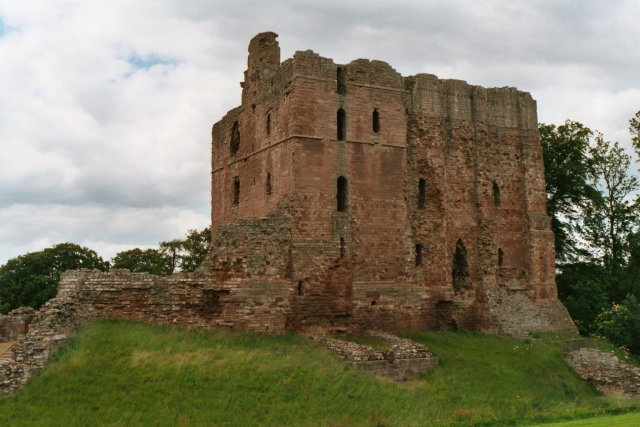
Twizell Castle
Twizell Castle is a historic site located near Cornhill-on-Tweed in Northumberland, England, embodying a rich narrative that spans from the medieval period through the Gothic Revival era. Originally established as a tower house in the early 15th century, it served as a fortified residence for the English nobility amid the turbulent border conflicts between England and Scotland. The castle's strategic position on the banks of the River Till highlights its military and administrative importance during this volatile period.
Medieval origins and border conflicts
The earliest known structure at Twizell was a medieval tower house held by Sir John Heron in the early 1400s. This tower formed part of a defensive network along the Anglo-Scottish border, designed to protect English lands and assert noble authority. In 1496, the tower was destroyed during a military campaign led by King James iv of Scotland, who allied with Perkin Warbeck, a pretender to the English throne. This event underscores the castle's involvement in the border wars and the broader political struggles of the era.
By 1513, the site—then known as "Twesil" or "Twesilhaugh"—was significant enough for King James iv to convene a council or parliament there while preparing to besiege the nearby Norham Castle. The estate remained under the ownership of the Heron family until around 1520 before passing to the Selby family.
16th and 17th century developments
During the mid-16th century, the castle's condition had deteriorated, with only parts of the original tower and the barmkin—a defensive courtyard—still intact. John Selby undertook repairs and enhancements, as documented in a 1595 inventory listing a chamber, a gallery, and several rooms within the tower. These improvements reflect the transition from purely defensive architecture to more comfortable noble living quarters.
In 1685, the estate was sold to Sir Francis Blake, whose family maintained residence until 1738 before relocating to Tillmouth Hall. This period marked the gradual decline of Twizell Castle as a principal noble residence.
Gothic revival rebuilding and decline
In the late 18th century, a renewed interest in medieval architecture inspired another Sir Francis Blake to initiate an ambitious rebuilding project. Engaging architect James Nesbit from Kelso, the plan was to transform Twizell Castle into a grand five-story mansion in the Gothic Revival style. Construction began around 1770 and continued intermittently for approximately forty years.
Despite the prolonged effort, the project was never completed. By 1882, much of the unfinished structure was dismantled, with its stone materials repurposed for a new mansion at nearby Tillmouth Park or sold off. The surviving portion is now a reduced two-story building that preserves elements of both the medieval and Gothic Revival phases.
Architectural features and remains
The extant remains of Twizell Castle form a rectangular stone structure with circular towers at each corner, illustrating the evolution of castle design from defensive medieval architecture to the romanticized Gothic Revival. The building incorporates stone and brick materials, with some north-east corner stonework and a distinctive chamfered doorway dating back to the earliest construction phase.
Within the main block, the vaulted basement rooms feature stone and brick vaulting designed to provide fire-resistant shelter. The castle stands approximately 39 meters above sea level on mostly flat terrain near the River Till, with the nearby medieval Twizell Bridge marking an important crossing point.
Many windows have been blocked up over time, reflecting changes in use and structural repairs. Although much original stone was removed in the late 19th century, enough remains to reveal the castle's historic layout and construction techniques.
The surrounding landscape and archaeological significance
The castle is situated in a rural setting amidst farmland with low population density, accessible via a public footpath that allows visitors to view the site while preserving its tranquil environment. The grounds include the earthwork remains of the medieval village of Twizell, offering archaeological insights into the settlement patterns and daily life of the castle's historical community.
This combination of architectural remnants and archaeological features makes Twizell Castle a valuable heritage site that illustrates the complex history of border fortifications, noble residences, and architectural trends in northern England.
Frequently asked questions (FAQ)
- How do I get to Twizell Castle?
- Twizell Castle is located near Cornhill-on-Tweed in Northumberland, England. It is accessible by public footpaths from nearby roads, but there is no direct public transport to the site. Visitors should plan to walk through rural farmland to reach the castle remains.
- What is the historical significance of Twizell Castle?
- Twizell Castle played a key role in the Anglo-Scottish border conflicts during the late medieval period. It was originally a fortified tower house and later involved in significant events such as the 1496 destruction by King James IV of Scotland and the 1513 council held by the same monarch.
- Can I visit the interior of Twizell Castle?
- The castle remains are largely ruins with limited structural safety. Visitors can view the exterior and surrounding earthworks but access inside the building is generally restricted for safety reasons.
- When was Twizell Castle rebuilt in the Gothic Revival style?
- The Gothic Revival rebuilding project began around 1770 under Sir Francis Blake and continued for about forty years, but it was never completed and was mostly dismantled by 1882.
- Are there any guided tours available at Twizell Castle?
- There are no regular guided tours at Twizell Castle due to its ruinous condition and private ownership. Visitors can explore the site independently while respecting the private property and natural surroundings.
Information
Current owner
Private owner
Loading map...
Visitor reviews
No reviews yet. Been here? Write the first review and help other travelers!
Write the first reviewVisited this castle? Share your experience
Your review helps other travelers and adds first-hand knowledge to our encyclopedia.