Norham Castle
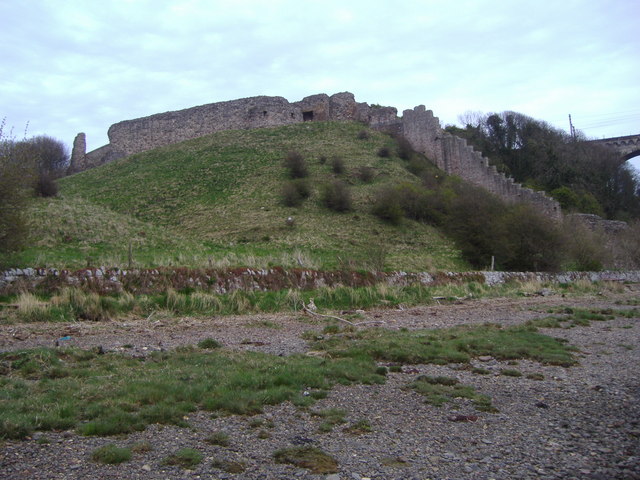
Norham Castle stands as a formidable relic of medieval military architecture and Anglo-Scottish border history in the village of Norham, Northumberland, England. Constructed in the early 12th century, this hill castle was strategically positioned overlooking the River Tweed, serving as a crucial defensive stronghold against Scottish incursions. Its imposing keep, layered wards, and extensive fortifications reflect centuries of conflict, adaptation, and architectural evolution that highlight its significance in northern England's turbulent medieval past.
Founding and early history
The origins of Norham Castle date back to 1121 when it was established by Ranulf Flambard, the powerful Bishop of Durham, who wielded both religious and secular authority over the region. The castle was built to protect the bishopric’s northern territories from frequent Scottish raids. Its initial construction capitalized on the natural defensive advantages of a steep northern slope overlooking the River Tweed, complemented by man-made fortifications such as moats and ditches.
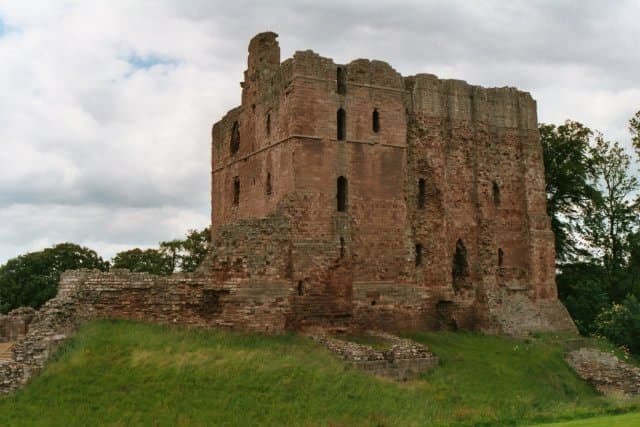
During the early decades, the castle became a focal point of Anglo-Scottish conflict. It was twice captured by Scottish King David I in 1136 and 1138, resulting in significant damage. Reconstruction efforts were led by Bishop Hugh de Puiset in the latter half of the 12th century, who also commissioned the imposing keep that dominates the inner ward. However, after Bishop Hugh supported a rebellion against King Henry II, Norham was seized by the English crown in 1174.
Medieval conflicts and royal involvement
Throughout the late 12th and 13th centuries, ownership of Norham oscillated between the crown and the bishopric. It was returned to ecclesiastical control in 1197 by Bishop Philip of Poitou, though temporarily reverted to crown control after his death in 1208. The castle’s strategic importance was underscored in 1209 when both King John of England and William the Lion, King of Scotland, stayed within its walls. Between 1208 and 1211, King John undertook significant fortification enhancements, which proved vital during a prolonged 40-day siege by Alexander II of Scotland in 1215.
King Edward I, known as the "Hammer of the Scots," frequently visited Norham during his campaigns, including notable stays in 1292 and 1296. During this period, Queen Margaret of France was housed at the castle. The early 14th century saw repeated Scottish attempts to capture Norham under Robert the Bruce, who besieged the castle in 1318, 1319, and 1322, all unsuccessfully. The castle briefly fell to the Scots in 1327 but was soon restored to the bishopric after peace was reestablished.
Later medieval sieges and architectural adaptations
During the Wars of the Roses in the late 15th century, Norham was held by the Yorkists in 1462 but endured a siege by Lancastrian forces the following year. Control of the castle shifted again in 1463 and 1464. To strengthen its defenses, Bishop Richard Foxe initiated improvements, including the addition of earthwork platforms and reinforced walls.
In 1497, James IV of Scotland besieged Norham for two weeks, employing artillery such as the famous cannon Mons Meg. The siege was lifted when English reinforcements arrived. James IV launched another invasion in 1513, during which the Scots bombarded and captured the castle’s outer ward, forcing a surrender and causing significant damage. After James’s defeat and death at the Battle of Flodden, Norham was reclaimed by England, and substantial repairs and fortifications were carried out between 1515 and 1523.
Architectural features and layout
Norham Castle is an exemplary hill castle that integrates natural topography with sophisticated medieval military architecture. The castle is divided into an outer ward and an inner ward, separated by a moat and accessed by drawbridges, emphasizing a layered defense system.
The main entrance, known as the West Gate or Marmion’s Gate, is a heavily fortified gateway approached via a stone causeway and a drawbridge. The outer ward also features the Sheep Gate on its southern side, providing a secondary access point. The inner ward is protected by another drawbridge and a strong gate on the west side, controlling entry to the castle’s heart.
The centerpiece of the inner ward is the massive keep, attributed to Bishop Hugh de Puiset. This imposing tower stands approximately 26 meters tall with walls up to 9 meters thick, underscoring its role as the last line of defense and a symbol of episcopal power. Adjacent to the keep were the bishop’s hall and other domestic buildings, now largely reduced to foundations.
Defensive features include contremurs—outer walls built in front of the main curtain walls—and murder holes, designed to repel attackers attempting to breach the gates. The castle’s fortifications were adapted over centuries to accommodate the evolving use of artillery, as evidenced by the earthwork platforms added in the early 16th century.
Decline and cultural legacy
Following the accession of James VI of Scotland to the English throne, Norham Castle’s military importance waned. It was granted to George Home, 1st Earl of Dunbar, and gradually fell into disuse and ruin. By the late 16th century, maintenance was neglected, especially after Queen Elizabeth I refused funding in 1596.
Despite its decline, Norham Castle gained cultural prominence in the 19th century through the evocative paintings of J.M.W. Turner, who captured the castle’s romantic ruins and dramatic riverside setting. Today, the castle is preserved as a historic monument, with its ruins offering valuable insights into medieval fortification and border warfare.
Visitors to Norham Castle can explore the remains of the keep, the foundations of the bishop’s hall, and the extensive defensive earthworks. The site’s combination of natural and constructed defenses makes it a compelling example of medieval hill castle design and a testament to the complex history of the Anglo-Scottish border region.
Frequently asked questions (FAQ)
- How do I get to Norham Castle?
- Norham Castle is located in the village of Norham, Northumberland, England. It is accessible by car and public transport from nearby towns such as Berwick-upon-Tweed. Visitors should check local travel options and parking availability in advance.
- What is the historical significance of Norham Castle?
- Norham Castle played a vital role in the Anglo-Scottish border conflicts from the 12th to the 16th centuries. It served as a defensive stronghold for the Bishop of Durham and later the English crown, witnessing numerous sieges and battles.
- Can I visit the interior of Norham Castle?
- As a ruin, Norham Castle’s interior is accessible to visitors, allowing exploration of the keep remains, foundations of the bishop’s hall, and defensive earthworks. However, some areas may be restricted for safety reasons.
- When is the best time to visit Norham Castle?
- The best time to visit Norham Castle is during the late spring to early autumn months, when weather conditions are more favorable for outdoor exploration and photography of the scenic riverside setting.
- Are there any guided tours available at Norham Castle?
- Guided tours may be available seasonally or during special events. Visitors should check with Historic England or local tourist information centers for current offerings and schedules.
Photo gallery

Information
Sources & official resources
Verify the information above using these authoritative references.
Loading map...
Visitor reviews
No reviews yet. Been here? Write the first review and help other travelers!
Write the first reviewVisited this castle? Share your experience
Your review helps other travelers and adds first-hand knowledge to our encyclopedia.