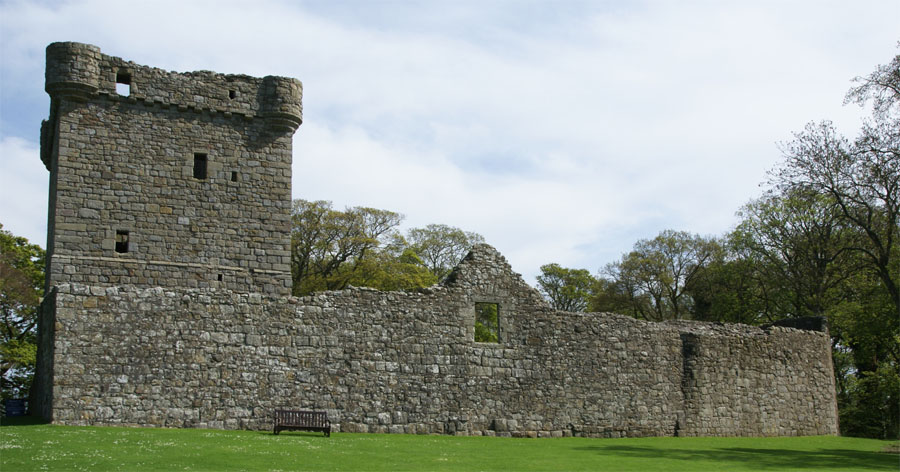
Tullibole Castle
Tullibole Castle stands as a remarkable example of a 17th-century Scottish laird's house located near the village of Crook of Devon in Scotland. This castle's origins trace back to the early 14th century, with the first recorded structure on the site dating to 1304. Over the centuries, it evolved from a modest tower house into a substantial residence reflecting the social status and architectural tastes of its owners. Today, Tullibole Castle is celebrated for its well-preserved Renaissance architectural features and its deep historical significance within Scottish heritage.
Early history and ownership
The site of Tullibole Castle has a documented history extending over seven centuries. The earliest mention of a building here dates to 1304, during the reign of King Edward I of England, who considered but ultimately rejected the site for a castle due to geographical unsuitability. By the late 15th century, the land was under the control of the Heron family, recorded in 1490, marking the beginning of documented noble ownership.
In 1589, the estate was acquired by John Halliday, who undertook significant expansions in 1608, transforming the original tower house into a larger and more fortified residence. This development aligned with the Renaissance period's architectural trends, emphasizing both defense and domestic comfort. The Halliday family's tenure marked a period of growth and enhancement for the castle.
Around 1740, ownership passed to the Moncrieff family through marriage, who maintained the estate for generations. The 18th century brought additional extensions to the castle, further increasing its size and grandeur. The Moncrieffs played a pivotal role in shaping the castle's historical narrative, including its darker associations with the Crook of Devon witch trials of 1662, where eleven alleged witches were executed under accusations linked to members of the family.
Architectural features and style
Tullibole Castle exemplifies the Renaissance architectural style adapted to Scottish laird houses of the 16th and 17th centuries. Its core structure is a four-story tower house, a common defensive residence type in Scotland, designed to balance protection with domestic needs. The exterior walls are coated with traditional harl, a lime-based roughcast that shields the stonework from harsh Scottish weather.
A distinctive feature is the rounded stair tower nestled in the inner angle of the main wings, housing a spiral staircase that connects the floors. This stair tower not only serves a practical purpose but also enhances the castle's defensive capabilities. The roofline is marked by stepped gables, a hallmark of Scottish Renaissance architecture, and small projecting corner turrets called tourelles add to the building's silhouette and historical character.
Above the main entrance, a carved stone panel dated 1508 bears the monograms "M.I.H." and "H.O.", likely commemorating early proprietors or builders associated with the castle's expansions. Inside, the layout includes a kitchen on the first floor and a hall on the second floor featuring an open fireplace, which served as the social and domestic heart of the residence.
Restoration and preservation
In 1956, Tullibole Castle underwent major restoration efforts that preserved much of its original fabric and decorative details. The renovation also included the surrounding gardens, which were redesigned in the late 1950s, coinciding with the change of the castle's name from "Tulliebole" to "Tullibole." These conservation efforts have ensured the castle remains a well-preserved example of its type and period.
Historical significance and memorial
The castle's history is notably intertwined with the tragic events of the Crook of Devon witch trials in 1662. Eleven individuals were executed following accusations of witchcraft, with members of the Moncrieff family implicated in these persecutions. Recognizing this somber chapter, a memorial was commissioned by Rhoderick Moncrieff, the current owner, and unveiled at the castle in 2012 to commemorate the victims and acknowledge this part of the castle's legacy.
In 1971, Tullibole Castle was designated a Category A listed building in Scotland, underscoring its national importance as a heritage site. This status reflects the castle's architectural merit, historical associations, and the quality of its preservation.
Modern use and visitor experience
Today, Tullibole Castle functions primarily as a venue for weddings and events, capitalizing on its picturesque setting and historic ambiance. It also operates as a bed and breakfast, offering guests the opportunity to experience life in a traditional Scottish laird's house. Visitors can appreciate the castle's architectural features, explore its gardens, and reflect on its complex history during their stay.
Architectural legacy
Tullibole Castle remains a significant example of Scottish Renaissance architecture, illustrating the evolution of tower houses into more comfortable and stately residences. Its combination of defensive elements like the stair tower and tourelles with domestic features such as spacious halls and fireplaces exemplifies the dual purpose of such castles during their time. The castle's successful preservation allows for ongoing study and appreciation of Scotland's architectural and social history.
Frequently asked questions (FAQ)
- How do I visit Tullibole Castle?
- Tullibole Castle is open to visitors primarily for weddings, events, and as a bed and breakfast. To visit, it is recommended to book in advance, especially for events or overnight stays. The castle's picturesque location near Crook of Devon makes it accessible by car.
- What is the historical significance of Tullibole Castle?
- Tullibole Castle is historically significant as a well-preserved example of a 17th-century Scottish laird's house and for its connection to the Crook of Devon witch trials in 1662. It reflects Renaissance architectural styles and Scottish noble history.
- Can I explore the castle's gardens?
- Yes, the gardens surrounding Tullibole Castle were renovated in the late 1950s and are part of the visitor experience. They offer a scenic and tranquil environment that complements the castle's historic ambiance.
- When was the castle built and expanded?
- The original tower house dates from the 16th century, with major expansions carried out in 1608 by John Halliday and further extensions in the 18th century under the Moncrieff family.
- Is Tullibole Castle suitable for weddings and events?
- Yes, Tullibole Castle is a popular venue for weddings and events, offering historic charm and beautiful surroundings. It provides facilities and accommodations suitable for such occasions.
Information
Sources & official resources
Verify the information above using these authoritative references.
Loading map...
Visitor reviews
No reviews yet. Been here? Write the first review and help other travelers!
Write the first reviewVisited this castle? Share your experience
Your review helps other travelers and adds first-hand knowledge to our encyclopedia.