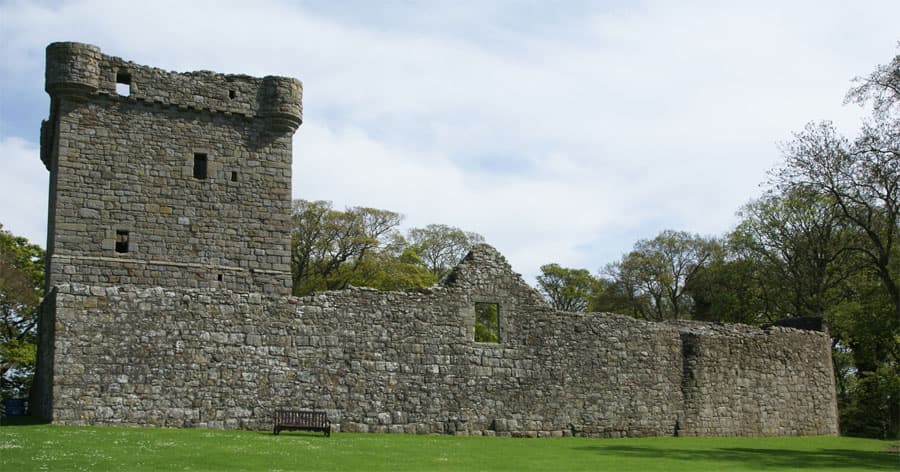
Loch Leven Castle
Loch Leven Castle stands as a striking ruined fortress on an island in Loch Leven, near Kinross in Scotland. Constructed around 1300, this late medieval hill castle played a significant role in Scottish history, particularly during the Wars of Scottish Independence (1296–1357). Its strategic location on an island made it a formidable defensive site and a secure prison for high-profile captives.
Historical significance and ownership
The castle’s history is deeply intertwined with Scotland’s turbulent medieval period. Initially held by English forces at the outbreak of the Wars of Independence, it was later captured by the Scots, with tradition crediting William Wallace for its seizure. In 1390, King Robert II granted Loch Leven Castle to Sir Henry Douglas, marking the beginning of nearly three centuries of Douglas family stewardship. This period saw the castle serve primarily as a state prison, housing notable prisoners such as Archibald Douglas, 5th Earl of Douglas, and Archbishop Patrick Graham.
The castle’s most famous prisoner was undoubtedly Mary, Queen of Scots, who was confined here from 1567 to 1568 after her defeat at the Battle of Carberry Hill. During her captivity, she resided mainly in the Glassin Tower, endured a miscarriage, and was coerced into abdicating the throne in favor of her infant son, James VI. Her dramatic escape in May 1568, aided by members of the Douglas family, remains one of the castle’s most compelling stories.
After Mary’s imprisonment, the castle’s importance waned. In 1588, the castle’s owner inherited the Earldom of Morton and relocated, leading to the castle’s decline as a residence. The property was purchased in 1675 by Sir William Bruce, a royal architect who incorporated the ruins into the gardens of his nearby Kinross House. Since then, Loch Leven Castle ceased to function as a dwelling and gradually fell into ruin.
Architectural features and layout
The castle originally occupied nearly the entire Castle Island, which was later expanded and landscaped in the early 19th century when the water level of Loch Leven was lowered due to canalization of the River Leven’s outflow. The layout consists of a roughly rectangular courtyard enclosed by a defensive curtain wall.
Prominently situated at the western corner is a five-storey tower house or keep, measuring approximately 36.5 feet by 31.5 feet. This tower features a spiral staircase embedded in the main wall, connecting its five floors. The basement and kitchen occupied the vaulted lower levels, while the great hall and private chambers were located above. Although the original roof and wooden floors have not survived, the remaining structure reveals the castle’s vertical organization and defensive capabilities.
On the southeast corner of the curtain wall stands the Glassin Tower, constructed around 1550. This distinctive round tower was designed to provide additional living space and to strengthen the castle’s defenses. It includes gunholes for firing upon approaching enemies and a vaulted basement designed to collect and store water, with channels to draw water from the loch and to dispose of waste. The tower’s lower chamber features an oriel window overlooking the water, while the upper chamber likely served as a bedroom. A small chamber at the top, accessible only from the wall walk, may have functioned as a private study or library.
Excavations in 1995 uncovered the stone base and steps of a stairway leading to the tower’s Great Hall, along with 16th-century pottery and animal bones, offering insights into the castle’s occupation during Mary’s imprisonment.
Defensive structures and outer court
Beyond the main courtyard, remnants of an outer court include an earth bank marking the former walls and traces of a bakehouse. These ruins indicate the larger complex that supported the castle’s defensive and domestic functions. The castle’s position on an island, surrounded by water, added a natural layer of defense, making direct assaults challenging.
Later history and conservation
Following its decline as a noble residence, Loch Leven Castle fell into ruin during the 18th century. In 1840, conservation efforts began with the clearing of debris and rubbish. The estate passed through several families, including the Bruces, Grahams, and Montgomerys, before the castle was placed under state care in 1939.
Today, managed by Historic Environment Scotland, Loch Leven Castle is a popular heritage site. Visitors can reach the island by a small ferry operating from Kinross during the summer months. The ruins offer a tangible connection to Scotland’s medieval past and the dramatic events surrounding Mary, Queen of Scots.
Visitor experience and significance
Exploring Loch Leven Castle provides a unique opportunity to walk through a well-preserved late medieval fortress with significant historical associations. The combination of its island setting, imposing tower house, and the Glassin Tower’s distinctive architecture creates a captivating atmosphere. Interpretive displays and guided tours enhance understanding of the castle’s role in Scottish history, particularly its function as a prison and its connection to royal intrigue.
The castle’s preservation as a ruin allows visitors to appreciate the medieval construction techniques, defensive innovations, and domestic arrangements of a Scottish stronghold. Its cultural significance is underscored by its association with major historical figures and events, making it a key destination for those interested in Scotland’s heritage.
Frequently asked questions (FAQ)
- How do I get to Loch Leven Castle?
- Loch Leven Castle is located on an island in Loch Leven, Kinross, Scotland. You can reach the castle by taking a short boat trip from the Loch Leven Heritage Trail, which operates regularly during the tourist season.
- What is the historical significance of Loch Leven Castle?
- Loch Leven Castle is renowned for its role in the imprisonment of Mary, Queen of Scots, in the late 16th century. The castle's rich history and connection to Scottish royalty make it an important site for understanding the country's past.
- When was Loch Leven Castle built?
- Loch Leven Castle dates back to the 13th century, with significant renovations occurring in the following centuries. Its strategic location and robust architecture helped it serve as both a royal residence and a fortress throughout its history.
- Can I visit Loch Leven Castle year-round?
- Loch Leven Castle is typically open to visitors from April to October, with operating hours varying by season. It's best to check the official website or local tourist information for the most current visiting hours and any seasonal closures.
- Why is the architecture of Loch Leven Castle unique?
- The castle features a distinctive design with its circular layout and robust stone walls, typical of medieval Scottish fortifications. Its well-preserved structures, including the impressive tower house, offer visitors a glimpse into the architectural styles of the period.
- Is it possible to access Loch Leven Castle for those with mobility issues?
- While Loch Leven Castle is a historic site with some natural terrain, the boat trip to the island is accessible. However, once on the island, some areas may be challenging to navigate due to uneven ground and steps, so it's recommended to check accessibility options in advance.
- What is the best time to visit Loch Leven Castle?
- The best time to visit Loch Leven Castle is during the warmer months, from late spring to early autumn, when the weather is pleasant and the boat services are fully operational. Visiting during these months also allows you to enjoy the surrounding natural beauty and scenic views of the loch.
- Are there any nearby attractions to explore after visiting Loch Leven Castle?
- Yes, nearby attractions include the scenic Loch Leven Heritage Trail, which offers walking and cycling paths around the loch, as well as the picturesque town of Kinross. Additionally, you can visit the Kinross House and the local wildlife at the Loch Leven Nature Reserve.
- What are the ticket prices for Loch Leven Castle?
- Ticket prices for Loch Leven Castle vary depending on age and concession categories, with discounts available for families and groups. It's advisable to check the official website for the most current pricing and any special offers.
Photo gallery

Information
Website
Visit websiteSources & official resources
Verify the information above using these authoritative references.
Loading map...
Visitor reviews
No reviews yet. Been here? Write the first review and help other travelers!
Write the first reviewVisited this castle? Share your experience
Your review helps other travelers and adds first-hand knowledge to our encyclopedia.



