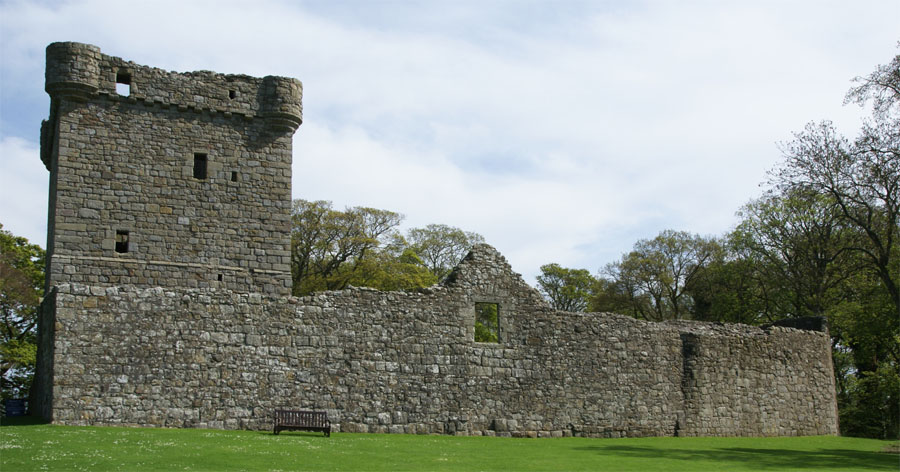
Burleigh Castle
Burleigh Castle, located just outside the village of Milnathort in Scotland, is a remarkable example of a late medieval Scottish tower house with significant architectural features dating primarily from the 15th and 16th centuries. The castle stands beside the modern A911 road, opposite a 19th-century steading that has been converted into housing. Its history is closely tied to the prominent Balfour family, who held the lands from the mid-15th century following a grant by King James II to John Balfour of Balgarvie.
The original core of Burleigh Castle was constructed in the late 15th or early 16th century as a tower house, a common fortified residence type in Scotland during this period. This tower house formed the nucleus of a square courtyard or barmkin, a defensive enclosure typical of Scottish castles designed to protect inhabitants and livestock. The castle’s layout and surviving structures illustrate the evolution of Scottish domestic and defensive architecture through the turbulent late medieval and early modern periods.
Historical background and ownership
The lands of Burleigh were granted by James II around 1456 to John Balfour of Balgarvie, who established the original tower house. The Balfour family maintained possession for several centuries and played notable roles in Scottish political and social history. In the late 16th century, Sir James Balfour of Pittendreich undertook major expansions and enhancements, reflecting both the family's rising status and the changing needs for defense and residence.
During Sir James's tenure, the castle was transformed with the addition of a curtain wall, a corner tower, and various outbuildings. These additions embodied the Scottish baronial architectural style and incorporated defensive features such as gun loops and pistol-holes, which were both functional and ornamental. The castle also served as a royal residence at times, with visits from Mary of Guise in 1540 and multiple visits by James VI of Scotland between 1587 and 1596, underscoring its regional importance.
The castle's history includes episodes of intrigue and conflict. In 1592, Colonel William Stewart was imprisoned here on suspicion of conspiracy against King James VI. The Balfour family's prominence continued into the early 17th century when Michael Balfour was ennobled as Lord Balfour of Burleigh in 1607, following an act that increased his wealth through arms sales.
The 18th century was marked by turmoil for the Balfours. Robert Balfour, 5th Lord Balfour of Burleigh, was condemned to death for murder in 1707 but escaped and later participated in the Jacobite uprising of 1715. After the rebellion's failure, his estates were confiscated, and he lived the rest of his life in exile until his death in 1757. Subsequently, ownership passed to the Irwins and later the Grahams of Kinross.
Architectural features and layout
The original tower house
The surviving remains of the original tower house are located in the northwest corner of the castle's former square courtyard. This tower rises to three stories plus a garret and features walls approximately 1.5 meters thick. The walls ascend to corbels that once supported a parapet walk—a defensive walkway along the top of the walls. Although the roof and internal floors have not survived, the vaulted basement remains intact, providing insight into the castle’s original defensive and domestic arrangements.
A turnpike stair in the northeast corner of the tower originally led to a small cap-house, which gave access to the parapet walk. This stair design was typical of Scottish tower houses, allowing defenders to move vertically within the structure while maintaining a compact footprint.
The 16th-century corner tower
To the southwest of the main tower stands the well-preserved 16th-century corner tower, which rises two stories above a basement and retains its original roof. The tower’s base is round but transitions to a square upper story through corbelling, a characteristic feature of the Scottish baronial style. This architectural technique allowed for more spacious upper chambers while maintaining a strong, defensible base.
The corner tower is notable for its excellent preservation and fine masonry. It features gun loops around the base, designed for defensive firing positions. Near the cap-house level, small round pistol-holes are present, which likely served a decorative purpose rather than practical defense. An inscription on the north gable bears the date 1582 alongside the initials IB and MB, commemorating Sir James Balfour and his wife Margaret, directly linking this tower to their period of ownership and construction.
Curtain wall and gatehouse
The two towers are connected by a section of curtain wall pierced by an arched gateway. Though now only a thin "skin" of masonry, this wall once formed the front of a two-story gatehouse. Architectural details such as a string-course, a hood-mould over the gateway, and a moulded surround that formerly contained a heraldic panel remain visible. These elements highlight the refined craftsmanship and architectural sophistication of late 16th-century Scottish castle design.
There is historical evidence suggesting that a defensive moat may have once surrounded the barmkin, adding an additional layer of protection to the castle’s enclosure. Defensive features such as gun loops and arrow slits are visible in the surviving masonry, indicating the castle’s role as a fortified noble residence during a period of frequent conflict.
Cultural significance and legacy
Burleigh Castle’s history is intertwined with Scotland’s political and social changes from the late medieval period through the early modern era. Its architectural features demonstrate the transition from purely military fortifications to residences that balanced defense with domestic comfort and status display.
The castle also inspired cultural works, notably the local poet Michael Bruce, who wrote the 1760 poem "The Lovers," drawing on stories of feuding families connected to Burleigh Castle and the nearby Arnot Tower. This connection highlights the castle’s place in the cultural memory of the region.
Today, the castle remains a significant historical monument. Its ruins offer valuable insights into Scottish baronial architecture, late medieval defensive design, and the social history of the Balfour family and their role in Scotland’s past. The site is accessible to visitors interested in Scotland’s rich heritage and architectural history.
Frequently asked questions (FAQ)
- How do I get to Burleigh Castle?
- Burleigh Castle is located in Milnathort, United Kingdom, and can be accessed via the A91 road. If traveling by public transport, the nearest train station is in Kinross, with bus services connecting to Milnathort.
- What is the historical significance of Burleigh Castle?
- Burleigh Castle dates back to the 16th century and is an excellent example of Scottish castle architecture. It played a crucial role in the region's history, serving as a residence for the influential Ruthven family.
- When was Burleigh Castle built?
- Burleigh Castle was constructed in the late 1500s, around 1560. It was built as a defensive structure and reflects the architectural style of the time.
- Can I visit Burleigh Castle?
- Yes, Burleigh Castle is open to the public for tours and exploration. Visitors are encouraged to check the official website for any special events or guided tour options.
- Why is Burleigh Castle a popular tourist attraction?
- Burleigh Castle attracts visitors for its rich history, stunning architecture, and picturesque surroundings. The castle offers a glimpse into Scotland's past and is a perfect spot for photography enthusiasts.
- Is it possible to explore the interiors of Burleigh Castle?
- While some areas of Burleigh Castle may be accessible, many parts remain private. Visitors can enjoy guided tours that provide insights into the castle's history and architecture.
- What are the opening hours for Burleigh Castle?
- Burleigh Castle typically opens from 10 AM to 5 PM during the tourist season, but it’s recommended to check in advance for any seasonal changes in hours. The castle may have reduced hours during the winter months.
- What are the ticket prices for visiting Burleigh Castle?
- Ticket prices for Burleigh Castle are generally reasonable, with discounts available for children and seniors. It's best to visit the official website or contact the castle for the most current pricing information.
- When is the best time to visit Burleigh Castle?
- The best time to visit Burleigh Castle is during the spring and summer months when the weather is pleasant and the gardens are in full bloom. However, visiting in the autumn can also provide beautiful scenery with the changing leaves.
- Are there any nearby attractions to Burleigh Castle?
- Yes, there are several nearby attractions, including the picturesque Kinross House and Loch Leven. The area also offers beautiful walking trails and opportunities for bird watching around the loch.
Information
Website
Visit websiteSources & official resources
Verify the information above using these authoritative references.
Loading map...
Visitor reviews
No reviews yet. Been here? Write the first review and help other travelers!
Write the first reviewVisited this castle? Share your experience
Your review helps other travelers and adds first-hand knowledge to our encyclopedia.