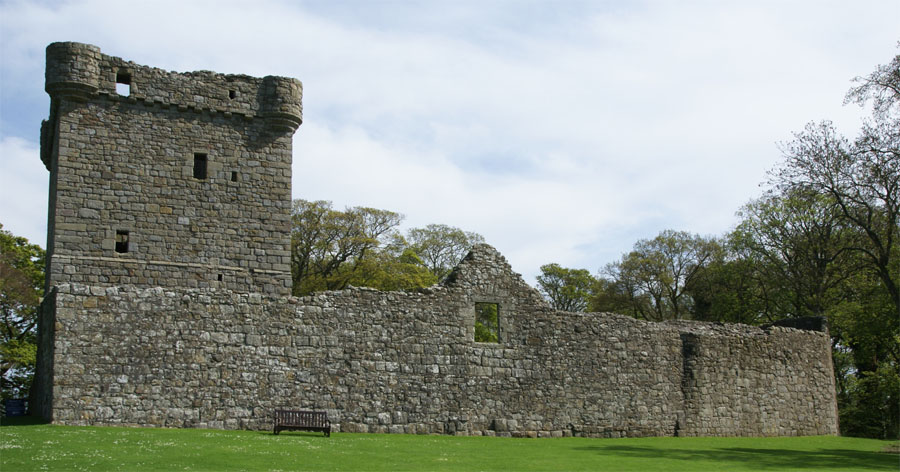
Cleish Castle
Cleish Castle is a prominent example of a 16th-century Renaissance tower house located in Kinross-shire, Scotland. Originally constructed by the Colville family, who held the estate from the early 16th century until 1775, the castle reflects the architectural and historical developments of its era. The Colvilles' connection to Cleish began in 1537, when Robert Colville inherited the barony from his father, Sir James Colville of Easter Wemyss. This marked the start of the castle’s significance as a noble residence and local power base.
Architectural evolution and features
The core structure of Cleish Castle is a classic tower house, a fortified residence typical of the Scottish Renaissance period. The original construction dates to the 16th century, with the building characterized by robust stone walls, narrow windows for defense, and a vertical emphasis common to tower houses of the time. Around the early 17th century, the castle was extended and heightened, as indicated by the upper dormers bearing the date 1600. These additions enhanced its stature and provided more living space, reflecting the transition from purely defensive needs to more comfortable noble living.
The castle’s design incorporates traditional elements such as battlemented parapets, crow-stepped gables, and a central tower keep. The structure was originally designed for defense but also as a symbol of status and authority within the region. Its location in Kinross-shire situates it within a landscape rich in Scottish history and aristocratic estates.
Historical context and ownership
The Colville family, notable Scottish nobility, were the castle’s original owners. Robert Colville’s son, John Colville, is a historically significant figure associated with Cleish Castle. John was involved in the Ruthven Raid, a 1582 political conspiracy against King James VI, and later participated in an attack on Holyroodhouse alongside Francis Stewart, 5th Earl of Bothwell. These events link Cleish Castle to the turbulent political intrigues of late 16th-century Scotland.
In 1775, the castle passed from the Colvilles to the Graham family of Kinross, who owned it for approximately two decades before selling it to the Young family. By the early 19th century, the castle had fallen into disrepair and was largely derelict before 1840.
19th and 20th century restorations
The castle underwent significant restoration and remodeling during the mid-19th century, embracing the Scots baronial style, a revivalist architectural movement that romanticized medieval Scottish castles with features like turrets, battlements, and ornamental stonework. The renowned Edinburgh architect John Lessels led the restoration and designed additions around 1870, which expanded the castle’s footprint and enhanced its historic character.
Further remodeling took place in the 1970s, although much of the later 19th-century additions were removed in the 1990s to restore a more authentic appearance. In 2001, the western extension was replaced, reflecting ongoing efforts to preserve the castle’s historical integrity while adapting it for modern use.
Current status and cultural significance
Today, Cleish Castle remains a private residence and is protected as a category A listed building, recognizing its national architectural and historical importance. The castle’s grounds are also included in the Inventory of Gardens and Designed Landscapes in Scotland, highlighting the significance of its surrounding landscape and gardens in the context of Scottish heritage.
The castle stands as a testament to the evolution of Scottish noble residences from fortified tower houses to romanticized historic homes. Its layered history, architectural transformations, and connections to notable historical figures make it a valuable site for understanding Scotland’s Renaissance period and beyond.
Architectural highlights
- 16th-century tower house core with defensive features
- Early 17th-century extensions and upper dormers dated 1600
- Scots baronial style restoration by John Lessels in the 19th century
- Stone battlements, crow-stepped gables, and turrets
- Multiple restoration phases in the 19th and 20th centuries preserving historical character
Visiting and accessibility
As a private residence, Cleish Castle is not generally open to the public. However, its status as a listed building and inclusion of its grounds in the national inventory underscore its cultural value. The surrounding area of Kinross offers other historic sites and natural attractions for visitors interested in Scottish history and landscapes.
Frequently asked questions (FAQ)
- Can I visit Cleish Castle?
- Cleish Castle is a private residence and is not generally open to the public. Visitors can appreciate its exterior and the surrounding landscape from public areas nearby.
- When was Cleish Castle originally built?
- Cleish Castle was originally built in the 16th century by the Colville family, with significant extensions added around 1600.
- What architectural style is Cleish Castle?
- The castle features a 16th-century Renaissance tower house core with later restorations in the Scots baronial style by architect John Lessels in the 19th century.
- Who was John Colville and what is his connection to Cleish Castle?
- John Colville was the son of Robert Colville and a notable historical figure who took part in the Ruthven Raid and an attack on Holyroodhouse, linking the castle to significant political events in 16th-century Scotland.
- Is Cleish Castle protected as a historic building?
- Yes, Cleish Castle is a category A listed building, recognizing its national importance and ensuring its preservation.
Information
Architect
John Lessels
Current owner
Private owner
Loading map...
Visitor reviews
No reviews yet. Been here? Write the first review and help other travelers!
Write the first reviewVisited this castle? Share your experience
Your review helps other travelers and adds first-hand knowledge to our encyclopedia.