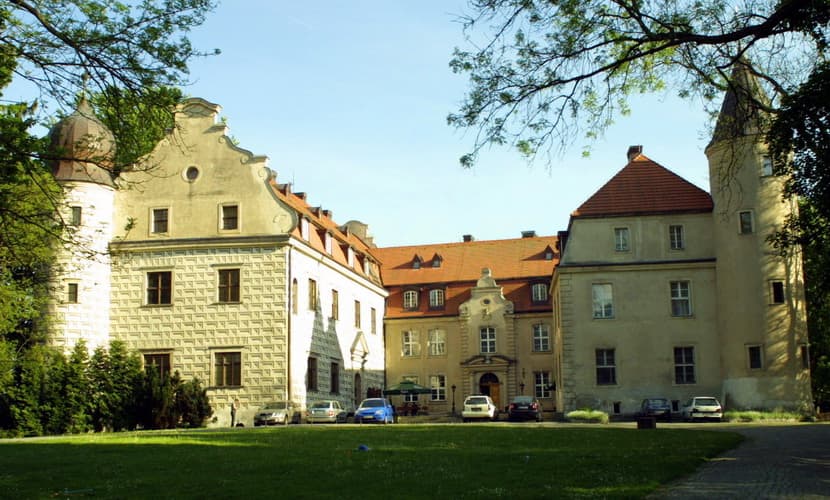
Tuczno
Tuczno Castle stands as a remarkable example of a late medieval bastioned fortress located in the town of Tuczno, Poland. Its origins possibly date back to the 10th century when a fishing settlement existed in the area, with some hypotheses suggesting a 12th-century castellany. However, the castle itself was constructed around 1300 by the noble family von Wedel, who received the land as a fief from the Ascanian margraves of Brandenburg. This fortress became the Wedel family's main seat for almost 400 years, reflecting the turbulent history and shifting political landscape of the region.
The castle was strategically situated between two lakes, Tuczno and Zamkowe, on a natural elevation surrounded by water and marshes on three sides, enhancing its defensive capabilities. It was built on what is known as a "raw root" site, meaning there was no prior fortification at the location despite some German literature mentioning an earlier "stone house" dating back to 1130, a claim not supported by archaeological evidence. The fortress's trapezoidal plan, measuring approximately 39 by 36 by 35 by 28 meters, featured a perimeter wall strengthened at the corners by massive buttresses and a northern gatehouse.
Architectural evolution and defensive features
The original castle, erected by Ludek von Wedel, was primarily a defensive stronghold with a robust curtain wall and a residential building along the eastern wall, measuring 35 by 13 meters. The steep slopes of the hill and the surrounding lakes and marshes formed a natural moat, making the castle difficult to assault. Over time, the castle's fortifications were adapted to meet evolving military needs.
Renaissance transformation
Between 1542 and 1581, Stanisław Wedel undertook significant renovations, replacing the Gothic eastern wing with a new three-story Renaissance building featuring two corner towers. This structure was richly decorated with carved stone portals, window frames, and fireplaces, while the facades were adorned with geometric sgraffito decorations. Despite these changes, the castle retained the Gothic courtyard layout enclosed by a 7-meter-high wall.
Baroque modifications
Further expansions occurred from 1608 to 1631 under Krzysztof Wedel-Tuszyński, who added southern and western residential wings and a third tower in the northwest corner to maintain symmetry. In the 17th century, the last segment of the Gothic defensive wall was demolished, stripping the castle of its military function and converting it into a Baroque palace residence. The southern wing received a new Baroque facade with a decorated main entrance portal, and other facades were similarly enhanced. The eastern wing was plastered, which unfortunately led to the loss of the original sgraffito decorations, and it was topped with a mansard roof.
Historical significance and ownership changes
Tuczno Castle's location on the border between the New March of Brandenburg and Poland gave it significant strategic importance. In 1368, the Wedel family became vassals of the Polish king Kazimierz Wielki, and the castle was incorporated into the Greater Poland voivodeship. The family's gradual Polonization was reflected in the addition of the name "Tuczyński" to their surname.
The castle played a key role during the conflicts between Poland and the Teutonic Order in the late 14th and early 15th centuries. It served as a northern defensive outpost and a base for raids on the corridor linking the Teutonic lands with Brandenburg and Western Europe. Despite attacks and partial destruction during the 1409 war and the Thirteen Years’ War (1454–1466), the castle was rebuilt and fortified again.
After the death of Andrzej Wedel-Tuczyński in 1717, the castle left the Wedel family and was divided among numerous heirs. Subsequent owners neglected the property, leading to its decline.
Modern history and restoration efforts
Following the partitions of Poland, Tuczno fell under Prussian control. In 1846, the western wing was demolished and replaced with a new structure, and the northwest tower was rebuilt with an additional floor. By the early 20th century, the castle had suffered considerable damage and was repurposed as a hospital.
During World War II, the castle sustained partial damage in battles on the Pomeranian Wall. After the war, it was briefly inhabited but a fire in 1947 left it in ruins. Archaeological excavations and stabilization efforts began in the late 1950s, revealing much about the castle’s history and architectural transformations.
From 1966 to 1976, a major restoration project restored Tuczno Castle to its pre-1846 appearance. The southern and western wings were rebuilt in Baroque style, while the eastern wing was restored in Renaissance style, including reconstruction of the sgraffito decorations discovered on the southeast tower.
Current use and cultural importance
Today, Tuczno Castle is managed by the Association of Polish Architects and functions as a conference and training center. Its rich architectural layers and historical significance make it an important cultural landmark in the region, attracting visitors interested in medieval fortifications, Renaissance and Baroque architecture, and Polish history.
The castle’s blend of natural defensive features, architectural evolution, and historical events exemplifies the complex heritage of borderland fortresses in Central Europe. Its preservation and adaptive reuse demonstrate the value placed on cultural monuments that connect modern Poland with its medieval past.
Frequently asked questions (FAQ)
- What is the historical significance of Tuczno Castle?
- Tuczno Castle, located in Poland, dates back to the 14th century and played a crucial role in the region's defense against invasions. Its rich history reflects the architectural and cultural evolution of the area, showcasing influences from various periods, including Gothic and Renaissance styles.
- When was Tuczno Castle built?
- Tuczno Castle was constructed in the early 14th century, specifically around 1340. It served as a fortified residence for local nobility and has witnessed numerous historical events throughout the centuries.
- What are the opening hours for Tuczno Castle?
- Tuczno Castle is generally open to visitors from April to October, with hours varying by day. It is advisable to check the official website for the most accurate and up-to-date information before planning your visit.
- Can I take guided tours of Tuczno Castle?
- Yes, guided tours are available at Tuczno Castle, providing visitors with insights into its history and architecture. Tour guides are knowledgeable and can enhance your experience by sharing fascinating stories about the castle and its past.
- Is it possible to access Tuczno Castle with limited mobility?
- Accessibility at Tuczno Castle may be challenging due to its historical structure and terrain. However, efforts are made to accommodate visitors with limited mobility, so it is recommended to contact the castle administration in advance to discuss specific needs.
- What is the best time to visit Tuczno Castle?
- The best time to visit Tuczno Castle is during the late spring and summer months when the weather is pleasant and the surrounding gardens are in full bloom. This season also offers various events and activities that enhance the visitor experience.
- Are there any nearby attractions to visit while at Tuczno Castle?
- Yes, there are several nearby attractions, including the beautiful landscapes of the Tuczno Lake and the charming local village. Visitors can also explore other historical sites in the vicinity, making it a great opportunity for a full day of exploration.
- What are the ticket prices for Tuczno Castle?
- Ticket prices for Tuczno Castle vary depending on the type of tour and age group. Generally, there are discounts for children, students, and seniors, so it's a good idea to check the ticketing information on their official website before your visit.
Photo gallery

Information
Loading map...
Visitor reviews
No reviews yet. Been here? Write the first review and help other travelers!
Write the first reviewVisited this castle? Share your experience
Your review helps other travelers and adds first-hand knowledge to our encyclopedia.



