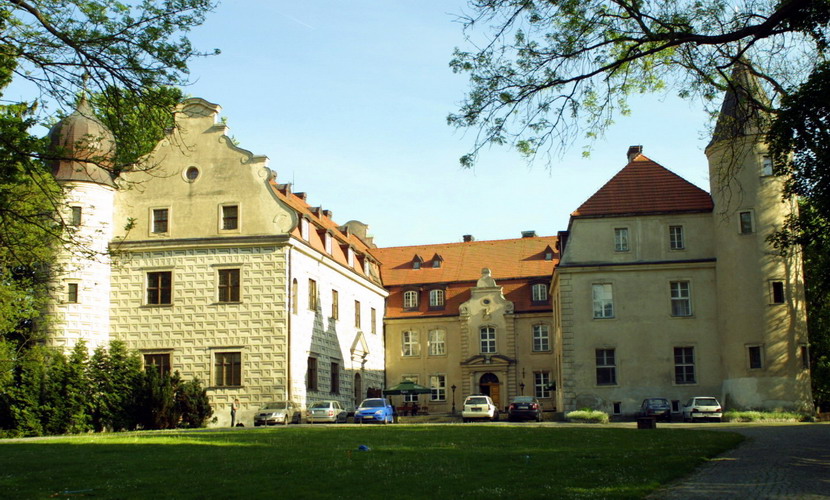
Drawno Castle
Drawno Castle stands as a significant historical monument in Drawno, Poland, embodying the complex history of territorial conflicts and noble family legacies in the region. Constructed originally in the early 14th century on an artificially elevated peninsula by Lake Dubie, the castle was built by the noble Wedel family, who were granted lands by the Margraves of Brandenburg after their expansion east of the Oder River. This strategic location not only served as the Wedels' ancestral seat but also guarded an important ford on the Drawa River, which was part of a vital trade route leading to Malbork.
The castle's origins likely trace back to a defensive stronghold from the 10th century, repurposed and expanded in the early 1300s. The main residential building, positioned at the highest point of the hill, is a rectangular brick structure measuring approximately 15 by 28.7 meters, resting on a foundation of fieldstones. It comprises three stories, with massive buttresses reinforcing its corners. The facades are decorated with zendrówka brickwork and shield-shaped blind windows on the gables, reflecting the Gothic architectural style prevalent at the time. Defensive features include a windowless ground floor and narrow arrow slits on the first floor, designed for protection during sieges.
Architectural and defensive features
The castle is fortified naturally by the steep seven-meter slopes of the hill and a surrounding dry moat, enhancing its defensive capability. Access to the castle was controlled via a ramp leading to the gate located at the northeastern corner. To the west of the main castle, there are two successive outer baileys, each enclosed by its own walls and ascending towards the main structure. These elements highlight the castle's function as both a noble residence and a military stronghold.
Drawno Castle was integrated with the town's fortifications, which included walls approximately 6 to 7 meters high, several towers, and three main gates: the Stone Gate, the New Gate, and the Polish Gate. The castle connected to the town's defenses on the northwest side, and a narrow passage linked it to the Polish Gate on the southeast, demonstrating a well-planned defensive system combining urban and castle fortifications.
Historical context and ownership
The settlement around the castle grew into a town, likely receiving municipal rights between 1313 and 1333. In 1326, the region suffered a raid by forces allied with Władysław Łokietek, resulting in damage to Wedel properties, which likely prompted the construction of the town walls. The castle itself experienced occupation by the Teutonic Knights in the early 15th century, reflecting the turbulent political landscape of the time. In 1478, the castle was retaken by Elector Albrecht Achilles, restoring Brandenburg control.
In 1556, the Wedel estate was divided among family members, with Drawno passing to Rüdiger von Wedel, under whose rule the town prospered. However, after his death in 1592, the estate fragmented, leading to the castle's gradual decline exacerbated by fires, wars, and legal disputes.
Renaissance transformation and decline
A significant Renaissance-era reconstruction around 1600 altered the castle's Gothic character. While the main building's footprint remained unchanged, new large windows were installed on the upper floors, and a new entrance was created on the eastern facade. The roofline was adorned with three decorative gables, and the shorter north and south facades were similarly enhanced, reflecting Renaissance aesthetic preferences and a shift towards comfort and status display alongside defense.
Despite these renovations, the castle's fortunes waned in the 17th century. It suffered severe damage during the retreat of Swedish forces in 1675, including the collapse of the northern gable in 1691. Further devastation occurred during the Seven Years' War when Russian artillery bombardment in 1758 left the castle in ruins. Today, only two eastern corner sections of the main residential building remain, reaching up to 12 meters in height, serving as silent witnesses to the castle's storied past.
Legacy and cultural significance
Drawno Castle's ruins offer valuable insights into the architectural evolution from medieval fortification to Renaissance residence. Its strategic location and integration with the town's defenses illustrate the military and administrative importance of such castles in the borderlands of Brandenburg and Poland. The castle's connection to the Wedel family, a prominent noble house, enriches its historical narrative, reflecting broader regional dynamics of power, warfare, and noble patronage.
Today, the site attracts historians, architects, and visitors interested in medieval and Renaissance military architecture, as well as those exploring the complex history of Pomerania and Brandenburg's eastern expansion. Preservation efforts focus on stabilizing the remaining structures and interpreting the castle's layered history for educational and cultural purposes.
Frequently asked questions (FAQ)
- When was Drawno Castle originally built?
- Drawno Castle was originally constructed in the early 14th century, with its first recorded mention in 1421.
- What architectural styles are represented in Drawno Castle?
- Drawno Castle primarily exhibits Gothic architecture with Renaissance modifications made around 1600.
- What caused the decline of Drawno Castle?
- The castle declined due to damage from wars, including Swedish and Russian attacks, fires, and fragmentation of the Wedel estate.
- Is it possible to visit the ruins of Drawno Castle today?
- Yes, visitors can explore the ruins of Drawno Castle, which remain as tall eastern corner sections of the main building.
- How was Drawno Castle integrated with the town's defenses?
- The castle was connected to Drawno's town walls, which included towers and gates, forming a combined defensive system.
Information
Loading map...
Visitor reviews
No reviews yet. Been here? Write the first review and help other travelers!
Write the first reviewVisited this castle? Share your experience
Your review helps other travelers and adds first-hand knowledge to our encyclopedia.