Trosky Castle
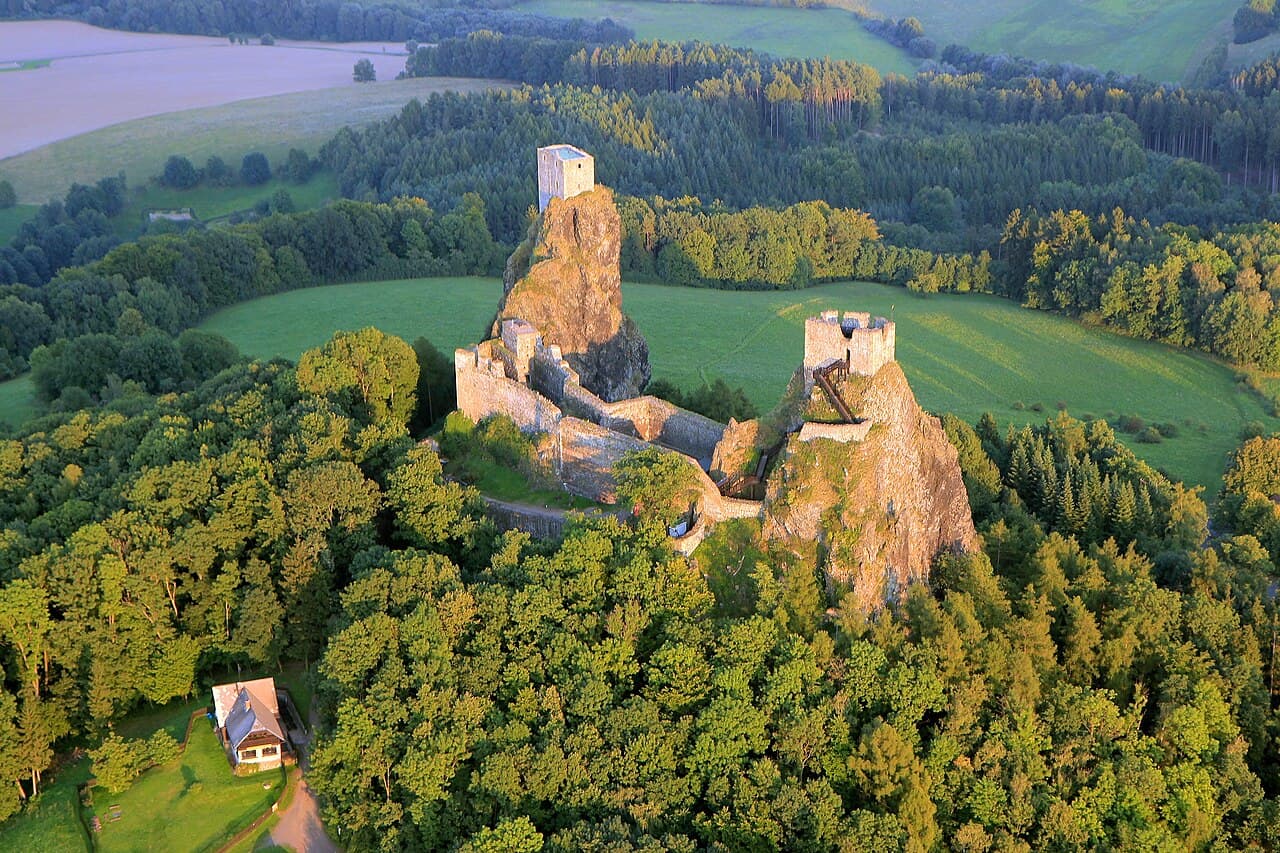
Trosky Castle is an extraordinary medieval fortress uniquely perched atop two prominent basalt volcanic plugs in the Bohemian Paradise region of Czechia. Constructed in the 14th century, this hill castle is renowned for its striking silhouette formed by twin towers named Baba (Crone) and Panna (Maiden), which rise dramatically from the rugged volcanic rock formations. The castle’s dramatic location and distinctive architecture have made it a symbol of the region and a popular destination for visitors interested in medieval history and castle architecture.
The castle was founded by Čeněk of Wartenberg in the latter half of the 14th century. Its construction capitalized on the natural defensive advantages of the volcanic plugs, with two major towers built atop separate peaks—Baba on the lower 47-meter outcrop and Panna on the higher 57-meter peak. Between these towers, a complex of residential buildings, palaces, and defensive structures was erected, all enclosed within three concentric rings of fortified walls. This strategic design provided formidable defense and residential functionality, making Trosky a stronghold of significant military and noble importance during the Late Medieval period.
Historical significance and ownership through the centuries
After its establishment, Trosky Castle passed through various hands, reflecting the turbulent political landscape of medieval Bohemia. Initially owned by Čeněk of Wartenberg, the castle became royal property under King Wenceslaus IV in the early 1390s. It was then acquired by Otto III of Bergau and later passed to his son Otto IV of Bergau, who is infamous for raiding the nearby Opatovice monastery and hiding its treasures within the castle’s underground chambers.
During the Hussite Wars in the 15th century, Trosky served as a staunch pro-Catholic fortress and resisted multiple sieges, including attacks in 1424, 1428, and 1469. Despite its resilience, the castle was eventually captured in 1469 by forces loyal to King George of Poděbrady. Following this period, the castle’s role as a noble residence diminished, and it was managed more as an administrative estate.
The Thirty Years’ War brought further destruction when the castle was burned down by the Imperial Army in 1648. This event marked the beginning of its decline into ruin. Ownership passed through notable noble families, including the Wallenstein family, before being sold in the early 19th century to Jan Lexa of Aehrenthal, who initiated romantic-era restoration efforts, such as the unfinished staircase to the Panna tower.
Today, Trosky Castle is a protected national cultural monument of the Czech Republic, reflecting its importance as a historical, architectural, and geological landmark. It also features in popular culture, notably in the video game Kingdom Come: Deliverance II, set during the early 15th century.
Architectural features and layout
The twin towers: baba and panna
The castle’s most distinctive features are its two towers, each perched on separate volcanic plugs. The Baba tower is a hexagonal, two-storey structure standing 47 meters above the surrounding terrain. Inside, it is divided into four chambers with large windows that maximize natural light. The entrance on the northern side leads into an antechamber, connecting the internal rooms.
The Panna tower, located on the higher 57-meter peak, is a roughly square, four-sided tower. It originally featured a pointed arch entrance on the western side at the first-floor level. The tower was extended eastward over time, with residential quarters on the first floor. Many of the current window shapes are results of 20th-century restoration efforts aimed at stabilizing the structure.
Castle core and fortifications
Between the two towers lies the castle core, which housed two palaces and various residential buildings. The eastern entrance led into this core area, which included a large two-room palace with living quarters on the upper floors. The central courtyard was the highest point of the core, while on the western side, a smaller wooden palace contained rooms including a smithy that remained operational until the 17th century.
The entire complex was protected by three rings of curtain walls, measuring 1.5 to 2 meters thick and up to 15 meters high. The northern forecourt contained economic buildings and a furnace, indicating metallurgical activities close to the main gate. Notably, the castle’s gatehouses were not supplemented by moats or ditches, relying instead on the natural defensive advantage of the volcanic rock formations.
Geological and preservation aspects
The castle’s foundation on two volcanic plugs is a rare geological feature that contributes to its dramatic appearance and defensive strength. The basalt rocks exhibit characteristic columnar jointing, a pattern of vertical cracks formed by cooling lava, and have endured centuries of weathering, including frost damage and erosion.
Restoration efforts in the 20th and 21st centuries have focused on stabilizing the volcanic rock bases and the masonry remains. These efforts have included the installation of staircases and observation platforms, improving visitor access to the Baba and Panna towers. The preservation work ensures that the castle’s ruins remain safe and accessible while maintaining their historical and geological integrity.
Cultural importance and tourism
Trosky Castle is a symbol of the Bohemian Paradise and features prominently in Czech cultural heritage. Its distinctive silhouette is often used in regional branding and tourism promotion. The castle attracts visitors interested in medieval architecture, history, and natural landscapes.
Visitors can explore the ruins, climb the towers, and enjoy panoramic views of the surrounding countryside. The site is equipped with interpretive signage and pathways to enhance the visitor experience. Seasonal events and guided tours further enrich understanding of the castle’s historical context and architectural features.
As a national cultural monument, Trosky Castle is protected under Czech law, ensuring ongoing conservation and responsible tourism management. Its combination of historical significance, unique geology, and scenic beauty make it a must-visit destination for castle enthusiasts and travelers to Czechia.
Frequently asked questions (FAQ)
- How do I get to Trosky Castle?
- Trosky Castle is located near the village of Troskovice in the Liberec Region of Czechia. It is accessible by car and public transport, with parking available nearby and walking paths leading to the castle ruins.
- What is the best time to visit Trosky Castle?
- The best time to visit Trosky Castle is during the late spring to early autumn months when the weather is mild and the surrounding Bohemian Paradise landscape is at its most vibrant.
- Is Trosky Castle wheelchair accessible?
- Due to its rugged terrain and medieval ruin condition, Trosky Castle is not wheelchair accessible. Visitors should be prepared for uneven paths and stairs.
- What are the opening hours and ticket prices?
- Trosky Castle is open daily from 10:00 to 16:00. Tickets cost €5 for adults and €3 for children, with discounts available for groups and seniors.
- Can I climb the towers at Trosky Castle?
- Yes, visitors can climb the stairs installed in the Baba and Panna towers to enjoy panoramic views of the Bohemian Paradise region. Safety measures are in place to ensure a secure visit.
- What is the historical significance of Trosky Castle?
- Trosky Castle is a symbol of medieval Bohemia and played a strategic role during the Hussite Wars as a pro-Catholic fortress. Its unique volcanic rock foundation and twin towers make it an architectural and historical landmark.
Photo gallery

Information
Opening hours
10:00-16:00, daily
Ticket prices
€5 adult, €3 child
Current owner
State museum
Website
Visit websiteSources & official resources
Verify the information above using these authoritative references.
Loading map...
Visitor reviews
No reviews yet. Been here? Write the first review and help other travelers!
Write the first reviewVisited this castle? Share your experience
Your review helps other travelers and adds first-hand knowledge to our encyclopedia.