Kost Castle
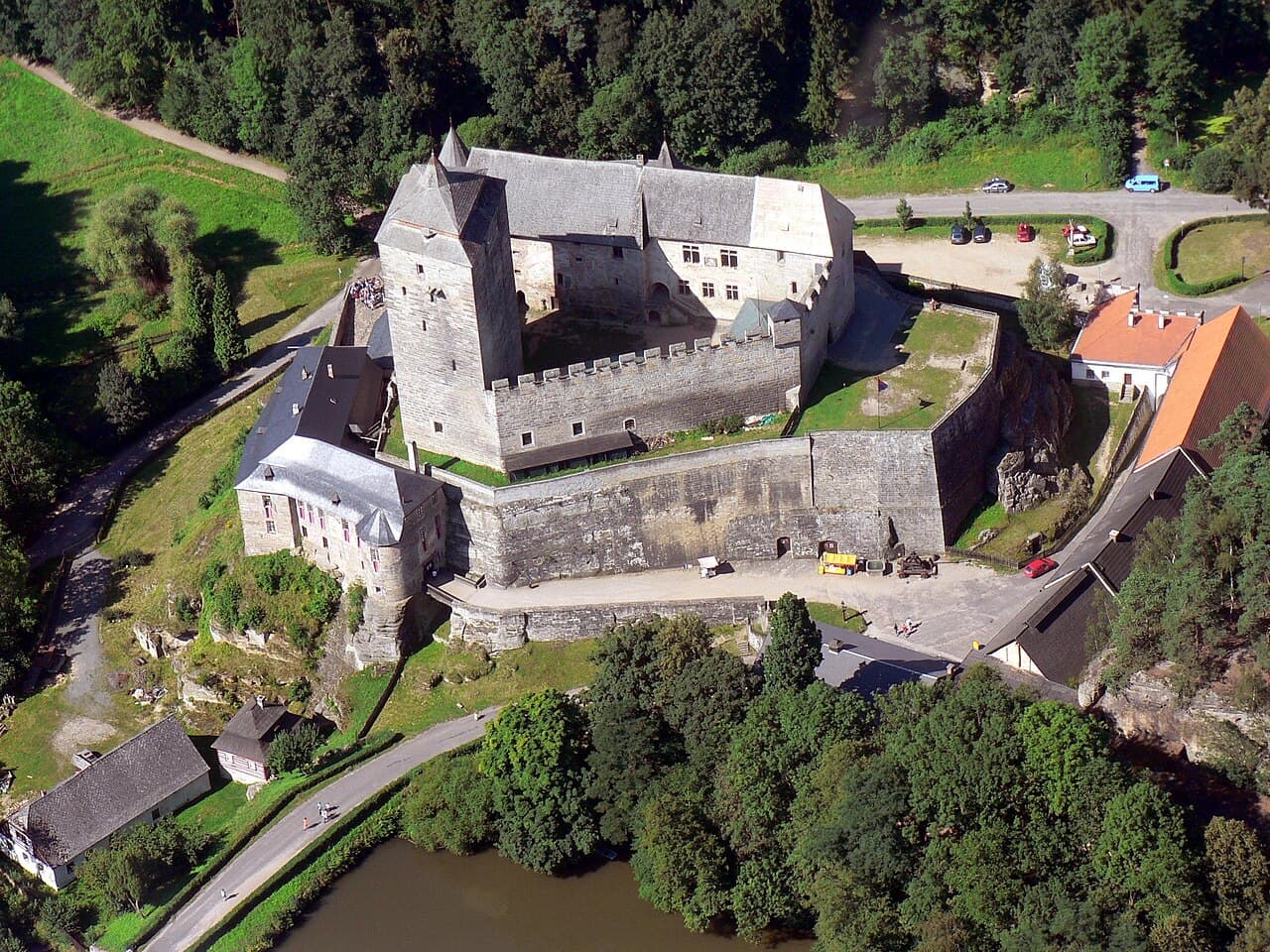
Kost Castle stands as one of the most remarkable Gothic fortresses in the Czech Republic, located near the village of Libošovice. Constructed in the 14th century, it is uniquely positioned not on a hill but on a sandstone promontory between two brooks, offering natural defensive advantages. This strategic location, combined with its distinctive architecture, has allowed Kost Castle to remain exceptionally well preserved, maintaining much of its medieval character and original features.
The castle's origins trace back to Beneš III of Vartenberk, who established Kost as his seat by 1349 after relocating from Sobotka. His son, Peter von Wartenberg, completed the initial construction phase, shaping the fortress into a formidable stronghold. Over the centuries, Kost Castle witnessed various noble families' ownership, including the Zajícové of Hazmburk, Schellenberg, Lobkowicz, and the Kinský dal Borgo family, each contributing to its architectural evolution and historical significance.
Architectural design and defensive features
Kost Castle's layout is dominated by its trapezoidal plan, a rare feature among Bohemian castles. The design was carefully crafted to optimize defense, with the trapezoidal White Tower positioned to deflect attacks. Its corners face the areas most vulnerable to siege engines like catapults, causing missiles to glance off rather than strike directly, minimizing damage. This tower, measuring approximately 17.6 by 14 meters with walls 3.2 meters thick, served both residential and storage purposes, with the lower floors used for grain storage and upper floors as living quarters.
The castle's fortifications include a series of three gates, each equipped with portcullises and drawbridges spanning moats, creating layered defenses. The first gate near the Red Tower—a round corner tower originally housing the castle chapel—leads to the inner courtyard. The second gate is adjacent to a small square tower to the northwest, and the third gate opens directly into the courtyard from the north. These features exemplify the castle's emphasis on security and controlled access.
Additional defensive structures include barbicans on the south, east, and north sides, protecting the castle's approaches. The castle's walls and towers are constructed primarily from local sandstone, showcasing medieval masonry techniques that have stood the test of time.
Historical significance and ownership
Kost Castle played a notable role during the Hussite Wars as a Catholic bastion and refuge for displaced priests. It famously resisted a siege by the Hussite leader Jan Žižka, cementing its reputation as a fortress difficult to conquer. This legacy contributed to the castle's enduring place in Czech history and folklore.
Throughout the 15th and 16th centuries, the castle changed hands among prominent noble families. The Zajícové family maintained it as a principal stronghold until 1497, after which it passed to the Schellenberg and later the Biberštejn family. The latter expanded the residential quarters, reflecting a shift towards greater domestic comfort alongside military functionality.
The Lobkowicz family owned Kost until the late 16th century, after which it gradually declined as a noble residence. In 1637, the Černín family acquired the castle, using it primarily as an administrative center. A significant fire in 1635 during military occupation caused extensive damage, leading to structural deterioration and adaptive reuse of spaces such as converting parts into granaries.
Ownership passed through the Netolický, Vratislav, and finally the Kinský dal Borgo families. The castle was nationalized in 1948 under the communist government and converted into a museum showcasing Gothic and Renaissance art. Following the Velvet Revolution, it was restituted to Giovanni Kinský dal Borgo in 1992, restoring the family's stewardship.
Architectural evolution and interior features
Kost Castle's architectural fabric reflects multiple building phases and stylistic influences. The oldest surviving structure is a square residential tower in the northwest corner, featuring three flat-ceilinged floors and a vaulted cellar. Its upper floor was enhanced in the late 14th century with ornate window frames, indicative of the Gothic style.
The palace wing opposite the White Tower includes the Red Tower, which originally contained the castle chapel before religious functions moved to a larger chapel within the courtyard. This chapel, located in the northeast corner, features a distinctive two-sided rounded apse and was originally covered by a simple wooden ceiling. After 1551, it was remodeled with a vaulted brick ceiling incorporating lunettes, enhancing both its structural integrity and aesthetic appeal.
Additional expansions in the 16th century introduced the Biberštejn Palace between the first and second gates, connected to the older palace by an elevated passage. The Šelmberk Palace in the northern wing included a black kitchen designed for heavy culinary use and an adjacent anteroom, highlighting the castle's evolving domestic functions.
Near the White Tower's base stood a late Gothic building initially housing estate officials, later converted into a carriage shed in 1875. The outer bailey accommodated economic structures such as a brewery and farm buildings, with gates providing access to nearby towns like Sobotka and Turnov. A gate by the White Pond was removed in the mid-19th century and replaced by a statue of St. John of Nepomuk.
Decorative elements include 16th-century sgraffito plasterwork on the Biberštejn Palace and adjacent buildings, reflecting Renaissance artistic influences. Baroque modifications were minimal, limited to a single sala terrena added at the White Tower's base by Albrecht of Wallenstein.
Preservation, restoration, and current status
Kost Castle is currently well preserved and functions as a cultural monument open to the public. It hosts various events and exhibitions that celebrate its rich history and architectural heritage. Recent restoration efforts between 2019 and 2021 focused on stabilizing the castle's foundations, walls, and the underlying sandstone rock, ensuring the longevity of its medieval structures.
Throughout the 20th century, Kost has been the subject of extensive historical and archaeological research, notably by historian Josef Pekař, who documented its economic and social development from the 17th to 19th centuries. These studies have contributed significantly to understanding the castle's role in regional history and its architectural evolution.
Visitors today can explore the castle's unique defensive features, residential quarters, and chapels, gaining insight into medieval life and fortification strategies. Kost Castle remains a testament to the ingenuity and resilience of Bohemian Gothic architecture and noble heritage.
Frequently asked questions (FAQ)
- How do I get to Kost Castle from Prague?
- Kost Castle is approximately 100 kilometers northeast of Prague. Visitors can reach it by car in about 1.5 hours via the D10 motorway and local roads. Public transport options include regional trains and buses to nearby towns such as Turnov, followed by a short taxi or bus ride to the castle.
- What are the opening hours of Kost Castle?
- Kost Castle is generally open to visitors from April to October. Typical opening hours are from 9:00 AM to 5:00 PM daily during the peak season. It is advisable to check the official website or contact the castle directly for the most current visiting hours and any special event schedules.
- Can I take guided tours at Kost Castle?
- Yes, guided tours are available at Kost Castle. These tours provide detailed insights into the castle's history, architecture, and notable events. Booking in advance is recommended, especially during the high tourist season, to ensure availability and a comprehensive experience.
- Is Kost Castle suitable for families with children?
- Kost Castle is family-friendly and offers engaging exhibitions and events that appeal to visitors of all ages. The castle's spacious courtyards and accessible pathways make it suitable for children, though some areas may have limited accessibility due to historical structures.
- What makes Kost Castle architecturally unique?
- Kost Castle is distinguished by its rare trapezoidal White Tower designed to deflect siege attacks, its well-preserved Gothic fortifications, and the layered defense system including portcullises, drawbridges, and barbicans. Its location on a sandstone promontory between brooks also sets it apart from typical hilltop castles.
Photo gallery

Photo by JardaTravnicek•Public domain
Information
Sources & official resources
Verify the information above using these authoritative references.
Loading map...
Visitor reviews
No reviews yet. Been here? Write the first review and help other travelers!
Write the first reviewVisited this castle? Share your experience
Your review helps other travelers and adds first-hand knowledge to our encyclopedia.