Pařez Castle
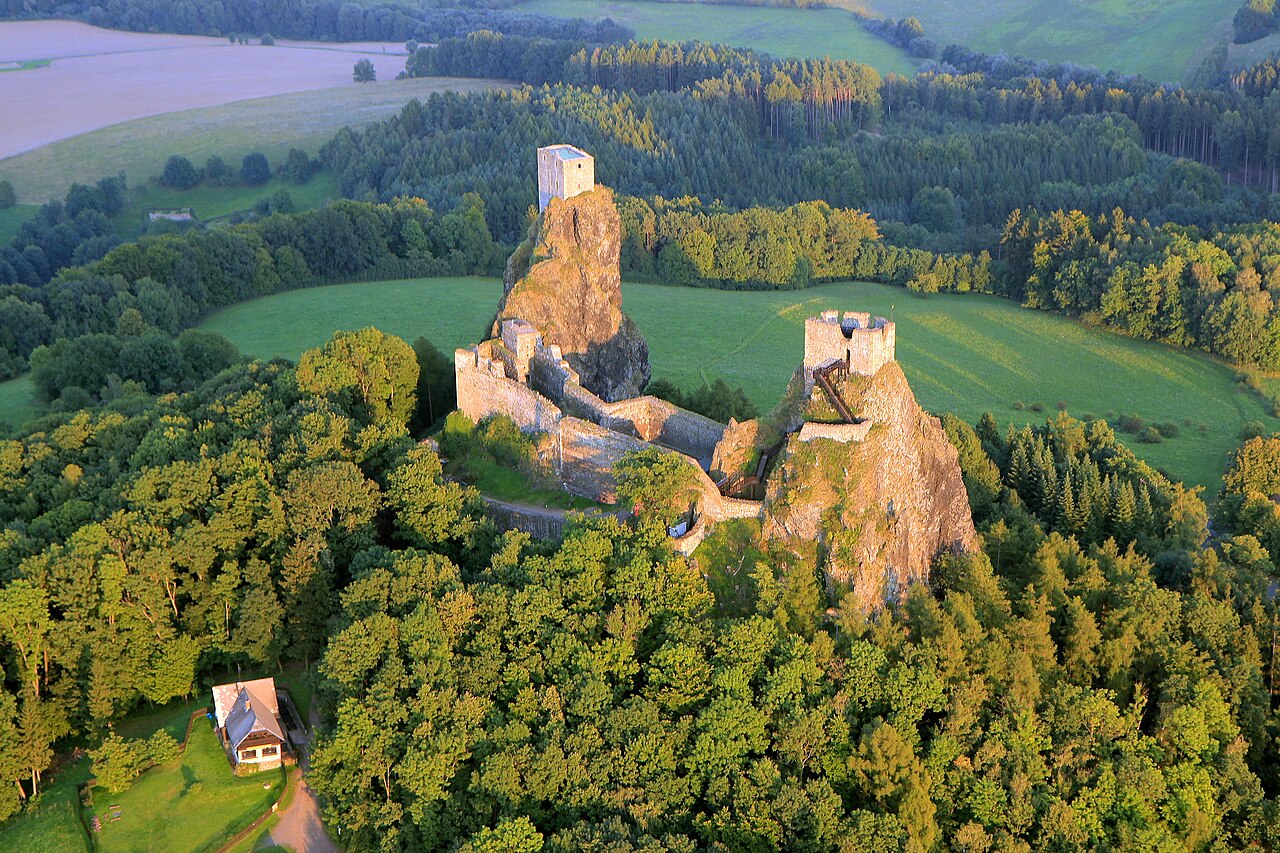
Pařez Castle stands as a compelling example of a medieval hill castle constructed in the late 14th century in the region of Bohemia, now part of the Czech Republic. Situated near the village of Pařezská Lhota, the castle was strategically built atop a solitary sandstone rock formation close to the Prachov Rocks, leveraging the natural steepness and elevation to enhance its defensive capabilities. This choice of location reflects the medieval trend of fortifying sites on naturally defensible terrain, a common practice among Bohemian nobility seeking to assert control and security in a turbulent era.
The earliest recorded mention of Pařez Castle dates to 1403, identifying Jan of Pařez as its owner. Historical evidence suggests that the castle’s founder may have been Petr of Pařez, documented in records from 1372, indicating the noble lineage associated with the site. The Lords of Pařez maintained the castle as a residence and local power center until the early 15th century. The castle’s architecture and layout were adapted to the sandstone rock, with extensive carving to create chambers and vaulted ceilings directly within the stone, showcasing a unique integration of natural and man-made defensive features.
Historical context and destruction
The castle’s history is closely tied to the Hussite Wars, a series of religious and civil conflicts that engulfed Bohemia in the early 15th century. By approximately 1424, Pařez Castle was violently destroyed during these wars, a conclusion supported by archaeological finds such as a stone cannonball discovered at the site, indicating military assault. By 1430, contemporary accounts already described the castle as a ruin. Following its destruction, the remaining structures served variously as a refuge for robbers and later as shelter for impoverished populations, reflecting the shifting social landscape of the region after the castle’s fall.
Architectural features and layout
Integration with sandstone rock
The castle’s core was essentially the sandstone rock itself, which was extensively carved to create functional spaces including small chambers and vaulted ceilings imitated in stone. This technique not only maximized the defensive advantage of the natural formation but also provided sheltered living and storage areas. The top plateau of the rock supported a palace structure, once enclosed by a stone wall. Archaeological evidence reveals foundation grooves with remnants of masonry and mortar, suggesting that the palace featured half-timbered walls typical of the period, though no wooden elements have survived.
Defensive structures and water defenses
Enhancing the natural defenses, the castle planners constructed dams to flood the area surrounding the rock, effectively creating a moat-like barrier that would have impeded attackers. Adjacent to the rock on the west side stands a partially preserved square tower, designed to be accessed by a pedestrian drawbridge. However, the tower’s entrance required complex earthworks or construction solutions, suggesting it may never have been fully operational as intended. This tower would have served as a key defensive and lookout point.
Siege camp and outer defenses
To the east, across a nearby valley, lies an area believed to be associated with a siege camp. This site is bordered by a ditch and an outer rampart, though its connection to the castle remains uncertain due to disturbances from later recreational activities. If related, this area would have played a role during the castle’s siege and eventual destruction.
Archaeological discoveries and artifacts
Excavations conducted in 1972 uncovered a variety of artifacts illuminating the castle’s active period and earlier cultural layers. Ceramic shards include fragments of vessels, an ornamental rattle, and a uniquely shaped ceramic lid with four lobes. Metal finds such as an iron chain link and a lead disc—possibly a gaming piece—suggest daily life and leisure activities within the castle. Additionally, a bone disc decorated with a swirling rosette motif likely served as decorative inlay for wooden furniture, while a stone weight may have been part of a door locking mechanism.
Notably, archaeological layers also revealed artifacts from the La Tène cultural period, indicating the site’s long-term significance before the castle’s construction. Local legend speaks of a lost hoard of Prague groschen, silver coins minted during the reign of King Wenceslaus IV, purportedly hidden in the castle’s tower, adding a layer of cultural mystique to the site.
Current condition and cultural significance
Today, Pařez Castle remains a ruin, with only partial preservation of its stone structures and carved chambers. The site offers valuable insights into medieval castle construction adapted to challenging natural terrain and the turbulent history of Bohemia during the late Middle Ages. Its integration with the sandstone rock and use of water defenses highlight innovative medieval military architecture. The castle’s ruins continue to attract historians, archaeologists, and visitors interested in medieval fortifications and Bohemian history.
Pařez Castle exemplifies the transitional period of castle building in the late 14th century, combining natural geological features with human ingenuity to create a defensible residence. Its destruction during the Hussite Wars marks it as a witness to one of the most significant conflicts in Czech history. The archaeological findings enrich our understanding of daily life, warfare, and craftsmanship during this era.
Frequently asked questions (FAQ)
- When was Pařez Castle built and by whom?
- Pařez Castle was constructed in the late 14th century by medieval Bohemians, likely founded by Petr of Pařez, a noble recorded in 1372.
- What led to the destruction of Pařez Castle?
- The castle was destroyed around 1424 during the Hussite Wars, as evidenced by a stone cannonball found at the site indicating military assault.
- What remains can visitors see at the castle site today?
- Visitors can see the ruins carved into the sandstone rock, including chambers with vaulted ceilings, foundation grooves of the palace, and a partially preserved square tower.
- Are there any legends associated with Pařez Castle?
- Yes, local legend speaks of a lost hoard of Prague groschen, silver coins minted during King Wenceslaus IV's reign, said to be hidden in the castle’s tower.
- What kind of archaeological finds have been uncovered at Pařez Castle?
- Excavations uncovered ceramics, iron artifacts, a bone disc with decorative motifs, and items from the La Tène period, illustrating the site’s long history and medieval life.
Information
Website
Visit websiteSources & official resources
Verify the information above using these authoritative references.
Loading map...
Visitor reviews
No reviews yet. Been here? Write the first review and help other travelers!
Write the first reviewVisited this castle? Share your experience
Your review helps other travelers and adds first-hand knowledge to our encyclopedia.