Tripoli Castle
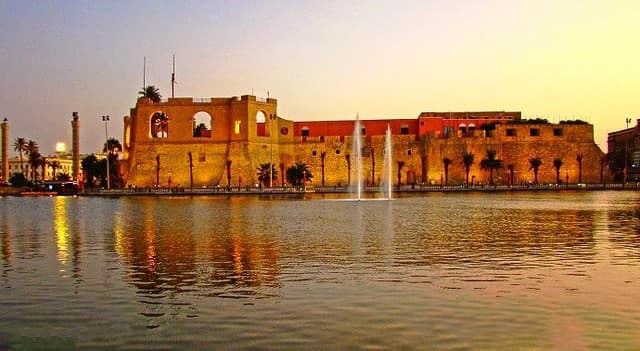
Tripoli Castle, commonly known as the Red Castle or As-saraya Al-hamra (السرايا الحمراء), is a prominent hill castle located on the waterfront of Tripoli, Libya. Overlooking the Mediterranean Sea and adjacent to the bustling Martyrs' Square, this fortress stands as a significant historical and cultural landmark in the city. The castle's strategic position on a slight elevation allowed it to serve as a defensive stronghold guarding the harbor and the old city throughout various periods of Tripoli's history.
The origins of the Red Castle trace back to the 16th century, during the Ottoman period, although the site itself has hosted fortifications since earlier times. The castle's distinctive red walls, constructed from local stone and brick, give it its name and a commanding presence along the waterfront. Its architectural design reflects a mix of military and residential functions, with thick defensive walls, bastions, and inner courtyards.
Architectural features and layout
The castle complex is characterized by its robust battlements and multiple towers that provide panoramic views of the sea and city. The main entrance is fortified, leading into a spacious courtyard that historically served as a gathering and staging area. Within the walls, there are several chambers and halls that have been adapted for museum use, showcasing artifacts related to Libya's rich history.
The castle's design incorporates defensive elements typical of Ottoman military architecture, including thick curtain walls and angled bastions to deflect cannon fire. The use of local red stone contributes both to its defensive strength and distinctive appearance. Over the centuries, the castle has undergone modifications and restorations, reflecting changing military technologies and aesthetic preferences.
Historical significance and use
Throughout its history, the Red Castle has played a central role in Tripoli's defense and administration. It was a key military fortress during Ottoman rule and later under Italian colonial administration. The castle was involved in various conflicts and sieges, including those related to the Barbary corsairs and European powers vying for control of the Mediterranean.
Since 1919, the castle has housed the Red Castle Museum (also known as the Assaraya Alhamra Museum), one of Libya's most important cultural institutions. The museum's collections include archaeological finds, ethnographic exhibits, and artifacts from Libya's diverse historical periods, ranging from prehistoric times through the Islamic era to the modern age.
The red castle museum and archaeological department
The museum within the castle serves as a repository of Libya's cultural heritage. It has been managed by the Libyan Department of Archaeology since 1952. The exhibits provide insight into the ancient civilizations that inhabited the region, including the Berbers, Phoenicians, Romans, and Arabs.
Visitors can explore displays featuring pottery, jewelry, coins, and tools, as well as reconstructions of historical scenes. The museum also highlights the architectural evolution of Tripoli and the castle itself, offering educational programs and guided tours.
Preservation and current condition
The Red Castle is currently well preserved and remains a vital cultural and historical site in Tripoli. Efforts have been made to maintain its structural integrity and to restore certain parts of the fortress to enhance visitor experience. Its location on the waterfront makes it accessible and a focal point for tourists and locals alike.
While the castle retains much of its original defensive character, adaptations for museum use have introduced modern amenities and exhibition spaces. The site continues to be an important symbol of Tripoli's historical resilience and cultural identity.
Visiting information and accessibility
The Red Castle Museum is open to the public, offering a unique opportunity to explore Libya's history within an authentic fortress setting. Visitors are advised to check current opening hours and any access restrictions before planning their visit, as political and security situations in the region can affect accessibility.
The castle's location near Martyrs' Square places it within easy reach of other historic sites and urban amenities in Tripoli, making it a convenient stop for cultural tourism.
Frequently asked questions (FAQ)
- When was Tripoli Castle built?
- Tripoli Castle, also known as the Red Castle, was constructed in the 16th century during the Ottoman period.
- What is the significance of the Red Castle Museum?
- The Red Castle Museum, housed within Tripoli Castle since 1919, preserves and displays Libya's rich archaeological and cultural heritage.
- Can visitors tour the castle?
- Yes, the Red Castle Museum is open to the public, allowing visitors to explore the historic fortress and its exhibits.
- Where is Tripoli Castle located?
- Tripoli Castle is located on the waterfront in Tripoli, Libya, adjacent to Martyrs' Square.
- What architectural features does Tripoli Castle have?
- The castle features thick defensive walls, bastions, multiple towers, and a central courtyard, reflecting Ottoman military architecture.
Photo gallery

Information
Loading map...
Visitor reviews
No reviews yet. Been here? Write the first review and help other travelers!
Write the first reviewVisited this castle? Share your experience
Your review helps other travelers and adds first-hand knowledge to our encyclopedia.