Tretower Castle
Tretower Castle stands as a remarkable example of a medieval motte and bailey castle located in the village of Tretower, Wales. Founded in the early 12th century, it reflects the Norman expansion into the upper Usk valley, illustrating the evolution of military architecture from timber fortifications to stone keeps. Its strategic location atop a natural hill provided commanding views and defensive advantages, characteristic of hill castles from the High Medieval period.
The castle's origins trace back to around 1100 when a Norman follower named Picard, serving under Bernard de Neufmarché, constructed a wooden motte and bailey to secure Norman control. This initial timber structure was typical of early Norman fortifications designed for rapid construction and immediate defense.
By approximately 1150, Picard's son, Roger Picard I, replaced the wooden motte with a stone shell keep, marking a significant upgrade in fortification. The shell keep formed an irregular circular enclosure atop the motte, with a gate tower oriented along the approach from the bailey. This stone construction provided enhanced durability and defensive capability against siege warfare.
Architectural evolution and key features
The 13th-century cylindrical keep
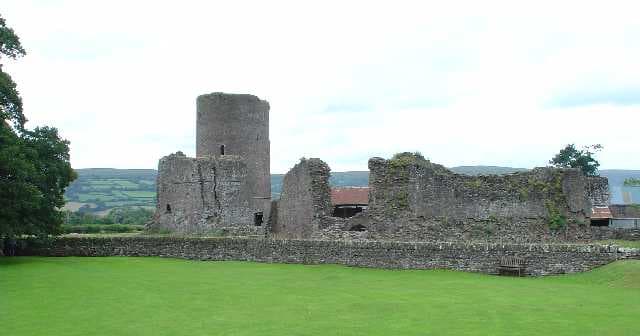
Between 1230 and 1240, Roger Picard II, the great-grandson of Roger Picard I, undertook major reconstruction by demolishing the inner walls of the shell keep and raising the outer walls to create a large cylindrical stone keep within the original enclosure. This keep rises three storeys above a strong slanted batter (talus), a defensive feature designed to deflect projectiles and prevent undermining. The keep's entrance is located on the first floor, a common Norman design to enhance security. Access to the upper floors was provided by staircases built within the thick walls, maximizing interior space and defensive strength. A decorative string course marks the top of the talus, adding an architectural flourish to the otherwise austere defensive structure.
The bailey and curtain walls
The castle's bailey, a roughly triangular enclosure to the east of the motte, was fortified with stone curtain walls and cylindrical corner towers by the early 13th century. These walls enclosed the outer ward, protecting the castle's support buildings and providing an additional defensive layer. Although much of the curtain wall has fallen into ruin, archaeological remains and incorporated 18th-century farm buildings reveal the original layout and extent of the fortifications. The bailey was originally surrounded by a water-filled moat fed by natural wetlands, enhancing the castle's defensibility by complicating direct assaults.
Internal structures and domestic adaptations
Inside the shell keep and cylindrical tower, archaeological excavations have uncovered a ground-floor hall and kitchen area, indicating the castle's role not only as a fortress but also as a noble residence. The lord's private chambers occupied the upper western part of the keep, featuring decorative stone carvings and architectural details typical of 12th-century design. This blend of military and domestic architecture reflects the dual purpose of such castles during the medieval period.
Originally, a battlemented walkway or wall walk ran along the outer walls, connected to the keep's second floor by a wooden bridge. This allowed defenders to move safely between the keep and curtain walls during an attack. Over time, as the castle's military importance waned, residential buildings were constructed away from the original fortifications, forming the nearby Tretower Court in the early 14th century. This manor house became the favored residence of the lords, signaling a shift from martial to domestic priorities.
Historical significance and ownership
Tretower Castle played a notable role during the turbulent 15th century, particularly during the Welsh revolt led by Owain Glyndŵr. The castle was defended by Sir James Berkeley, an English royal supporter, against Welsh attacks. To bolster its defenses, new structures were likely added northwest of the motte to house a reliable garrison during this period.
Ownership passed to the Herbert family in the 15th century, with William Herbert transferring the estate to his half-brother Roger Vaughan around 1450. Vaughan is credited with building Tretower Court, which became the principal residence, reflecting the declining military role of the castle. By the 16th century, the castle fell into disuse, and its stones were repurposed for agricultural buildings, including an 18th-century farmhouse constructed within the bailey.
Preservation and current condition
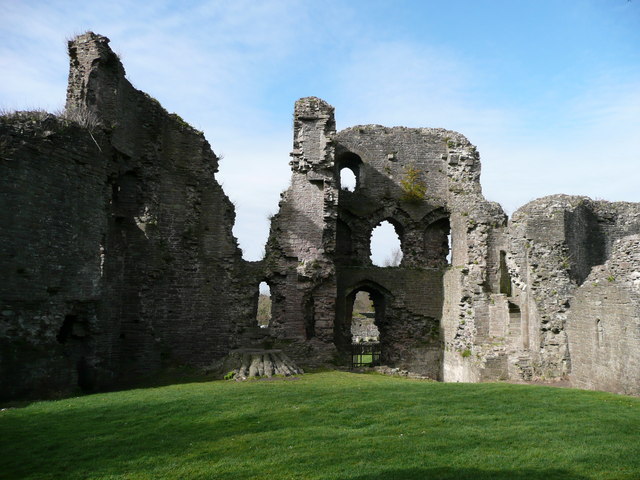
The castle suffered significant damage in the 20th century, including a major collapse of the shell keep walls in 1947. Subsequently, the site was acquired by the state, which undertook restoration and stabilization efforts during the 1960s. Today, Tretower Castle is a Grade I-listed ruin, recognized for its historical and architectural significance. The remains showcase a layered history of Norman military architecture evolving into a noble residence, with surviving elements of the shell keep, cylindrical keep, curtain walls, and bailey walls.
The castle's position on a natural hill, combined with its stone fortifications and water defenses, exemplifies the strategic considerations of medieval castle design. Visitors can explore the ruins and gain insight into the Norman conquest of Wales, the architectural innovations of the High Medieval period, and the social transformations that led to the castle's decline and adaptation.
Visiting and educational value
Today, Tretower Castle serves as a valuable cultural heritage site, offering educational opportunities about medieval military architecture and Norman history in Wales. Its well-preserved ruins allow for detailed study of motte and bailey construction, shell keeps, and cylindrical Norman keeps. The juxtaposition of military and domestic structures illustrates the changing functions of castles through the centuries.
The castle's setting in the picturesque village of Tretower enhances its appeal, providing visitors with a tangible connection to the medieval past within the Welsh landscape. Interpretive materials and guided tours help contextualize the site's history and architecture, making it an important destination for both historians and tourists interested in medieval Britain.
Frequently asked questions (FAQ)
- How do I get to Tretower Castle?
- Tretower Castle is easily accessible by car and public transport. If you're driving, it's located just off the A40 road, with ample parking available nearby. For public transport, check local bus services that connect to Tretower from surrounding towns.
- What is the historical significance of Tretower Castle?
- Tretower Castle dates back to the 12th century and was an important stronghold during the medieval period. It showcases the architectural evolution from a motte-and-bailey structure to a stone castle. Its history is deeply intertwined with the local nobility and Welsh conflicts, making it a key site for understanding the region's past.
- When was Tretower Castle built?
- Construction of Tretower Castle began in the late 11th century, with significant developments occurring throughout the 12th and 13th centuries. The castle was strategically built to oversee the surrounding lands and defend against invaders. Its architecture reflects the design trends of the medieval period, making it a fascinating study for visitors.
- Can I take guided tours of Tretower Castle?
- Yes, guided tours are available at Tretower Castle, providing visitors with in-depth knowledge of its history and architecture. These tours are led by knowledgeable guides who can share interesting stories and facts about the castle. It’s advisable to check the schedule in advance as tours may vary by season.
- Why is Tretower Castle considered an architectural gem?
- Tretower Castle is renowned for its well-preserved structures, including the impressive gatehouse and the great hall. Its combination of defensive features and residential elements showcases the dual purpose of castles during medieval times. The unique design reflects both Welsh and Norman influences, making it an important example of historical architecture.
- Is it possible to visit Tretower Castle year-round?
- Yes, Tretower Castle is open to visitors throughout the year, although opening hours may vary by season. It’s best to check the official website for current hours and any seasonal events. Visiting during the warmer months can offer a more pleasant experience as gardens and landscape views are more vibrant.
- What are the ticket prices for Tretower Castle?
- Ticket prices for Tretower Castle are generally affordable, with discounts available for children, students, and seniors. Family tickets are also offered at a reduced rate, making it accessible for groups. Be sure to check the official site for the latest pricing and any special promotions that may be available.
- What is the best time to visit Tretower Castle?
- The best time to visit Tretower Castle is during the spring and summer months when the weather is milder and the gardens are in full bloom. These seasons also often feature special events and activities, enhancing the visitor experience. However, autumn can provide a beautiful backdrop with changing foliage, making it a lovely time to explore as well.
- Are there any nearby attractions to Tretower Castle?
- Yes, Tretower Castle is located near several attractions, including the picturesque Brecon Beacons National Park and the charming town of Crickhowell. Visitors can enjoy hiking, cycling, and exploring local shops and restaurants in the area. Additionally, other historical sites, such as the ruins of nearby castles, provide further opportunities for exploration.
Photo gallery

Information
Website
Visit websiteSources & official resources
Verify the information above using these authoritative references.
Loading map...
Visitor reviews
No reviews yet. Been here? Write the first review and help other travelers!
Write the first reviewVisited this castle? Share your experience
Your review helps other travelers and adds first-hand knowledge to our encyclopedia.