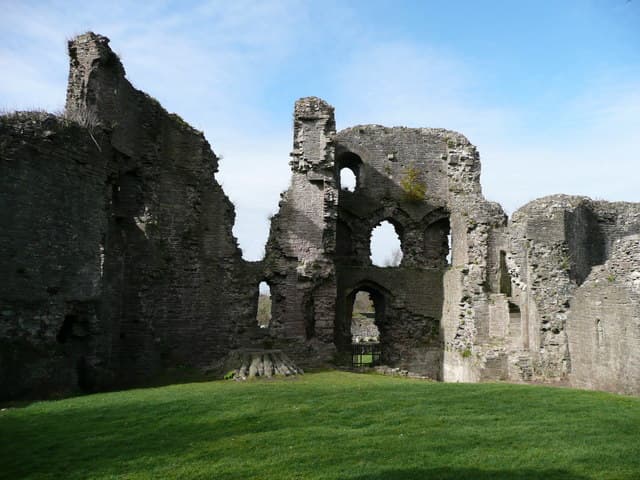
Abergavenny Castle
Abergavenny Castle stands as a significant Norman fortress located in the historic market town of Abergavenny, Wales. Established around 1087 by the Norman lord Hamelin de Balun, the castle was strategically positioned on a hill overlooking the River Usk and its valley. This commanding location allowed it to serve as a defensive stronghold guarding the lowland areas from incursions by Welsh forces from the surrounding hills to the north and west.
The castle's initial construction featured a wooden keep atop a motte, surrounded by a ditch and palisade, typical of early Norman fortifications. By the early 12th century, this wooden structure was replaced by a more durable stone keep, reflecting the castle's growing military and administrative importance in the contested border region known as the Welsh Marches. The castle's evolution reflects the turbulent political landscape of medieval Wales, where control frequently shifted between Welsh princes and Norman lords.
The dark history of the massacre and conflict
One of the most infamous events associated with Abergavenny Castle occurred in 1175, when William de Braose, a powerful Marcher lord, orchestrated a brutal massacre within the castle's great hall. Under the guise of reconciliation, de Braose invited Welsh leaders from Gwent, including Seisyll ap Dyfnwal and his son Geoffrey, only to have them slaughtered as retribution for the death of Henry Fitzmiles. This act of treachery intensified hostilities in the region and led to further violence.
In retaliation, in 1182, Hywel ap Iorwerth, lord of Caerleon, ordered the destruction of the nearby Dingestow Castle and the burning of Abergavenny Castle itself. Though de Braose was absent during the attack, many of his men were taken hostage. This cycle of violence exemplifies the fraught nature of Norman-Welsh relations during the High Medieval period.
Architectural transformation and fortification
Following the 1182 attack, the castle underwent extensive rebuilding beginning around 1190. The reconstruction employed locally quarried Old Red Sandstone, a durable material that enhanced the castle's defensive capabilities. The new design featured a robust curtain wall fortified by five towers strategically placed to provide overlapping fields of fire and defense. A substantial stone keep was also constructed, serving as the last line of defense and a symbol of Norman authority.
During the late 13th and early 14th centuries, the castle was further expanded under the ownership of the Hastings family. John Hastings, 1st Baron Hastings, added two distinctive western towers—a circular tower and a polygonal tower—between 1295 and 1314. These towers were designed not only for defense but also to provide enhanced residential comfort, indicating the castle's dual military and domestic functions.
The barbican and defensive features
The castle's entrance was fortified with a gatehouse and a barbican, a fortified outer gateway constructed around the early 15th century, possibly just before or after the 1404 rebellion of Owain Glyndŵr. This addition provided an extra layer of protection against attackers. The barbican, while architecturally modest compared to other parts of the castle, was a crucial defensive element during times of siege.
The castle in warfare and decline
Abergavenny Castle played a pivotal role throughout the centuries in the ongoing conflicts between the English crown and Welsh princes. In 1215, it was visited by King John of England, underscoring its strategic importance. During the early 15th century, the castle endured a siege amid the Owain Glyndŵr rebellion, with records from 1405 indicating a substantial garrison of mounted soldiers and archers defending the stronghold.
However, by the mid-17th century, the castle's military significance waned. During the English Civil War, King Charles I ordered the castle to be slighted—deliberately damaged to prevent its use by opposing forces. This slighting led to the destruction of the stone keep and many other buildings, reducing the once formidable fortress to ruins.
Later use and preservation
In the 19th century, the castle site was transformed into a picturesque landscape feature. In 1819, Henry Nevill, 2nd Earl of Abergavenny, constructed a hunting lodge atop the motte. This lodge, characterized by its slender polygonal columns, was later converted into a museum that preserves and exhibits local history, including a saddler's workshop and a Victorian Welsh farmhouse kitchen.
The surrounding grounds were developed into formal gardens by William Nevill, 5th Earl of Abergavenny, enhancing the site's aesthetic appeal and providing scenic views over the Usk valley. The castle ruins, hunting lodge, and gardens have been recognized for their cultural and historical significance, receiving heritage protection since 1952.
Architectural remains and visitor experience
Today, visitors to Abergavenny Castle can explore the impressive remains of the castle's 12th-century curtain walls, which stand as the most striking feature of the site. The five surviving towers, including the notable western circular and polygonal towers, offer insight into medieval defensive design and residential architecture.
The site also includes the barbican gatehouse, cellars, and foundations of domestic buildings such as kitchens and the great hall, although these no longer survive above ground. The 19th-century hunting lodge atop the motte functions as the Abergavenny Museum, providing educational exhibits and a glimpse into local heritage.
Visitors can enjoy walking paths through the formal gardens, which complement the historic ruins and offer panoramic views of the surrounding landscape. The castle's combination of military history, architectural evolution, and cultural legacy makes it a compelling destination for those interested in medieval history and Welsh heritage.
Frequently asked questions (FAQ)
- How do I get to Abergavenny Castle?
- Abergavenny Castle is located in the town center of Abergavenny, Wales. It is easily accessible by car and public transport, with nearby parking and bus stops.
- What are the opening hours of Abergavenny Castle?
- The castle and museum are open daily from 10:00 to 17:00, allowing visitors ample time to explore the site and exhibits.
- Is there an admission fee to visit Abergavenny Castle?
- Admission to Abergavenny Castle and its museum is free, making it an accessible cultural attraction for all visitors.
- What can I see at Abergavenny Castle museum?
- The museum features exhibits such as a saddler's workshop and a Victorian Welsh farmhouse kitchen, showcasing local history and traditional crafts.
- Can I explore the castle ruins?
- Yes, visitors can freely explore the castle ruins, including the impressive curtain walls, towers, and the barbican gatehouse, all providing insight into medieval fortifications.
Photo gallery

Information
Opening hours
10:00-17:00, daily
Ticket prices
Free
Current owner
Local authority
Website
Visit websiteSources & official resources
Verify the information above using these authoritative references.
Loading map...
Visitor reviews
No reviews yet. Been here? Write the first review and help other travelers!
Write the first reviewVisited this castle? Share your experience
Your review helps other travelers and adds first-hand knowledge to our encyclopedia.



