Trenczyn
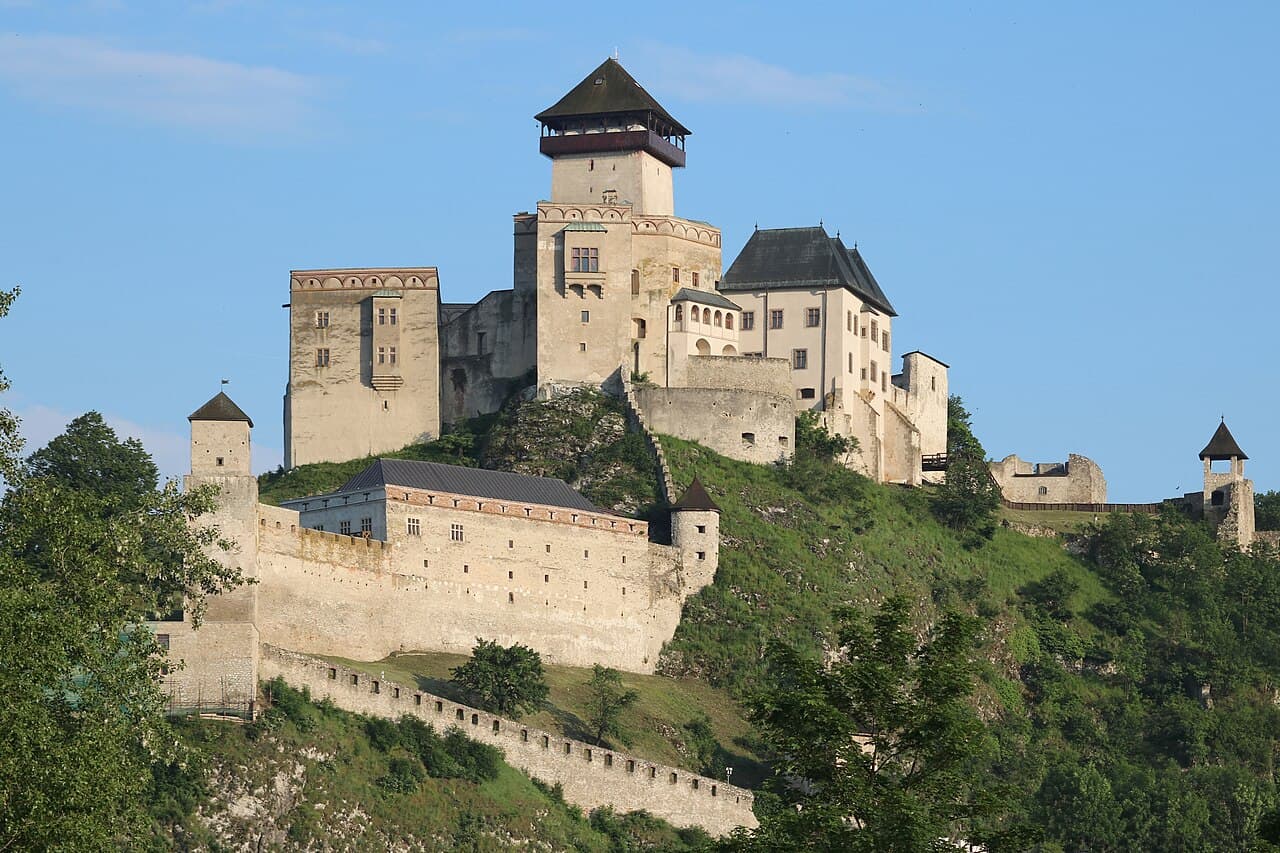
Trenčín Castle is one of the most iconic castles in Slovakia, prominently situated on a steep limestone cliff overlooking the town of Trenčín and the Váh river valley. This bastioned fortress dominates the landscape of the entire Považie region and holds the status of a national cultural monument. Its strategic location has been valued since ancient times, with archaeological evidence revealing continuous human presence from the Bronze Age through Roman, Great Moravian, medieval, and early modern periods.
The earliest known mark of the site's significance dates back to 179 CE, when Roman soldiers of the II Legion left a Latin inscription carved into the rock beneath the castle. This inscription commemorates a Roman victory over Germanic tribes during the Marcomannic Wars and represents the northernmost confirmed Roman presence in what is now Slovakia. The site later hosted Celtic tribes and became a fortified settlement during the era of the Great Moravian Empire in the 9th century, including a distinctive four-apsed rotunda church.
Early medieval foundations and roman legacy
The hill on which Trenčín Castle stands was originally used as a fortified hill-fort in the early medieval period. Archaeological excavations have uncovered the remains of a Great Moravian rotunda dating to the 9th century, which is one of the oldest known ecclesiastical buildings in Slovakia. This rotunda, with its unique four-apsed design, reflects the early Christian architectural influences in the region and underscores the site's religious as well as military importance.
Following the decline of Great Moravia, the site evolved into a more substantial stone fortress in the 11th century, marking the beginning of the castle proper. The initial construction included a Romanesque stone tower and a rotunda, which served as the core of the royal stronghold tasked with guarding the Carpathian passes and the ford over the Váh river. This early castle was the administrative center of the Trenčín comitatus, one of the oldest counties in the Kingdom of Hungary.
Gothic expansion and the era of matúš csák
Between 1260 and 1270, the original Romanesque tower was replaced by a larger square Gothic tower, measuring approximately 12 by 12 meters. This tower, known today as the Máté Tower, was significantly heightened and fortified, becoming the dominant architectural feature of the castle. Its walls at the base reach nearly 3.5 meters in thickness, demonstrating the emphasis on defense.
In 1275, the castle came under the control of Stefan Csák, a powerful nobleman from one of Hungary's most influential families. His nephew, Matúš Csák (Matthew Csák), who served as Palatine of Hungary, undertook extensive expansions. He raised the tower further, reinforced the castle walls, and added new residential palaces and a chapel, transforming the fortress into a formidable stronghold and noble residence.
Fortifications and royal patronage in the 14th and 15th centuries
After Matúš Csák's death in 1321, the castle was seized by the forces of King Charles Robert of Hungary following a prolonged siege. The castle then became a royal possession and underwent further development under subsequent monarchs. During the reign of King Louis I the Great, a smaller palace known as the Palace of Louis was constructed on the northern side of the tower.
In the early 15th century, under King Sigismund of Luxembourg, the castle was expanded with the addition of the Barbara Palace, named after the king's second wife. This palace included a grand knights' hall and a chapel, reflecting both the residential and ceremonial functions of the castle. The fortress was also encircled by a new ring of walls with multiple towers and a drawbridge over a defensive moat. These enhancements enabled the castle to withstand several attacks by Hussite forces in the early 1400s.
Renaissance modifications and military advancements
Ownership passed to the Zápolya family in 1475, who initiated another wave of construction and modernization. The palaces of Louis and Barbara were rebuilt and a new palace was added, along with the Summer Tower. The southern defenses were significantly strengthened with two dry moats, three earthen ramparts equipped with firing slits, and two large artillery bastions: the Jeremias Tower and the Mill Tower.
Between 1540 and 1560, under the supervision of imperial engineers, the castle's fortifications were adapted to the evolving demands of artillery warfare. A Renaissance bastion was constructed in the lower courtyard, protecting the upper town gate and the bridges over the Váh river. A powder mill and various service buildings were also added, along with a deep well to supply water to the garrison.
The Great Tower, built between the Palace of Louis and the Zápolya Palace, housed artillery that defended the main access routes and the town below. By the late 16th century, additional earthworks further fortified the castle’s defenses.
17th-century military use and decline
In 1596, the castle became the property of the Illésházy family, who held it until the 19th century. During the 17th century, the castle garrison was reinforced with imperial troops due to the threat posed by advancing Ottoman forces, although the castle itself was never captured by the Turks.
However, the presence of the imperial garrison caused tensions with the townspeople, as the soldiers occasionally bombarded the town to enforce compliance. The castle remained militarily active until 1782, when the Illésházy family resumed full control. Plans for restoration were interrupted by a devastating fire in 1790, which caused extensive damage and led to the castle’s gradual decline into ruin.
Modern restoration and cultural significance
After decades of neglect, restoration efforts began in 1956 and have continued intermittently to the present day. Today, Trenčín Castle is partially restored and open to visitors as a museum showcasing medieval and Renaissance architecture, noble life, and military history.
The castle complex includes the Máté Tower with its thick defensive walls and panoramic views, the Palaces of Louis, Barbara, and Zápolya, the Summer Tower, and the Gothic chapel. Visitors can explore the multiple courtyards, walls, bastions, and gates, including the southern fortifications which are notable examples of historical military engineering.
Trenčín Castle’s layered history from Roman times through medieval and Renaissance periods, combined with its impressive architectural features and strategic location, make it a key cultural and historical landmark in Slovakia and Central Europe.
Architectural highlights
- Máté Tower: The castle’s oldest and most prominent tower, originally Romanesque, rebuilt in Gothic style with walls up to 3.5 meters thick.
- Barbara Palace: A late Gothic residential palace with ribbed vaults, a knight’s hall, and a chapel, reflecting royal patronage in the 15th century.
- Zápolya Palace: Renaissance-era noble residence housing a collection of historical portraits and artifacts.
- Southern fortifications: Complex defensive system with dry moats, earthen ramparts, and artillery bastions designed to counter artillery attacks.
- Four-apsed rotunda: Archaeological remains of a rare early medieval church structure from the Great Moravian period.
- Star-shaped bastions: Renaissance military innovations for improved artillery defense built in the 16th century.
- Well of Love: A deep well dug over several centuries to supply water to the castle garrison.
Visiting trenčín castle
Trenčín Castle is accessible via a series of gates and courtyards leading from the lower to the upper castle. Visitors can tour the restored palaces, towers, chapel, and defensive walls. The castle museum displays medieval weaponry, furnishings, and archaeological finds, providing insight into the lives of its noble occupants and soldiers.
The summit of the Máté Tower offers breathtaking panoramic views of the Váh valley and surrounding mountain ranges, making it a highlight for visitors. The castle hosts cultural events, exhibitions, and educational programs that celebrate its rich history and architectural heritage.
Frequently asked questions (FAQ)
- How do I get to Trenczyn Castle?
- Trenczyn Castle is easily accessible by car or public transportation. If you are traveling from Bratislava, you can take a train to Trencin, followed by a short walk to the castle. The castle is situated on a hill, offering a picturesque view of the town and surrounding countryside.
- What is the historical significance of Trenczyn Castle?
- Trenczyn Castle is one of the most important historical sites in Slovakia, dating back to the 11th century. It played a crucial role in the defense against invasions and was a residence for several noble families. The castle's rich history is reflected in its architecture and the various artifacts displayed within.
- When was Trenczyn Castle built?
- Construction of Trenczyn Castle began in the early 11th century, making it one of the oldest castles in Slovakia. Over the centuries, it underwent numerous renovations and expansions, reflecting different architectural styles. The castle has been a witness to many significant historical events throughout its long existence.
- Can I visit Trenczyn Castle year-round?
- Yes, Trenczyn Castle is open for visitors throughout the year, although opening hours may vary by season. It’s advisable to check the official website for specific dates and times, especially during the winter months. Guided tours are available to enhance your visit and provide deeper insights into the castle's history.
- Why is Trenczyn Castle considered an architectural marvel?
- Trenczyn Castle showcases a unique blend of Romanesque, Gothic, and Renaissance architectural styles. Its strategic location on a rocky cliff not only provides stunning views but also served defensive purposes in the past. The impressive towers and fortifications are a testament to the engineering skills of the time.
- Is it possible to take guided tours at Trenczyn Castle?
- Yes, guided tours are available at Trenczyn Castle, offering visitors a comprehensive overview of its history and architecture. These tours are led by knowledgeable guides who can provide fascinating insights and stories about the castle. Reservations may be recommended during peak tourist seasons.
- What are the ticket prices for visiting Trenczyn Castle?
- Ticket prices for Trenczyn Castle vary depending on age and the type of tour selected. Discounts are often available for students, seniors, and groups. It's a good idea to check the official website for the most up-to-date pricing information before your visit.
- What is the best time to visit Trenczyn Castle?
- The best time to visit Trenczyn Castle is during the spring and early autumn when the weather is pleasant and the surrounding nature is vibrant. Summer months can be busier with tourists, while winter offers a unique charm with fewer crowds. Regardless of the season, the castle's stunning views are always a highlight.
- Are there nearby attractions to visit along with Trenczyn Castle?
- Yes, there are several attractions near Trenczyn Castle, including the charming town of Trencin itself, which features beautiful architecture and local shops. The Považie Museum and the historic Trencin Synagogue are also nearby, providing a glimpse into the region's culture and history. Visitors can easily explore these sites in a day.
Photo gallery

Information
Website
Visit websiteSources & official resources
Verify the information above using these authoritative references.
Loading map...
Visitor reviews
No reviews yet. Been here? Write the first review and help other travelers!
Write the first reviewVisited this castle? Share your experience
Your review helps other travelers and adds first-hand knowledge to our encyclopedia.