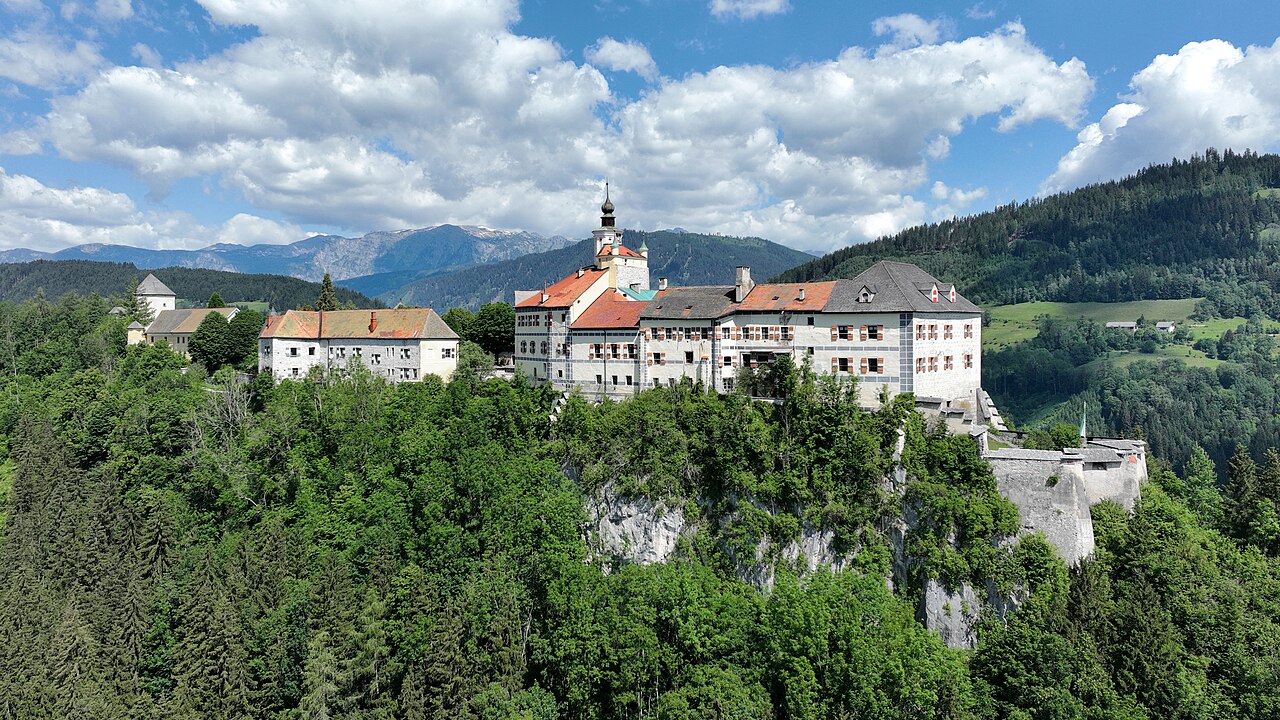
Trautenfels Castle
Trautenfels Castle is a distinguished Renaissance palace located in the district of Liezen in Styria, Austria. Its origins trace back to the 13th century, with the first documented mention of a fortification at the strategic crossroads of the Salzstrasse and the Ennstal Valley dating from between 1260 and 1262. Initially known as Neuhaus, the medieval structure served as a defensive dam and stronghold until the 16th century, reflecting the military and trade significance of the location.
Medieval origins and Renaissance transformation
The original medieval construction of Trautenfels Castle was modest but strategically important. In the 16th century, the castle underwent significant artistic enhancement, most notably through the addition of Renaissance frescoes. These frescoes are attributed to a northern Italian artist and were likely commissioned to celebrate the wedding of the castle's then-owner, Ferdinand Hoffman, to Margarete von Harrach in 1563. This period marked a transition from purely defensive architecture to a residence that also emphasized artistic and cultural refinement.
Baroque expansion under Count Siegmund Friedrich von Trauttmansdorff
In 1664, the castle was acquired by Count Siegmund Friedrich von Trauttmansdorff, the Styrian provincial governor. Between 1670 and 1672, he undertook an extensive renovation and expansion of the castle, transforming it into a Baroque palace known as Schloss Trautenfels. The renovation introduced a mighty rectangular construction featuring roofed courtyards and a prominent high tower. The interior was richly decorated between 1670 and 1673, including frescoes by the renowned artist Carpoforo Tencalla on the first floor, which remain a highlight of the palace today.
Architectural features and artistic highlights
The castle's architecture from this period reflects typical Baroque grandeur with five bastions providing formidable defense and a freestanding castle chapel adding spiritual significance. The palace's layout and artistic embellishments demonstrate the fusion of military functionality with the aesthetic aspirations of the Baroque era. The interior spaces such as the Marble Hall and the State Rooms are richly decorated, showcasing the wealth and status of its owners.
Later ownership and modern use
After passing through various owners, Trautenfels Castle was purchased in 1878 by Josef Count Lamberg. The castle's role shifted over time, and following World War II, it was acquired by the Styrian Youth Hostel Association (Jugendherbergswerk), which managed the property until 1983. Subsequently, ownership transferred to the municipality of Pürgg-Trautenfels and the state of Styria. A comprehensive renovation and revitalization project took place from 1988 to 1992 under the guidance of architect Manfred Wolff-Plottegg, preparing the castle for modern use.
Regional landscape museum and cultural significance
Since 1992, Trautenfels Castle has housed the Regional Landscape Museum of the Universalmuseum Joanneum. The museum features a permanent collection of about 1,000 exhibits that explore the natural and cultural history of the Ennstal Valley and the Ausseerland region. Visitors can explore the Antler Room of the Counts of Lamberg, the splendid Marble Hall, and the richly decorated State Rooms, all of which provide insight into the castle's layered history and the region's heritage.
Nearby historical sites: the Protestant church ruins
A few meters west of the palace lie the ruins of the Protestant church of Neuhaus, situated on the same ridge. During the Reformation, this church was the most significant religious center in the upper Ennstal valley. Established by the lords of Schloss Trautenfels, it was a focal point of Protestant worship before succumbing to the vigorous Counter-Reformation efforts in the Duchy of Styria. Excavations in 1991 uncovered the remnants of the church, which now serve as a memorial to this turbulent period in the region's religious history.
Architectural and historical importance
Trautenfels Castle exemplifies the evolution of Central European castle architecture from a medieval fortress to a Renaissance residence and ultimately a Baroque palace. Its transformation under Count Trauttmansdorff reflects the broader cultural shifts of the 17th century, where fortifications became symbols of status and artistic expression as much as military bastions. The castle's preservation and adaptive reuse as a museum allow visitors to engage with both the architectural grandeur and the rich historical narratives of Styria.
Today, Trautenfels Castle stands as a well-preserved monument that offers a window into the region's past, combining military, cultural, and religious histories within its walls and surrounding landscape. Its blend of Renaissance frescoes and Baroque design makes it a unique destination for those interested in castle architecture and Austrian history.
Frequently asked questions (FAQ)
- What is Trautenfels Castle known for?
- Trautenfels Castle is renowned for its stunning architecture and picturesque location overlooking the Ennstal valley. It serves as a significant historical monument, showcasing the evolution of castle design from the Middle Ages to the present day.
- When was Trautenfels Castle built?
- Trautenfels Castle was originally constructed in the 13th century, with various modifications made over the centuries. The castle has been preserved to highlight its historical significance and architectural beauty, making it a fascinating site for visitors.
- Can I visit Trautenfels Castle?
- Yes, Trautenfels Castle is open to the public, allowing visitors to explore its rich history and beautiful surroundings. Guided tours are available, providing insights into the castle's past and the stunning views from its vantage points.
- What are the opening hours for Trautenfels Castle?
- The opening hours for Trautenfels Castle vary by season, typically operating from March to November. It is advisable to check the official website for the most current hours before planning your visit.
- Is it possible to tour the castle grounds?
- Yes, visitors can tour both the interior and exterior of Trautenfels Castle. The castle grounds offer beautiful walking paths and gardens, making it a delightful experience for guests of all ages.
- What are the ticket prices for Trautenfels Castle?
- Ticket prices for Trautenfels Castle are generally affordable, with discounts available for children, students, and seniors. Check the official website for the latest pricing information and any special offers that might be available.
- When is the best time to visit Trautenfels Castle?
- The best time to visit Trautenfels Castle is during the spring and early autumn months when the weather is pleasant and the surrounding landscape is vibrant. This allows visitors to fully enjoy the outdoor spaces and breathtaking views from the castle.
- Are there nearby attractions to visit?
- Yes, Trautenfels Castle is located near several attractions, including the beautiful Ennstal valley and the scenic hiking trails in the surrounding areas. Visitors can also explore nearby towns and cultural sites, making it an ideal starting point for a day of exploration.
- Is Trautenfels Castle accessible for visitors with disabilities?
- Trautenfels Castle has made efforts to be accessible to all visitors, with some areas equipped for those with mobility challenges. However, due to the historical nature of the site, some sections may have limitations, so it's best to inquire in advance for specific accessibility information.
Information
Loading map...
Visitor reviews
No reviews yet. Been here? Write the first review and help other travelers!
Write the first reviewVisited this castle? Share your experience
Your review helps other travelers and adds first-hand knowledge to our encyclopedia.