Totnes Castle
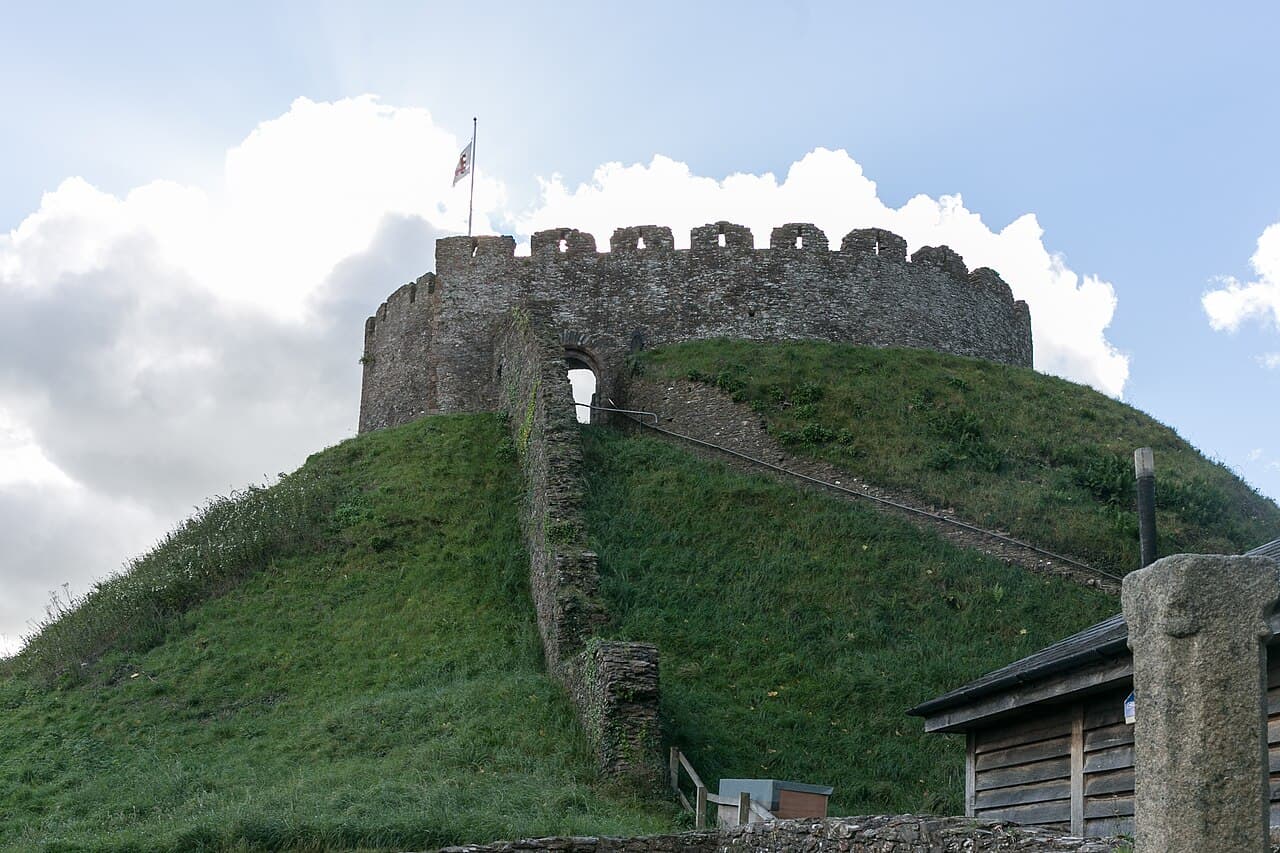
Totnes Castle stands as one of the finest and best-preserved examples of a Norman motte and bailey castle in England. Located in the historic market town of Totnes on the River Dart in Devon, this castle commands a strategic position atop a large hill, overseeing the approaches to three surrounding valleys. Its imposing presence and well-preserved stone structures offer a remarkable glimpse into medieval military architecture and Norman feudal power in southwest England.
The origins of Totnes Castle date back to shortly after the Norman Conquest of 1066. The castle was initially established by Juhel of Totnes (also known as Judhael de Totnes), a Breton nobleman and one of William the Conqueror's trusted lieutenants. In 1068, Juhel was granted the feudal barony of Totnes, and to consolidate his control over these newly acquired lands, he constructed the first fortifications. These early defenses were typical of Norman military strategy at the time, consisting of a wooden palisade enclosing a large bailey and a timber fortification atop a substantial motte (earth mound).
Early construction and strategic importance
The original castle was built on a motte rising approximately 17.5 meters (about 55 feet) with a base diameter of roughly 56 meters (175 feet). This elevated earthwork provided a commanding vantage point over the town and the surrounding landscape, allowing defenders to monitor and control movement through the three valleys that converge near Totnes. The wooden defenses were typical of early Norman castles, designed for rapid construction and immediate military utility.
However, Juhel's tenure was short-lived. After the death of William the Conqueror, Juhel supported Robert Curthose, William's eldest son, in his claim against William II. As a result, Juhel's lands, including Totnes Castle, were confiscated and granted to Roger de Nonant. Subsequently, when Henry I ascended the throne, he retained the castle under royal control, highlighting its continued strategic significance.
Transition to stone fortifications
By the late 12th century, the castle passed to the powerful de Braose family, who were influential Marcher Lords. Around 1219, under Reginald de Braose, the castle underwent a significant transformation. The original timber fortifications were replaced with a stone shell keep, a circular stone wall enclosing the summit of the motte. This development marked a shift from temporary wooden structures to more permanent and formidable stone defenses, reflecting the evolving military architecture of the period.
The stone shell keep was complemented by a surrounding curtain wall that enclosed the bailey, enhancing the castle's defensive capabilities. The use of locally sourced Devonian limestone and red sandstone in construction provided durability and a distinctive appearance. These materials are still evident in the surviving walls and keep, which have endured remarkably well over the centuries.
Ownership and repairs in the 14th century
In 1273, the castle came under the ownership of the de la Zouch family, a noble lineage primarily based in the Midlands. Although the Zouches rarely resided at Totnes, the castle was maintained to some extent. By 1326, however, it had fallen into disrepair. Recognizing its strategic and administrative importance, King Edward II issued a royal order for its restoration.
The 14th-century repairs involved rebuilding the shell keep and strengthening the curtain walls using the characteristic Devonian limestone and red sandstone. A stable was also constructed to support the castle's garrison, and a constable was appointed to oversee the site's defense and administration. The castle's design from this period features a U-shaped keep with two main staircases built into the thickness of the walls, leading to a parapet walk protected by battlements. This layout exemplifies the military architectural style of the late medieval period.
Later history and changing functions
Following the Wars of the Roses in the 15th century, Totnes Castle once again declined in military importance and fell into partial ruin. During the English Civil War in the 17th century, the castle was occupied but did not witness any significant military action. Its role during this time was largely administrative rather than martial.
Ownership changed hands several times after the Civil War. In 1485, it passed to Sir Richard Edgecomb, and in the 18th century, the castle was acquired by Edward Seymour, the 9th Duke of Somerset. Seymour introduced recreational features such as a tennis court and a tea room, reflecting the castle's transition from a fortress to a leisure estate. These additions illustrate how medieval castles were often repurposed to suit changing social and cultural needs over time.
Architectural features and current condition
Today, Totnes Castle retains much of its 14th-century stonework, including the impressive shell keep and the surrounding curtain walls. The castle's elevated position on a hill approximately 35 meters above sea level offers commanding views of the town below and the three valleys it overlooks. This strategic location was critical to its defensive function throughout its history.
The castle's layout is characteristic of Norman military architecture, with the motte and bailey design clearly visible. The stone shell keep is circular and robust, surrounded on three sides by a high curtain wall. Within the curtain walls, visitors can see the remains of medieval structures such as the stable and the town wall with the North Gate, which further emphasize the castle's historical role in regional defense.
Constructed primarily from Devonian limestone and red sandstone, the castle's stonework has endured remarkably well. The walls are thick and include two staircases embedded within their thickness, leading to battlemented parapets that once allowed defenders to patrol and protect the site. The castle's preservation status is considered well-preserved, making it a valuable example of medieval fortification in England.
Cultural significance and heritage status
Totnes Castle is recognized as a scheduled monument and a Grade I listed building, reflecting its outstanding historical and architectural importance. Since 1984, it has been under the stewardship of English Heritage, which manages its conservation and facilitates public access.
The castle attracts visitors interested in medieval history, Norman architecture, and the rich heritage of Devon. Its well-preserved structures and commanding hilltop location provide an immersive experience of England's feudal past. Educational programs and guided tours help interpret the castle's history and architectural features for a broad audience.
Visitor experience and accessibility
Visitors to Totnes Castle can explore the stone keep, walk along the curtain walls, and enjoy panoramic views of the surrounding countryside. The site includes informative displays detailing the castle's history and architecture. The castle's hilltop position means that some walking uphill is required, but pathways are maintained for safe access.
English Heritage provides visitor facilities including a small shop and rest areas. The castle is open seasonally with varying hours, and admission fees contribute to ongoing preservation efforts. Totnes Castle remains a prominent landmark in Devon, embodying centuries of English history and Norman military ingenuity.
Frequently asked questions (FAQ)
- How do I get to Totnes Castle?
- Totnes Castle is located in the town of Totnes, Devon, accessible by car or public transport. The castle sits on a hill in Castle Street, within walking distance from the town center.
- What is the historical significance of Totnes Castle?
- Totnes Castle is a prime example of a Norman motte and bailey castle, built shortly after the Norman Conquest to secure control over the region. Its stone shell keep and curtain walls reflect medieval military architecture and feudal power.
- When was Totnes Castle built and by whom?
- The castle was originally built shortly after 1066 by Juhel of Totnes, a Breton nobleman granted the barony by William the Conqueror. The stone shell keep and curtain walls date mainly from the 14th century.
- Can I explore the castle’s interior and walls?
- Yes, visitors can explore the stone keep, walk along the curtain walls, and view the remains of medieval structures such as the stable and town wall. Informative displays provide historical context.
- Is Totnes Castle suitable for families and children?
- Totnes Castle is family-friendly with open spaces and educational exhibits. However, the hilltop location requires walking uphill, so appropriate footwear and supervision for children are recommended.
- What are the opening hours and ticket prices?
- Opening hours vary seasonally, typically from morning until late afternoon. Ticket prices are set by English Heritage and may include discounts for children, seniors, and members. It is advisable to check the official website before visiting.
Photo gallery

Information
Sources & official resources
Verify the information above using these authoritative references.
Loading map...
Visitor reviews
No reviews yet. Been here? Write the first review and help other travelers!
Write the first reviewVisited this castle? Share your experience
Your review helps other travelers and adds first-hand knowledge to our encyclopedia.