Torres de Oeste
Torres de Oeste is a remarkable historic fortress situated in the municipality of Catoira, in the Galicia region of Spain. This hill castle occupies a strategic position at the confluence of the Ulla River and the Ría de Arousa, a location that has been of military and cultural significance since ancient times. The site’s origins trace back to the Castro period, a pre-Roman Iron Age culture indigenous to northwestern Iberia, evidencing continuous human settlement and fortification efforts that evolved through the Roman era into the medieval period.
The earliest known military construction at the site was the Roman Castellum Honesti, which laid the groundwork for later defensive structures. The fortress gained heightened importance during the Early Medieval period, particularly in the 9th and 10th centuries, when it served as a vital bulwark against Viking incursions along the ria. These Norse raiders penetrated upriver, threatening the Christian communities of Galicia. The defense of the region was notably marked by the sacrifice of Bishop Sisnando, who died defending his diocese, underscoring the fortress’s role as a religious and military stronghold.
Medieval expansion and fortification
Following the initial Roman and early medieval phases, the fortress underwent significant expansion and renovation during the 11th and 12th centuries. A pivotal moment occurred on October 29, 1024, when King Alfonso V of León granted ownership of the towers to Bishop Vistruario of Iria. This transfer initiated a series of fortification projects led by successive bishops, including Cresconio, Diego Páez, and notably Diego Xelmírez, one of the most influential ecclesiastical figures of medieval Galicia.
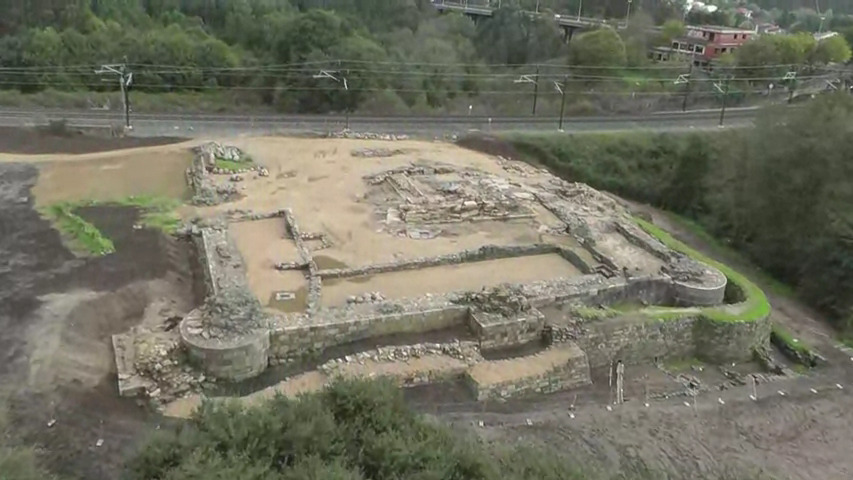
By the 12th century, the fortress had evolved into a formidable defensive complex featuring seven towers arranged around a fortified enclosure. This enclosure was naturally protected by surrounding marshlands, which served as a significant obstacle to attackers. In 1122, Diego Xelmírez commissioned the construction of a chapel dedicated to the Apostle Santiago, further cementing the fortress’s religious significance alongside its military function.
Architectural features and defensive design
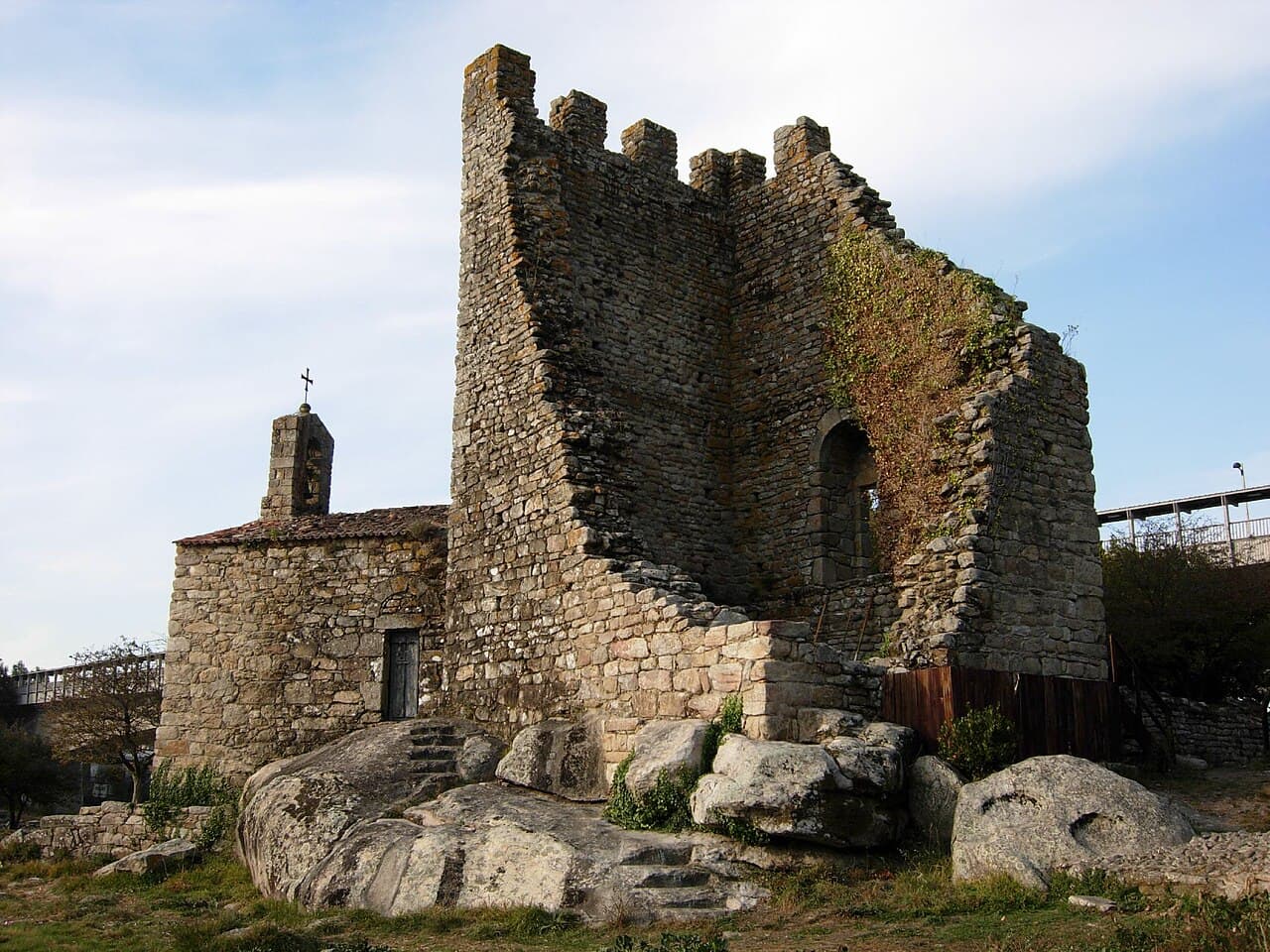
The Torres de Oeste exemplifies medieval military architecture adapted to its unique environment. The fortress’s seven towers were built with square bases using medium-sized cut stones known locally as Asturian stone. Larger stones reinforced corners and openings to enhance structural integrity. Today, two of these towers remain largely intact, while a third is heavily ruined, providing valuable insight into the construction techniques of the period.
The attached chapel is a significant architectural element, featuring a single nave and a semicircular apse. Its interior is covered by a barrel vault with a characteristic horseshoe arch—a hallmark of medieval Spanish ecclesiastical architecture. The chapel’s entrance is marked by a simple door topped by a pentagonal lintel and a semicircular arch, with a bell gable rising above the façade. Although the tympanum once bore an inscription, only faint traces remain today.
The fortress’s defensive walls demonstrate functional design choices. The southern wall is plain, lacking decorative elements, and includes a lintelled door with a relieving arch similar to the main entrance. In contrast, the northern wall is pierced by five arrow slits topped by horseshoe arches, enhancing defense against attacks from that direction. This combination of natural and man-made defenses, including the surrounding marshes, made the fortress a difficult target for direct assault.
Historical significance and decline
The Torres de Oeste played a crucial role in the defense of Galicia during the turbulent Early and High Middle Ages. Its position guarding the river and ria made it a key point of resistance against Viking raiders and other invaders. The fortress’s religious ties, exemplified by the bishops’ involvement and the chapel dedicated to Santiago, highlight its dual military and spiritual importance.
From the 15th century onward, the fortress’s strategic value declined, and it gradually fell into disrepair. By 1525, much of the structure had been destroyed. The site remained largely neglected until the 20th century, when it was declared a National Monument. Archaeological excavations, particularly the comprehensive study led by Alberto Balil Illana in 1971, revealed layers of the fortress’s complex history, from its Roman origins to its medieval prominence.
Recent discoveries, such as a French coin minted in Angers dating to the 11th or 12th century found near the chapel in 2022, suggest the fortress was connected to broader European trade or pilgrimage routes during the time of Diego Xelmírez. This finding adds a fascinating dimension to the understanding of the fortress’s role in medieval Galicia.
Artifacts and cultural heritage
The site has yielded several important artifacts that illuminate its historical and religious significance. Among these are two inscribed stone artifacts now housed in the Pontevedra Museum. One is a slab bearing a medieval chronogram "ERA MCC," while the other is a rectangular relief featuring a Greek cross flanked by alpha and omega symbols. This relief bears the Latin inscription "IN HOC SIGNO TUETUR PIUS HOC SIGNO VINCITUR INIMICUS", meaning "In this sign, the pious one is protected; by this sign, the enemy is conquered."
These artifacts, along with the fortress’s surviving architecture and the natural defenses of the surrounding marshes, provide a tangible link to the region’s layered history. Torres de Oeste stands today as a testament to Galicia’s rich medieval heritage and the enduring legacy of its early Christian and military leaders.
Frequently asked questions (FAQ)
- How do I get to Torres de Oeste?
- Torres de Oeste is located in Spain, easily accessible by car or public transport. If traveling by train, the nearest station is a short bus ride away, and local taxis are readily available for convenience.
- What is the historical significance of Torres de Oeste?
- Torres de Oeste dates back to the medieval period and served as a strategic defense point during various conflicts. Its architecture reflects the typical features of the era, making it an important site for understanding Spain's history.
- When was Torres de Oeste built?
- Construction of Torres de Oeste began in the 12th century and continued to evolve over the following centuries. The castle has undergone several renovations, preserving its historical integrity while adapting to modern needs.
- Can I take guided tours of Torres de Oeste?
- Yes, guided tours are available at Torres de Oeste, providing in-depth information about the castle's history and architecture. These tours are conducted by knowledgeable guides who can enhance your experience with fascinating stories and insights.
- Why is Torres de Oeste a popular tourist attraction?
- Torres de Oeste attracts visitors due to its impressive medieval architecture and stunning views of the surrounding landscape. Its rich history and well-preserved structures offer a unique glimpse into Spain's past, making it a must-visit for history enthusiasts.
- Is it possible to visit Torres de Oeste year-round?
- Yes, Torres de Oeste is open to visitors throughout the year, though hours may vary seasonally. It’s advisable to check the official website for any seasonal changes in opening hours before planning your visit.
- What are the ticket prices for visiting Torres de Oeste?
- Ticket prices for Torres de Oeste are reasonably set to accommodate a wide range of visitors. Discounts may be available for students, seniors, and groups, so be sure to inquire at the ticket counter upon arrival.
- What is the best time to visit Torres de Oeste?
- The best time to visit Torres de Oeste is during the spring and fall when the weather is mild and pleasant. These seasons also tend to see fewer crowds, allowing for a more enjoyable exploration of the castle.
- Are there any nearby attractions to explore after visiting Torres de Oeste?
- Yes, there are several nearby attractions, including local museums and historical sites that complement your visit to Torres de Oeste. Additionally, the surrounding natural scenery offers opportunities for hiking and enjoying the great outdoors.
Photo gallery

Information
Loading map...
Visitor reviews
No reviews yet. Been here? Write the first review and help other travelers!
Write the first reviewVisited this castle? Share your experience
Your review helps other travelers and adds first-hand knowledge to our encyclopedia.