Castle da Rocha Forte
Castle da Rocha Forte stands as a significant medieval fortress located near Santiago de Compostela in the region of Galicia, Spain. Constructed around 1240 by Archbishop Juan Arias, the castle served as both a defensive stronghold and a residence for the archbishop and the cathedral chapter. Its strategic position controlled the vital road from Padrón to Santiago, an important route for pilgrims traveling from Portugal. Unlike many medieval castles perched atop hills, this fortress was uniquely situated in a valley near the confluence of the Vilar stream and the Sar river, enabling it to monitor and regulate traffic entering the city from the south.
The castle's first documentary mention dates to 1255, linked to the capitular constitutions of Archbishop Juan Arias. Throughout the 13th and 14th centuries, the fortress played a pivotal role in asserting ecclesiastical authority over the surrounding territory. It was designed not only for military defense but also as a refuge for church officials during periods of civil unrest. The castle's dual function as a residence and a stronghold underscored its importance in the power dynamics of medieval Santiago.
Historical significance and turbulent events
During the early 14th century, the castle was at the heart of local conflicts. Notably, in 1317, Berenguel de Landoira was appointed archbishop amidst considerable opposition. The residents of Santiago rebelled against his authority, culminating in a brutal suppression where Archbishop Landoira ordered the execution of the rebellion's leaders. This event cemented the castle's reputation as a symbol of ecclesiastical power and control.
One of the most infamous episodes in the castle's history occurred on September 16, 1320, known as the "Day of Wrath," when eleven city representatives were treacherously killed within its walls during supposed negotiations. This act intensified local animosities and highlighted the fortress's role in the violent political struggles of the period.
Throughout the 14th and 15th centuries, the castle underwent several modifications under successive archbishops, including Lope de Mendoza. It remained a key defensive and administrative center, enduring sieges and rebellions. In 1458, Archbishop Rodrigo de Luna faced a siege by a noble-led brotherhood defending civic liberties. Despite royal intervention, the castle held out until a reconciliation was achieved in 1459.
However, the castle's dominance and the abuses by archbishop's soldiers, including theft and violence, fueled resentment among local peasants. This unrest culminated in the Great Irmandiña Revolt of 1467, a massive popular uprising that targeted symbols of feudal oppression. The castle was attacked by approximately 11,000 insurgents and was destroyed to its foundations, marking one of the earliest and most complete destructions of a fortress during this revolt. Unlike many other castles damaged in these conflicts, Castle da Rocha Forte was never rebuilt.
Architectural features and layout
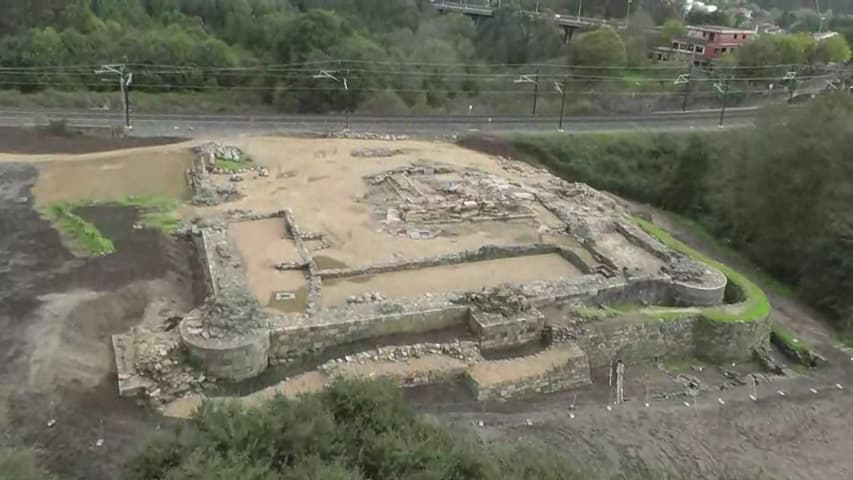
The castle's remains cover about 4,000 square meters on a promontory known as Rocha Vella. Its defensive design was complex, consisting of three concentric enclosures that provided layered protection. The outer walls, though partially ruined, still extend approximately 40 meters in the southeast section. The inner fortifications are more intact, featuring a central keep surrounded by nine circular towers equipped with crenellations for defense.
Two notable towers, Santa Eufemia and Torre Nova, were strategically positioned at corners and along key walls to maximize defensive coverage. The castle incorporated multiple defensive elements, including fortified gates, posterns (small secondary doors), drawbridges, a moat with permanent water, and barbicans that guarded the main entrances. This arrangement created a fortified complex resembling a small walled city.
Adjacent to the keep was a vaulted chapel dedicated to Santa Eufemia, reflecting the castle's religious significance. Excavations have uncovered vaulted underground chambers accessible by stepped entrances, a stone masonry well approximately 3.7 meters deep still containing water, and an advanced drainage system designed to manage runoff beyond the walls.
The construction utilized finely cut sandstone blocks joined with lime mortar, demonstrating skilled masonry. Architectural fragments recovered include Gothic capitals, carved moldings, celosías (decorative window grilles), and column shafts adorned with plant motifs. Some walls retain traces of lime plaster, indicating finished interior surfaces.
A trapezoidal bastion within the southeast barbican, measuring nearly 36 meters long and up to 4.5 meters high, remains well preserved, highlighting the fortress's formidable defensive capabilities. The site also yielded a variety of artifacts such as local and imported medieval pottery from Sevillian and Manises workshops, horse shoes, bronze fittings, animal bones, and glass fragments.
Military history and archaeological discoveries
Evidence of the castle's military past includes large collections of stone projectiles called bolaños, some shaped for use with siege engines like trebuchets. Numerous Bodkin arrowheads, known for their armor-piercing design, were found alongside two swords currently under study, confirming the fortress endured serious assaults.
Coins discovered at the site, numbering 39, mostly date from the reign of Henry III of Castile (1390–1404). These include various denominations such as blancas de vellón, obols, novens, and cornados, indicating the castle's prolonged period of activity and economic significance.
The northern part of the castle remains partially obscured due to modern infrastructure, including a railway line that crosses the site, which has contributed to its fragmented condition. Despite this, ongoing archaeological excavations since 2001—conducted through collaboration between the City Council of Santiago and the University of Santiago de Compostela—aim to preserve, study, and interpret the ruins. These efforts have transformed the area into an archaeological park, providing valuable insights into medieval fortification, ecclesiastical power, and local history.
Later history and legacy
After its destruction in the 15th century, the castle's stones were repurposed in the construction of other local buildings, including the now-lost castle of Pico Sacro and possibly parts of the Santiago de Compostela Cathedral. In the 20th century, the ruins were further impacted by railway construction and the installation of an electricity pylon in 1962. During the Franco era, the site was reportedly used as a hideout.
Today, Castle da Rocha Forte remains an important cultural and historical landmark. Its ruins offer a tangible connection to the medieval ecclesiastical authority and the social conflicts of Galicia. The archaeological park serves as a resource for education and heritage tourism, preserving the memory of a fortress that once played a central role in the defense and governance of Santiago de Compostela.
Frequently asked questions (FAQ)
- How do I get to Castle da Rocha Forte?
- Castle da Rocha Forte is located in Santiago de Compostela, Spain, and is easily accessible by public transport. You can take a local bus or a taxi from the city center, which is about a 10-minute drive away.
- What is the historical significance of Castle da Rocha Forte?
- Castle da Rocha Forte has a rich history dating back to the medieval period, serving as a defensive stronghold during various conflicts. Its strategic location made it an important site for protecting the region and controlling trade routes.
- When was Castle da Rocha Forte built?
- The construction of Castle da Rocha Forte began in the late 12th century and was completed in the early 13th century. It reflects the architectural styles of its time, showcasing both Romanesque and Gothic elements.
- Can I take guided tours of Castle da Rocha Forte?
- Yes, guided tours are available for visitors who wish to learn more about the castle's history and architecture. These tours typically last about an hour and provide in-depth insights into the castle's significance and features.
- Why is Castle da Rocha Forte a popular tourist attraction?
- Castle da Rocha Forte is popular due to its stunning architecture, historical importance, and picturesque views of the surrounding landscape. Visitors are drawn to its unique blend of history and scenic beauty, making it a perfect spot for photography and exploration.
- Is it possible to visit Castle da Rocha Forte year-round?
- Yes, Castle da Rocha Forte is open to visitors throughout the year, although hours may vary seasonally. It's advisable to check the official website for the most current opening hours before planning your visit.
- What are the ticket prices for visiting Castle da Rocha Forte?
- Ticket prices for Castle da Rocha Forte are generally affordable, with discounts available for students and seniors. Children under a certain age may enter for free, making it an accessible option for families.
- What is the best time to visit Castle da Rocha Forte?
- The best time to visit Castle da Rocha Forte is during the spring and fall when the weather is pleasant and the crowds are smaller. These seasons offer a comfortable climate for exploring the castle and its surroundings.
- Are there any nearby attractions to visit along with Castle da Rocha Forte?
- Yes, nearby attractions include the historic Santiago de Compostela Cathedral and several museums that showcase the rich culture of the region. Many visitors enjoy combining their trip to the castle with a stroll through the charming streets of Santiago.
Photo gallery

Information
Loading map...
Visitor reviews
No reviews yet. Been here? Write the first review and help other travelers!
Write the first reviewVisited this castle? Share your experience
Your review helps other travelers and adds first-hand knowledge to our encyclopedia.