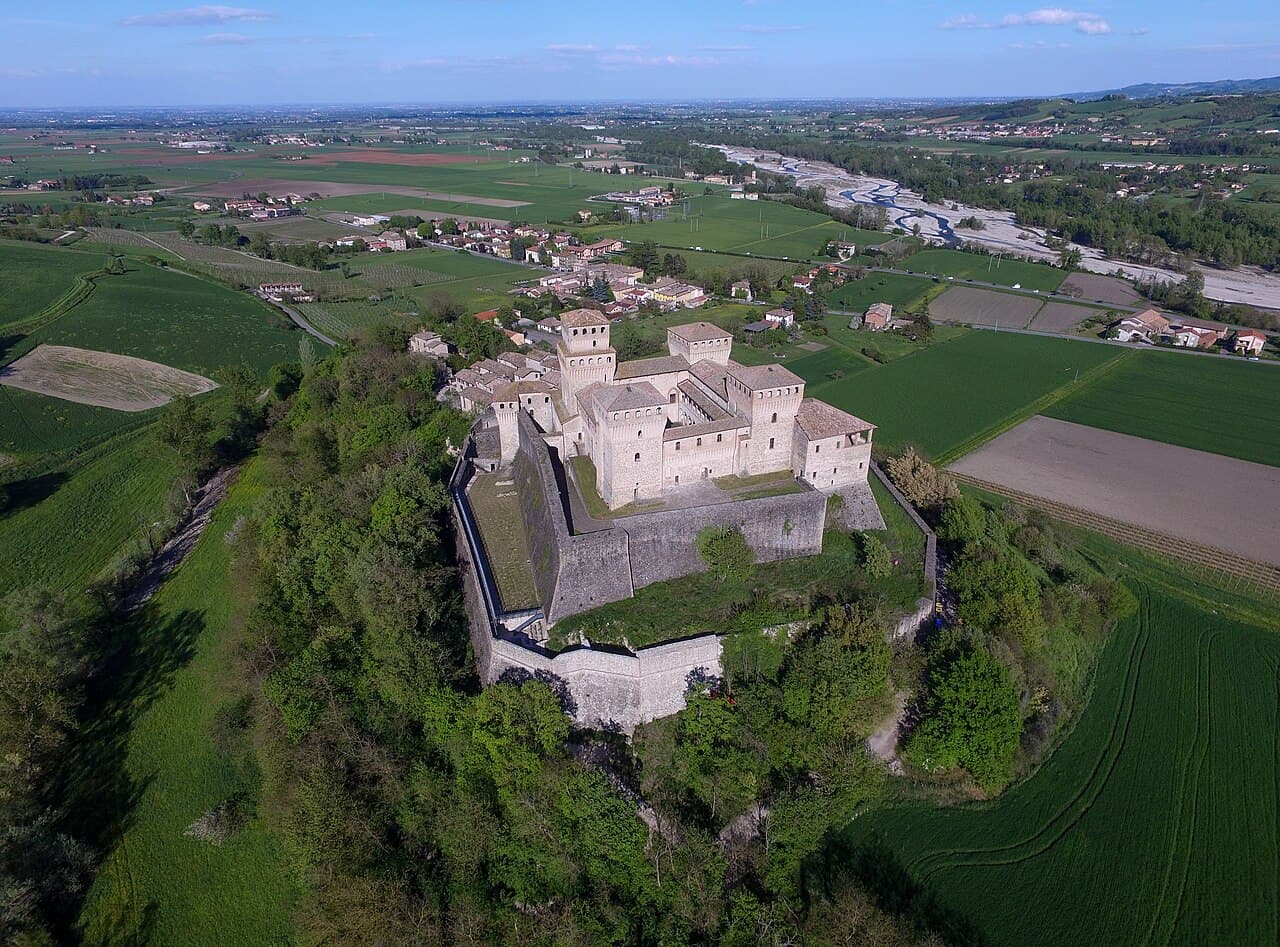
Torrechiara Castle
Torrechiara Castle is a remarkable example of a late medieval hill castle located on a rocky promontory overlooking the Parma valley in northern Italy. Constructed between 1448 and 1460 by Pier Maria II Rossi, count of San Secondo, the castle was designed both as a formidable military stronghold and an elegant private residence. Its dual purpose reflects the complex social and political environment of 15th-century Italy, where noble families sought to assert dominance through both martial power and cultural patronage.
The castle’s strategic position atop a hill at 278 meters above sea level provided commanding views of the surrounding landscape, crucial for defense and control of the valley. The nearly rectangular layout centers on the expansive Corte d’Onore (Courtyard of Honour), about 470 square meters in area, which serves as the heart of the fortress and residence. The castle’s architecture combines robust fortifications with refined residential spaces, illustrating the transition from purely military castles to multifunctional noble estates during the Renaissance period.
Historical background and construction
The site of Torrechiara Castle has a long history of fortification dating back to the medieval period. Initial fortifications were recorded as early as 1259, with a fortified house erected by the Scorza family in the 1260s. This earlier structure was destroyed in 1293, and despite a decree forbidding defensive constructions in 1297, the location remained strategically significant and was frequently contested by local noble families.
The castle as it stands today was built by Pier Maria II de’ Rossi on the ruins of these earlier fortifications. His construction was motivated by the need to control the Parma valley militarily and to create a luxurious residence for himself and his lover, Bianca Pellegrini. The castle’s decorations are rich with symbolic references to their relationship, with their initials and emblems prominently displayed throughout the structure.
Following Pier Maria II’s death in 1482 during the turbulent Rossi family wars, the castle changed hands multiple times. It came under the control of Milanese and French forces before being acquired by local noble families such as the Sforza di Santa Fiora. These later owners transformed the fortress into a more comfortable residence, adding panoramic loggias and converting defensive bastions into gardens, reflecting evolving tastes and reduced military threats.
Ownership passed through the Sforza Cesarini and Torlonia families over the centuries. In the early 20th century, Pietro Cacciaguerra purchased the castle and removed much of its original furnishings. Recognizing its cultural and historical importance, the Italian government declared Torrechiara a national monument in 1911 and took ownership in 1912. A significant earthquake in 2008 caused damage to the castle’s external walls and the San Nicomede tower, prompting restoration efforts completed by 2014.
Architectural features and layout
Fortifications and towers
The castle’s fortifications are exemplary of late medieval military architecture adapted to residential needs. It features four large square corner towers with tiled roofs, each named for symbolic or geographical associations. The tallest, the Lion Tower, rises 40 meters plus a 6-meter donjon and proudly displays the Rossi family lion emblem. The Lily Tower, overlooking the Rio delle Favole valley, bears the emblem of Bianca Pellegrini. Other towers include the San Nicomede Tower, named after the oratory it houses, and towers oriented toward the surrounding valleys.
A fifth tower, the Ravelin Tower, guards the inner defenses, a feature highlighting the castle’s layered fortification system. Originally, the castle was surrounded by three concentric stone walls: the outermost encircled the hill, the middle enclosed a northern settlement, and the innermost protected the citadel. Two dry moats with drawbridges once enhanced the defenses, traces of which remain visible today.
Courtyard and porticoes
The Corte d’Onore is the central open space around which the castle’s rooms and towers are arranged. It contains a 66-meter deep brick-lined well, essential for water supply during sieges. The courtyard is bordered by two porticoes: the western portico features massive stone columns, a fountain, and a grand staircase adorned with a fresco attributed to Jacopo Loschi. The eastern portico has slender brick columns with intricately carved sandstone capitals bearing the intertwined initials of Pier Maria II and Bianca Pellegrini, symbolizing their enduring bond.
Gatehouse and entrances
The castle’s main entrance was originally near the Lion Tower on the northwest but was later moved to a fortified gatehouse on the northeast. This gatehouse is protected by a stone ravelin and features two portals: a smaller rounded arch for pedestrian access and a larger pointed arch for carts and horses, reflecting the dual needs of defense and daily use.
Interior spaces and artistic heritage
Camera d’oro and frescoes
The Camera d’Oro ("Golden Chamber") is the castle’s most famous interior space, believed to have been Pier Maria II’s bedroom and study. It is renowned for its exquisite 15th-century fresco cycle by Benedetto Bembo, which celebrates the love story between Pier Maria II and Bianca Pellegrini. The room once featured gilded decorations and terracotta reliefs, though some gilding was removed around 1910. The frescoes combine romantic symbolism with Renaissance artistic techniques, making the chamber a masterpiece of Italian castle decoration.
Other decorated rooms
Additional rooms on the ground floor include three "day rooms" adorned with late 16th-century grotesque frescoes by Cesare Baglioni and his workshop. These frescoes depict mythological and natural motifs, reflecting Renaissance tastes for elaborate and symbolic decoration.
The castle’s large northern hall, situated between the Camera d’Oro and the Lion Tower, served as a reception room. It is richly frescoed with grotesques, allegorical scenes, and displays eight large coats of arms representing the Sforza di Santa Fiora family and their papal and ducal patrons, highlighting the castle’s continued importance as a noble residence into the Renaissance.
San nicomede oratory and artworks
The San Nicomede oratory is a small chapel accessible from the eastern portico. It contains a Gothic pointed niche and a brick altar. Originally, it housed a 1462 polyptych by Benedetto Bembo depicting the Madonna and saints, and a wooden tribune likely created by Arduino da Baiso around 1475 for private worship. These artworks were removed in the early 20th century, with surviving pieces now preserved in Milan’s Castello Sforzesco Pinacoteca.
Kitchen and service areas
The castle’s kitchen, located in the northeast corner, contains a large stone fireplace, ovens, a food warmer, and a built-in sloped sink. It connects to storage rooms, a former fruit garden along the northern wall, a lower kitchen, and servants’ quarters above. The stables, accessible from the western portico at the base of the Lily Tower, could accommodate about ten horses and retain original wooden mangers and troughs with a pebble floor.
Later modifications and restoration
In the late 16th century, the castle’s eastern facade was enhanced with two bastion extensions topped by panoramic loggias, offering sweeping views of the Parma valley. These additions reflect the shift from purely defensive architecture to more leisurely and aesthetic considerations.
The castle suffered damage during a 2008 earthquake, particularly to the external walls and the San Nicomede tower. Restoration efforts completed by 2014 included rebuilding the collapsed roof and restoring original frescoed rooms, ensuring the preservation of the castle’s historical and artistic heritage.
Today, Torrechiara Castle is managed by the Italian Ministry of Culture and is part of a regional association of castles in Parma, Piacenza, and Pontremoli. It hosts cultural events such as the Torrechiara Festival, dedicated to the renowned soprano Renata Tebaldi, held in the Courtyard of Honour, linking the castle’s historical legacy with contemporary cultural life.
Frequently asked questions (FAQ)
- How do I visit Torrechiara Castle?
- Torrechiara Castle is open to visitors year-round, with guided tours available that explore its rich history and artistic heritage. It is advisable to check the official website for current opening hours and any special events.
- What is the historical significance of Torrechiara Castle?
- Torrechiara Castle is a prime example of late medieval military architecture combined with Renaissance residential design. It was built by Pier Maria II Rossi as both a fortress and a romantic residence, reflecting the complex social dynamics of 15th-century Italy.
- Can I see the Camera d'Oro frescoes?
- Yes, the Camera d'Oro is one of the castle’s highlights, featuring exquisite 15th-century frescoes by Benedetto Bembo celebrating the love story of Pier Maria II Rossi and Bianca Pellegrini. It is accessible during guided tours.
- Is Torrechiara Castle accessible for people with mobility issues?
- Due to the castle’s medieval structure and hillside location, accessibility may be limited for visitors with mobility challenges. Some areas involve stairs and uneven surfaces, so it is recommended to contact the castle management in advance for assistance.
- When is the best time to visit Torrechiara Castle?
- Spring and early autumn offer pleasant weather and fewer crowds, making these seasons ideal for visiting Torrechiara Castle. The castle also hosts cultural events during summer, which can enhance the visitor experience.
- Are there nearby attractions to visit after Torrechiara Castle?
- The Parma valley region is rich in cultural and natural attractions, including the city of Parma with its renowned art and cuisine, as well as other historic castles in the Emilia-Romagna region. Visitors often combine their trip with exploring these sites.
- What are the ticket prices for Torrechiara Castle?
- Ticket prices vary depending on the type of visit and age group. Standard adult tickets are typically affordable, with discounts for children, seniors, and groups. It is best to consult the official website for current pricing.
- What are the opening hours of Torrechiara Castle?
- Opening hours can vary seasonally and during special events. Generally, the castle is open from mid-morning to late afternoon. Checking the official website before planning a visit ensures up-to-date information.
Photo gallery

Information
Sources & official resources
Verify the information above using these authoritative references.
Loading map...
Visitor reviews
No reviews yet. Been here? Write the first review and help other travelers!
Write the first reviewVisited this castle? Share your experience
Your review helps other travelers and adds first-hand knowledge to our encyclopedia.


