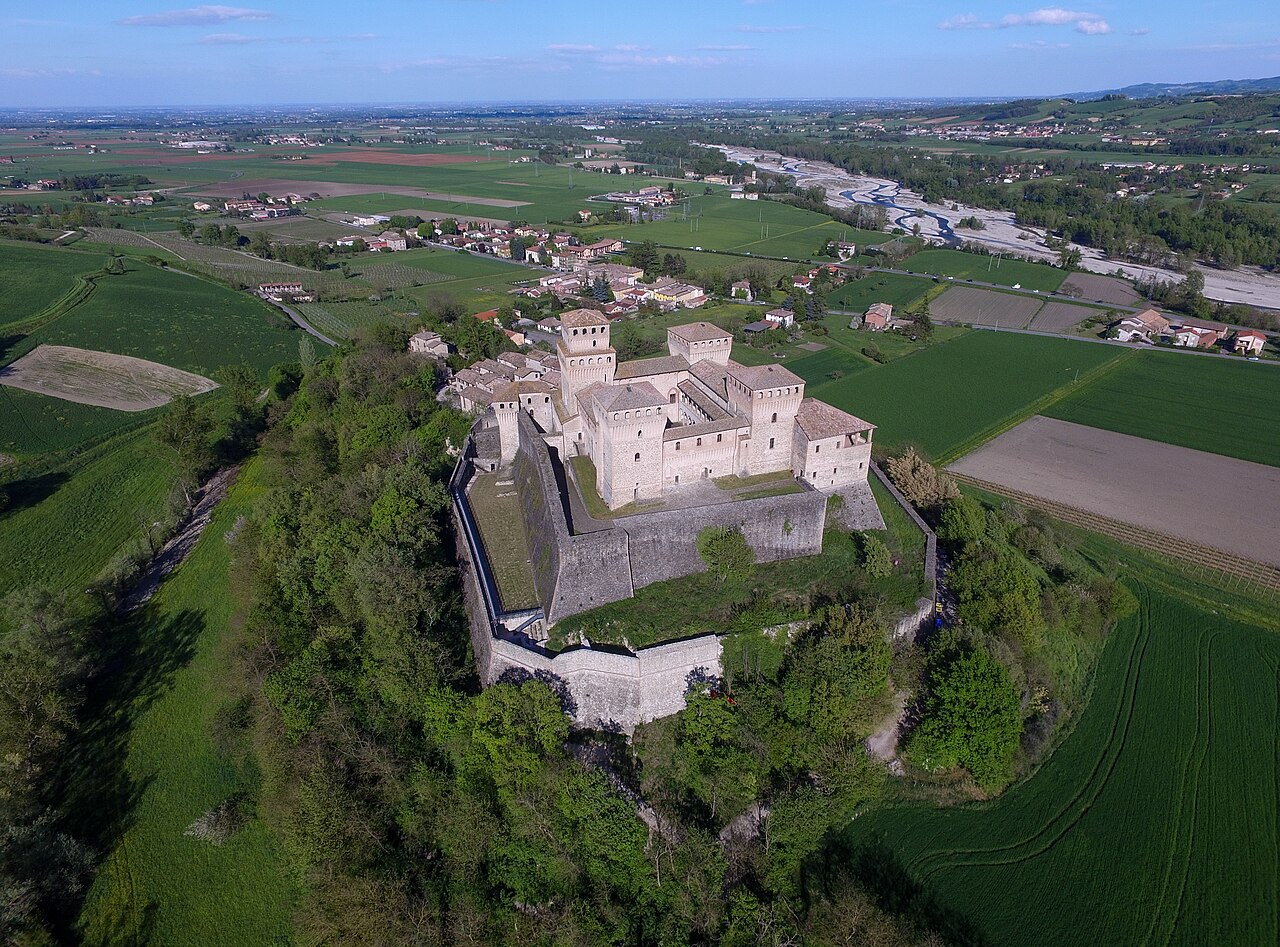
The Castle of Selva Smeralda stands as a remarkable example of medieval fortification nestled on a steep hillside in the municipality of Terenzo, Italy. This hill castle commands a strategic vantage point overlooking the Sporzana stream valley, embodying centuries of feudal power struggles, architectural evolution, and historical significance. Though its exact founding date remains uncertain, the fortress's core structures date primarily to the 14th century, with its imposing keep or mastio representing the strongest surviving element of the complex.
Constructed primarily of brick masonry, the square tower of the keep retains much of its original medieval fabric, including distinctive carved stone corbels on three sides that illustrate the craftsmanship and defensive design typical of the period. These corbels once supported upper defensive platforms or machicolations, integral to the castle's protective architecture. Adjacent to the keep, ancillary buildings made of mixed stone and brick materials have undergone various modifications and restorations, particularly in the early 2000s, which have preserved the castle's core while adapting parts for agricultural use and residential purposes.
Historical background and feudal ownership
The castle's documented history begins in the medieval period when it was established by local noble families who controlled the surrounding lands. During the 13th century, the settlement then known as Nivianus Draconorum and its castle were under the dominion of the Draghi family. This community was ecclesiastically aligned with the parish of San Vitale Baganza, reflecting the intertwined nature of feudal and religious authority.
Subsequently, the castle passed into the hands of the Rossi family, a powerful feudal dynasty influential in the region's political landscape. The Rossi family's tenure was marked by conflict and shifting allegiances. Notably, in 1409, the castle endured a siege led by Ottobuono de’ Terzi, compelling the Rossi brothers to cede several fortresses to the Terzi family as part of a peace agreement. This episode underscores the volatile nature of feudal warfare and territorial disputes in northern Italy during the late medieval era.
By 1424, the political tides shifted when Duke Filippo Maria Visconti, the Milanese ruler, restored the contested lands to Pietro de’ Rossi, reaffirming the family's control. The castle remained within the Rossi lineage until 1464, when Pier Maria II de’ Rossi bequeathed it, along with associated fiefs, to his son Guido Neviano de’ Rossi. This period reflects the consolidation of familial power and the importance of hereditary succession in maintaining feudal estates.
Conflicts and decline in the 16th century
The castle's fortunes shifted dramatically in the mid-16th century amid the turbulent War of Parma (1552). Following the death of Pier Maria II during the so-called Rossi War, ownership transferred to Colonel Lorenzo Smeraldi of Parma. The fortress became a target during the conflict when imperial forces led by Ferrante I Gonzaga attacked and looted the castle and its surrounding village.
This siege resulted in the capture of Giovanni Smeraldi, allied with the influential Farnese family. After a dramatic sequence involving imprisonment, escape, recapture, and eventual execution, the Smeraldi family abandoned the castle, retreating to Parma. This marked a significant turning point, signaling the decline of the castle's military and residential importance.
Later ownership and restoration
In the aftermath, the castle's ownership passed through various noble families, including the Tarasconi Smeraldi counts formed by the union of the Smeraldi and Tarasconi lineages. They maintained control until the abolition of feudal rights under Napoleon in 1805. Subsequent owners included the Folli family and later the Hungarian Orbàn family, reflecting the shifting ownership patterns typical of many Italian rural estates.
In recent decades, the castle has undergone thorough restoration efforts aimed at preserving its architectural integrity. These restorations have sensitively adapted the site for agricultural lodging and summer residence use, ensuring the castle remains a living part of the region's cultural heritage.
Architectural features and layout
The castle's layout exemplifies a typical fortified design tailored to its hilltop location. The dominant feature is the 14th-century keep, a tall, square tower constructed mainly of brick, which has withstood the ravages of time remarkably well. The presence of carved stone corbels on three sides provides important clues to the castle's defensive mechanisms, suggesting the former existence of overhanging battlements or machicolations used to repel attackers.
Surrounding the keep are outbuildings constructed from a combination of stone and brick. These structures have been altered over centuries but retain much of their original form thanks to early 21st-century restoration work. Internally, some rooms have been repurposed for agricultural equipment storage, but the overall fabric of the castle remains intact, preserving its medieval character.
No significant decorative elements or inscriptions have been documented at the site, emphasizing the castle's primarily military and functional role rather than a residence of lavish ornamentation. The surviving walls and defensive structures continue to bear witness to the castle's long history of feudal ownership, military conflict, and adaptation to rural estate life.
Strategic location and defensive advantages
Perched on a steep hillside, the castle's position provided a commanding view over the Sporzana stream valley, enabling early detection of approaching enemies. The natural slope enhanced its defensive capabilities, making direct assaults difficult. The compact layout and robust masonry further strengthened its resilience against sieges.
Cultural and heritage significance
Today, the Castle of Selva Smeralda stands as a testament to the complex feudal history of northern Italy. Its preservation and adaptive reuse reflect an ongoing commitment to safeguarding cultural heritage while integrating historical sites into contemporary rural life. The castle attracts historians, architecture enthusiasts, and visitors interested in medieval fortifications and Italian noble lineage.
Frequently asked questions (FAQ)
- How do I get to the Castle of Selva Smeralda?
- The Castle of Selva Smeralda is located in the picturesque region of Italy, easily accessible by car or public transport. Visitors can take a train to the nearest town and then use local buses or taxis to reach the castle. It's advisable to check local transport schedules for the most convenient options.
- What is the historical significance of the Castle of Selva Smeralda?
- The Castle of Selva Smeralda dates back to the 12th century and played a crucial role in regional defense and governance. Its architecture reflects the medieval style and the strategic importance of the location during historical conflicts. The castle is a testament to the rich history of the region and offers insight into the lives of its past inhabitants.
- When was the Castle of Selva Smeralda last renovated?
- The most recent renovations of the Castle of Selva Smeralda occurred in the early 21st century, ensuring the preservation of its historical structure while enhancing visitor accessibility. These renovations included restoring the castle walls and updating the visitor facilities. This careful restoration has allowed the castle to remain a significant tourist attraction.
- Can I take guided tours of the Castle of Selva Smeralda?
- Yes, guided tours are available at the Castle of Selva Smeralda, providing visitors with in-depth knowledge about its history and architecture. Tours are conducted by knowledgeable guides who can answer questions and share interesting anecdotes. It's recommended to book your tour in advance to secure your spot.
- Why is the Castle of Selva Smeralda a popular tourist destination?
- The Castle of Selva Smeralda attracts tourists due to its stunning architecture, rich history, and breathtaking views of the surrounding landscape. The castle's enchanting atmosphere and well-preserved structures make it a favorite among photographers and history enthusiasts. Additionally, the castle often hosts cultural events that add to its appeal.
- Is it possible to visit the Castle of Selva Smeralda with children?
- Absolutely! The Castle of Selva Smeralda is family-friendly, offering engaging activities for children, including treasure hunts and educational workshops. The castle's grounds provide plenty of space for children to explore safely. Just ensure to supervise them as some areas may have steep drops or uneven terrain.
- What are the opening hours of the Castle of Selva Smeralda?
- The Castle of Selva Smeralda is open to visitors from 9 AM to 6 PM, with extended hours during the summer months. It is advised to check the official website for any seasonal changes or special events that may affect opening times. Arriving early allows you to enjoy the castle without the crowds.
- What are the ticket prices for the Castle of Selva Smeralda?
- Ticket prices for the Castle of Selva Smeralda vary, with discounts available for children, seniors, and groups. Adult tickets are typically around €10, while children under 12 may enter for free. It's best to check the official website for the most up-to-date pricing and any special offers.
- What nearby attractions can I visit after the Castle of Selva Smeralda?
- After visiting the Castle of Selva Smeralda, you can explore nearby attractions such as the charming village of Selva Smeralda and the scenic hiking trails in the surrounding hills. Additionally, local wineries and artisanal shops offer a taste of the region's culture and cuisine. Each of these attractions enhances your overall experience in this beautiful part of Italy.
Information
Loading map...
Visitor reviews
No reviews yet. Been here? Write the first review and help other travelers!
Write the first reviewVisited this castle? Share your experience
Your review helps other travelers and adds first-hand knowledge to our encyclopedia.