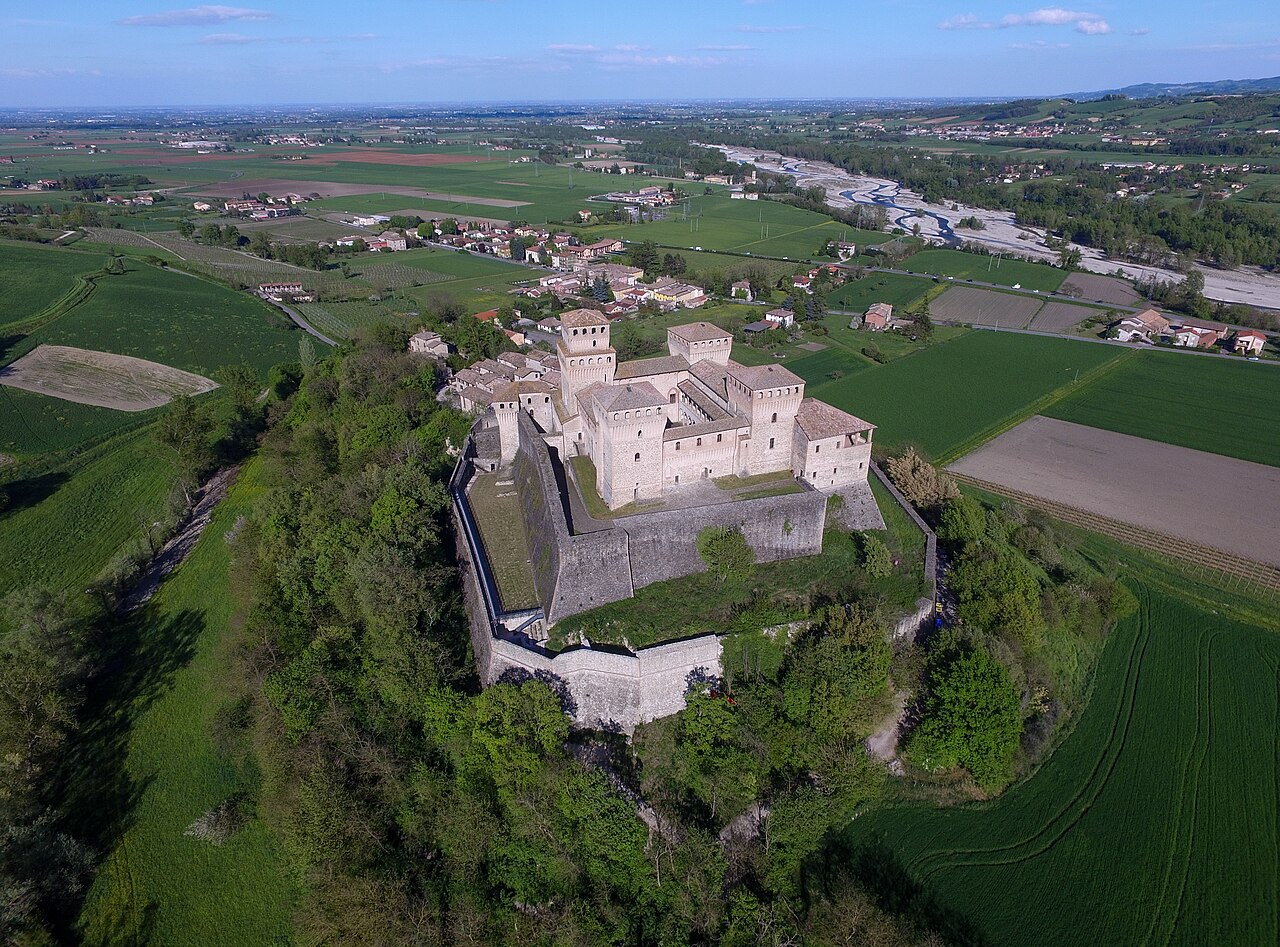
Castello di Torrechiara
Castello di Torrechiara, located in the Emilia-Romagna region of Italy, stands as a remarkable example of a late medieval fortress transformed into a luxurious residence. Originally mentioned in the eleventh century as "Torclara," the castle underwent a significant reconstruction between 1448 and 1460 under the direction of Pier Maria Rossi. This rebuilding was inspired by a romantic gesture, as the castle was designed to honor his beloved Bianca Pellegrini. The castle's history is deeply intertwined with the personal love story of its builder, which is vividly reflected in its architecture and decoration.
Architectural design and fortifications
The castle retains its distinctive square-shaped body typical of late medieval military architecture, surrounded by four robust towers and an imposing crenellated curtain wall. This design reflects the dual purpose of the castle as both a defensive stronghold and a noble residence. The entrance to the castle is through a long covered passageway that leads visitors into the central courtyard. Within the courtyard stands the small church of St. Nicomedes, notable for its door adorned with the monograms of Bianca Pellegrini and Pier Maria Rossi, symbolizing their bond.
Defensive features
The four towers, strategically positioned at each corner of the square layout, provided vantage points for surveillance and defense. The crenellated walls allowed defenders to protect the castle effectively while maintaining the aesthetic balance of the structure. The castle's elevated position on a hill further enhanced its defensive capabilities, typical of a hill castle designed to oversee the surrounding landscape.
Interior decoration and frescoes
Inside, the castle is renowned for its rich interior decoration, particularly the extensive frescoes that adorn many rooms. The old kitchen remains a significant space, alongside notable chambers such as the Jupiter room, the Pergola, the Room of Landscapes, the Room of Victoria, the Room of Angels, the Velario, and the Coat of Arms room. These frescoes are attributed to artists from the Sforza Cesare Baglione school, reflecting the artistic trends of the period.
Hall of Acrobats
On the upper floor, the Hall of Acrobats stands out with decorations by artists associated with Baglione Paganino's school. This hall is notable for its intricate frescoes depicting acrobatic figures, showcasing the blend of artistic skill and thematic creativity typical of Renaissance art.
Camera d'Oro (Golden Room)
The most celebrated interior space is the Camera d'Oro, or Golden Room, named for the original gold leaf that once covered its wall panels. This room features a rare and exquisite cycle of frescoes attributed to Benedetto Bembo. The frescoes depict scenes of chivalric love rituals and celebrate the enduring bond between Bianca Pellegrini and Pier Maria Rossi. Symbols such as two intertwined hearts and the inscriptions "Digne et phrases in aeternum" (with dignity and forever) and "Nunc et semper" (now and forever) emphasize the romantic theme. The Golden Room overlooks a large porch constructed at the end of the fifteenth century, marking the castle's transition from a military fortress to a noble dwelling.
Historical context and significance
The castle's construction during the mid-15th century reflects the broader trend in Italian fortifications, where military structures gradually incorporated residential and representational functions. Pier Maria Rossi, a prominent nobleman and military leader, used the castle not only as a defensive bastion but also as a symbol of power and love.
Over time, as the need for military defense lessened, the castle's role evolved. The addition of luxurious frescoes and comfortable living quarters illustrates this shift from purely martial architecture to a Renaissance residence blending art, culture, and fortification.
Preservation and current status
Today, Castello di Torrechiara is well preserved and remains one of the most significant castles in the Emilia-Romagna region. Its architectural integrity and rich decorative program attract scholars and tourists alike. The castle serves as a cultural landmark, showcasing the fusion of late medieval military architecture with Renaissance artistic innovation.
Visitors can explore the castle's various rooms, admire the frescoes, and appreciate the historical narrative embedded in its walls. The site offers insight into the lifestyle of Italian nobility during the transition from the Middle Ages to the Renaissance.
Frequently asked questions (FAQ)
- When was Castello di Torrechiara built and by whom?
- Castello di Torrechiara was rebuilt between 1448 and 1460 by Pier Maria Rossi as a luxurious residence for his beloved Bianca Pellegrini.
- What architectural style characterizes Castello di Torrechiara?
- The castle features a mixed architectural style combining late medieval military design with Renaissance artistic elements, especially in its frescoes and interior decoration.
- What is the significance of the Camera d'Oro in the castle?
- The Camera d'Oro, or Golden Room, is famous for its rare fresco cycle attributed to Benedetto Bembo, depicting chivalric love rituals celebrating the bond between Bianca Pellegrini and Pier Maria Rossi.
- Is Castello di Torrechiara open to visitors?
- Yes, the castle is well preserved and open to visitors who can explore its historic rooms, frescoes, and architectural features.
- Where is Castello di Torrechiara located?
- The castle is located in the Emilia-Romagna region of Italy, known for its rich medieval and Renaissance heritage.
Information
Loading map...
Visitor reviews
No reviews yet. Been here? Write the first review and help other travelers!
Write the first reviewVisited this castle? Share your experience
Your review helps other travelers and adds first-hand knowledge to our encyclopedia.