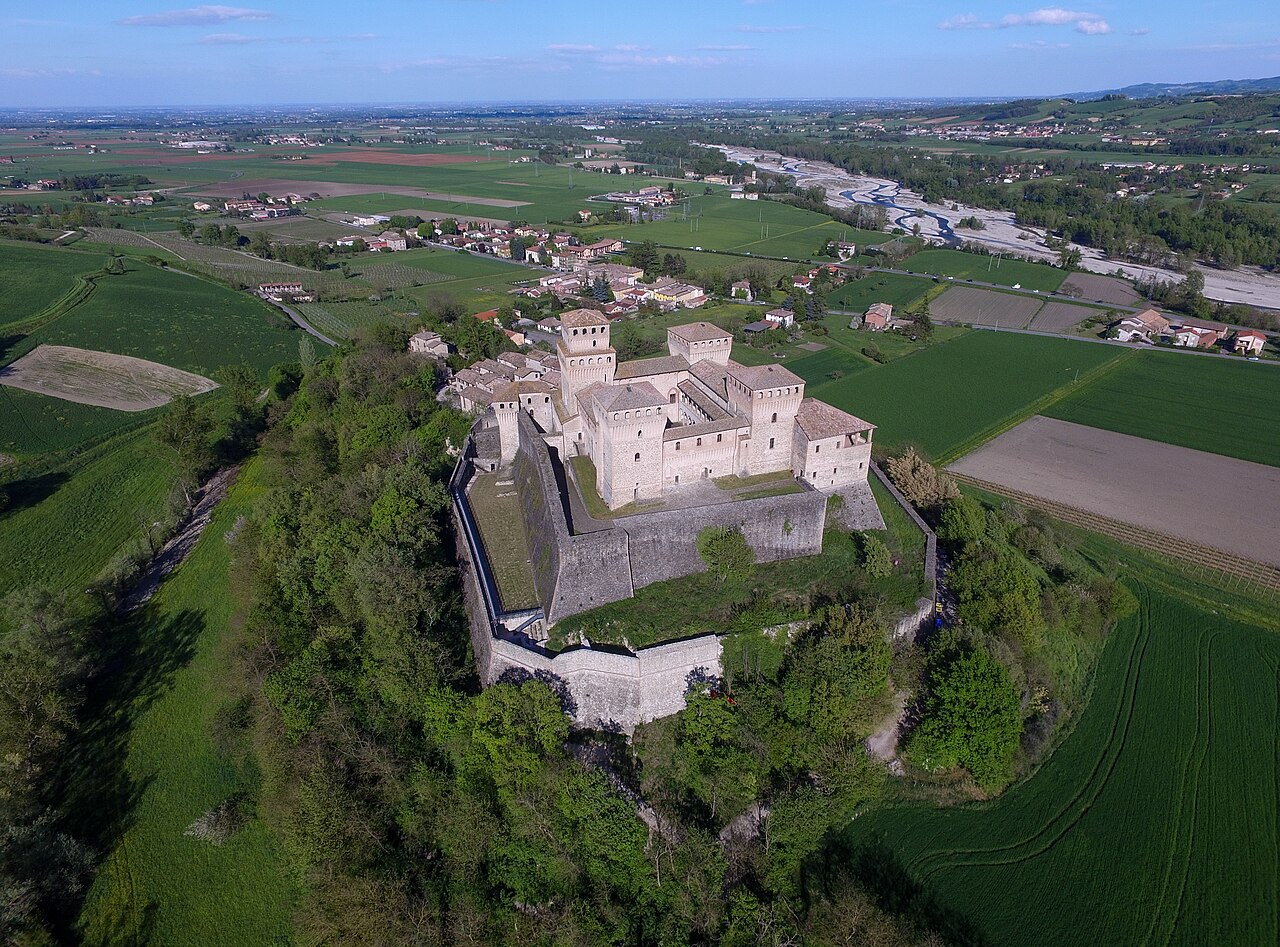
Castello di Felino
The Castello di Felino stands as a prominent example of medieval military architecture in the Emilia-Romagna region of Italy. Located in the municipality of Felino, near Parma, this hill castle has played a significant role in the area's history since at least the 12th century. Its strategic position overlooking the Baganza Valley allowed it to serve both as a defensive stronghold and a noble residence, reflecting the turbulent political and military landscape of northern Italy throughout the Middle Ages and Renaissance.
Historical documentation first reliably mentions a fortress at Felino in 1140, although the surrounding lands appear in records as early as the 9th century. The grant of these lands by King Lothair II in 948 to Count Manfredo di Ugo underscores the area's early medieval importance. By the late 12th century, the castle was part of imperial politics when Emperor Frederick Barbarossa awarded the fiefdom to Guido de’ Ruggeri of Parma, cementing its role in the feudal system and regional power struggles.
Medieval origins and strategic significance
The castle’s initial construction likely dates to the early 12th century, designed to control key routes and assert feudal authority. Its elevated position on a steep stone base made it a formidable defensive site. The fortress’s rectangular layout, surrounded by a deep moat and featuring four massive corner towers, was typical of hill castles built for both defense and administration.
Throughout the 14th century, the Rossi family acquired the castle through marriage, using it as a principal seat for over a century. This period was marked by frequent conflict involving local noble families such as the Pallavicino, Terzi, and Gonzaga, who contested control over Felino and its surrounding territories. The castle endured multiple sieges and assaults, necessitating continual reinforcement of its defenses.
Renaissance transformations and military decline
The most significant architectural changes occurred under Pier Maria II de’ Rossi in the 15th century. He reshaped the castle into a rectangular plan with four corner towers and a surrounding moat, enhancing its defensive capabilities. The presence of machicolations—openings allowing defenders to drop projectiles on attackers—attests to the castle's military function during this era.
However, the castle’s military role diminished following the War of the Rossi (1482-1483), when forces led by Ludovico il Moro besieged and captured it. Ludovico ordered the demolition of key fortifications, signaling a decline in the castle’s strategic importance. Control then passed to the Sforza family, who maintained possession amidst ongoing regional conflicts in the 16th century.
Ownership changes and architectural adaptations
Subsequent centuries saw the castle pass through the hands of prominent noble families, including the Pallavicino, Sforza di Santa Fiora, Masi, and Lampugnani. The 17th century was marked by political intrigue, feudal conspiracies, and shifts in the estate’s status, culminating in its elevation from county to marquisate.
In the late 18th century, the castle transitioned from a military fortress to a countryside residence under the bishops of Parma. Bishop Francesco Pettorelli Lalatta adapted the structure for residential use, reflecting broader changes in castle functions during the post-medieval period. Despite these modifications, the castle eventually fell into neglect by the early 20th century.
Modern restoration and cultural significance
The castle entered private ownership in 1935 when sold to the Brian family, who began adapting parts of it for hospitality purposes in the 1960s. A major restoration phase commenced in 1974 under Sergio Alessandrini, focusing on preservation and careful restoration of architectural features.
Today, the Castello di Felino is notable not only for its well-preserved medieval architecture but also for its cultural role. Since 2004, its basement houses a museum dedicated to the production of Felino salami, linking the castle to the region’s culinary heritage and attracting gastronomic tourism.
Architectural features and layout
The castle’s design follows a rectangular plan centered around an open courtyard with a well. The four corner towers are massive and robust, with the southwestern turret guarding the narrow entrance bridge. The entire complex is surrounded by a deep moat, originally complemented by defensive walls and fortifications, some of which were dismantled during the late 15th-century demolitions.
The fortress rests on a steep stone base pierced by multiple embrasures for defensive weapons. The towers and main buildings once featured machicolations supported by long corbels, though these were removed in the late 1400s. The main entrance is accessed via a high stone arch bridge, formerly equipped with a wooden drawbridge operated by mechanisms housed in a small turret above the gate.
The western and northern towers differ architecturally from the others, lacking corbels and decorative cornices. The eastern keep, likely rebuilt in the early 16th century, has an irregular five-sided plan with a projecting northern spur and is crowned by a dungeon at approximately 330 meters above sea level.
Interior spaces and artistic elements
Inside, the castle contains several rooms preserving original features such as ancient fireplaces and collections of historical weapons and armor. A notable artifact is a bell cast in 1652 commissioned by Duke Ranuccio II Farnese.
The most artistically significant interior space is the Oratory of St. Peter the Apostle, built in 1454-1455 on the second floor of the eastern tower by Pier Maria II de’ Rossi. It features an umbrella-shaped vaulted ceiling and frescoes uncovered during restoration in 1997. The oratory’s lunettes display the coats of arms of various past owners, including the Pallavicino family and Cardinal Francesco Sforza di Santa Fiora, with artwork attributed to Cesare Baglione.
Basement and museum
The basement comprises stone and brick cellars and kitchens vaulted with barrel-shaped ceilings. This space has been restored and adapted to house the museum dedicated to the local Felino salami, celebrating the gastronomic tradition of the region and enhancing the castle’s appeal as a cultural destination.
Visiting castello di felino
Visitors to the Castello di Felino can explore its well-preserved architectural features, including the towers, moat, and courtyard, as well as the richly decorated interiors of the oratory. The museum in the basement offers insights into the region’s culinary heritage, making the castle a unique blend of history and culture.
The castle’s location in the scenic Baganza Valley provides picturesque views and a connection to the natural landscape that has shaped its history. Its combination of medieval military architecture and Renaissance artistic elements makes it a valuable site for enthusiasts of history, architecture, and gastronomy.
Overall, the Castello di Felino exemplifies the evolution of a medieval fortress into a cultural landmark, reflecting the complex history of northern Italy from the early Middle Ages through the Renaissance and into the modern era.
Frequently asked questions (FAQ)
- What is the historical significance of Castello di Felino?
- Castello di Felino is a medieval fortress that dates back to the 10th century, playing a crucial role in the defense of the region. Its architecture reflects the military strategies of the time and offers insights into the feudal system in Italy. Today, it stands as a symbol of the local heritage and attracts history enthusiasts from around the world.
- When was Castello di Felino built?
- The construction of Castello di Felino began in the early 10th century, with significant modifications occurring throughout the centuries. The castle has been restored and preserved, allowing visitors to glimpse its rich historical past. Its structure showcases various architectural styles that evolved during its long history.
- What are the opening hours of Castello di Felino?
- Castello di Felino is open to visitors from Tuesday to Sunday, with hours varying seasonally. Typically, it opens at 10 AM and closes at 6 PM, but it's advisable to check the official website for the most current information. Special hours may apply on holidays or for events, so planning ahead is recommended.
- Can I visit Castello di Felino with children?
- Yes, Castello di Felino is family-friendly and welcomes visitors of all ages. Children can enjoy exploring the castle's towers and learning about its history through interactive exhibits. The spacious grounds also provide a safe and engaging environment for young visitors.
- Is it possible to take guided tours of Castello di Felino?
- Yes, guided tours are available at Castello di Felino, providing an in-depth look at its history and architecture. These tours are led by knowledgeable guides who can share fascinating stories and insights about the castle's past. It's recommended to book in advance, especially during peak tourist seasons.
- What are the ticket prices for visiting Castello di Felino?
- Ticket prices for Castello di Felino are quite reasonable, with discounts available for students and seniors. General admission is typically around €5, while children under 12 may enter for free. Special rates may apply for guided tours and group visits, so checking the official site is advisable.
- When is the best time to visit Castello di Felino?
- The best time to visit Castello di Felino is during the spring and fall when the weather is mild and pleasant for exploring. These seasons also offer fewer crowds compared to the summer months, allowing for a more enjoyable experience. Additionally, visiting during local festivals can enhance your experience with cultural events.
- What nearby attractions can I explore after visiting Castello di Felino?
- After exploring Castello di Felino, visitors can check out the beautiful village of Felino itself, known for its culinary delights, especially the famous Felino salami. Other nearby attractions include the stunning landscapes of the Parma countryside and the historic city of Parma, known for its art, architecture, and gastronomy. Enjoying local restaurants can also provide a delicious taste of the region.
- How do I get to Castello di Felino?
- Castello di Felino is easily accessible by car, located just a short drive from the city of Parma. Public transportation options are also available, with buses connecting Felino to nearby cities. For those traveling from afar, the closest major airport is Parma Airport, which is approximately 20 kilometers away.
Information
Website
Visit websiteSources & official resources
Verify the information above using these authoritative references.
Loading map...
Visitor reviews
No reviews yet. Been here? Write the first review and help other travelers!
Write the first reviewVisited this castle? Share your experience
Your review helps other travelers and adds first-hand knowledge to our encyclopedia.