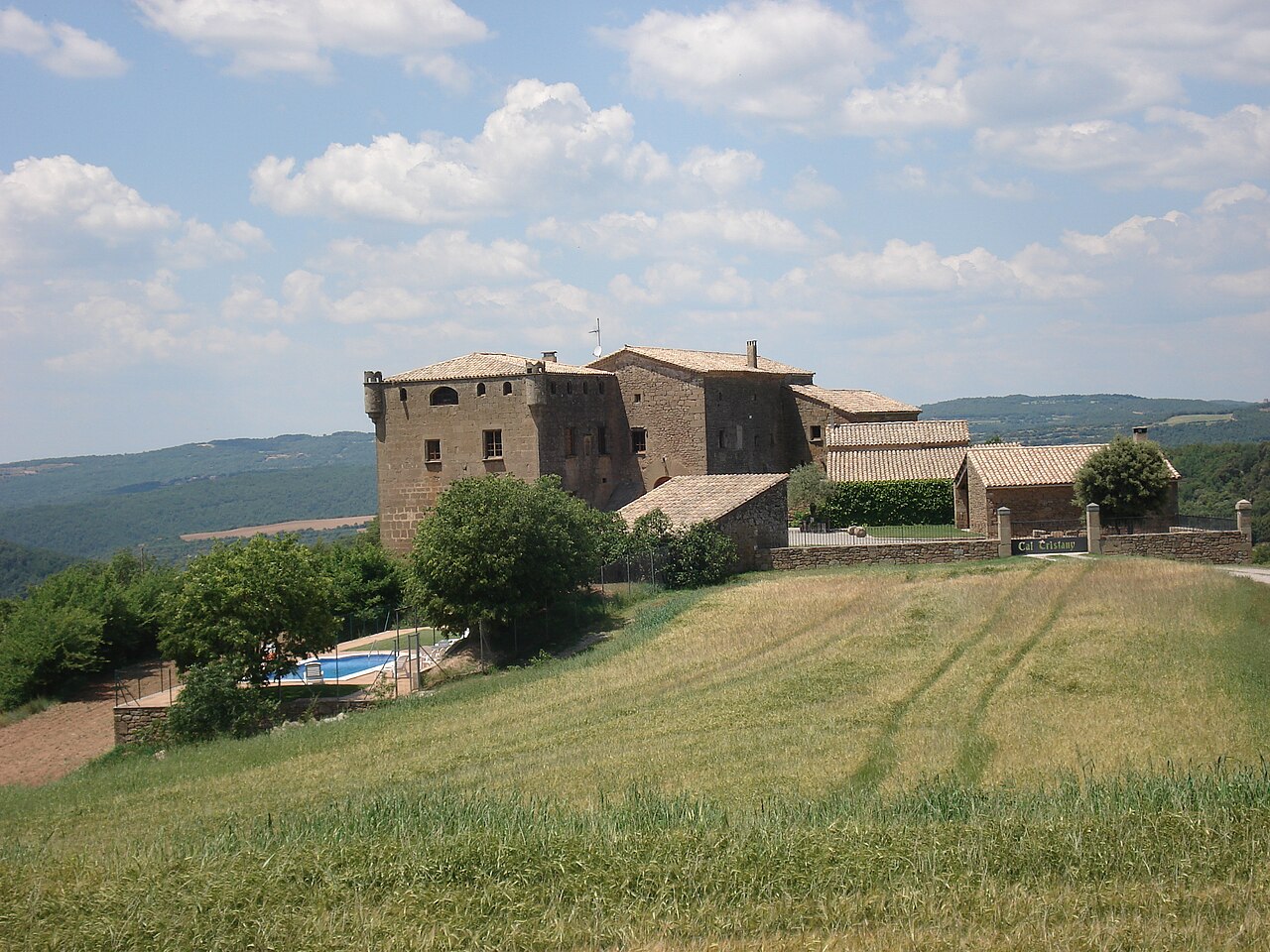
Torre de Vallferosa
The Torre de Vallferosa stands as a remarkable monument of early medieval military architecture in Catalonia, Spain. This hill castle watchtower, located in the hamlet of Vallferosa within the municipality of Torà, reflects a rich history shaped by the shifting control between Muslim and Christian powers during the turbulent centuries of the Reconquista. Its strategic position overlooking the Barranc dels Quadros ravine underscores its role in surveillance and territorial control.
Traditional historiography dated the tower's construction to around 970 AD, attributing it to Christian efforts to consolidate regained lands. However, recent scientific studies have pushed its origins back to the 8th or early 9th century, coinciding with the period of Muslim presence in the region. This earlier dating suggests the tower initially served practical functions such as overseeing communication routes used for seasonal livestock movements, trade, and tax collection, rather than solely military defense. Later, during the 11th century, Christian forces adapted the tower for enhanced defensive purposes as political control shifted.
Historical context and ownership
The tower is historically linked to the kastrum de Valle Frausa, documented in 1052 as part of the County of Urgell. By the 12th century, the noble family of Vallferosa rose to prominence in the area, with notable figures such as Berenguer de Vallferosa and Ramon de Ribelles involved in property transactions and feudal administration. The fortress and its lands changed hands several times, reflecting the complex feudal landscape of medieval Catalonia.
By the late 14th century, the tower was incorporated into the County of Cardona, which later became a duchy. The administrative control shifted to the bailiwick of Torà, and the local lord moved his residence to the nearby Clavells farmhouse. The Torre de Vallferosa primarily functioned as a refuge during times of siege or threat, rather than a permanent dwelling.
Architectural features and construction phases
The Torre de Vallferosa rises to a height of 33 meters and is an outstanding example of early medieval construction techniques. The tower's structure combines stone and mortar with rammed earth, an innovative method involving compressed earth layers that enhanced durability. This combination reflects a transitional phase in military architecture, moving towards more robust fortifications.
The tower's entrance is positioned approximately 10 meters above ground level, originally accessible only by a retractable rope ladder. This elevated doorway was a defensive innovation, designed to hinder attackers and protect the interior. Inside, the tower features a sophisticated defensive system, especially evident on the fourth floor, where a unique arrangement of arrow slits allows defenders to cover a wide field of fire. These slits are unusually thick and shielded by diagonal wooden elements, enabling archers to shoot through both upper and lower openings, the latter of which could be closed with a wooden panel. This design is unparalleled in medieval fortifications across Europe.
Scholarly debate has long surrounded the tower's construction phases. Earlier theories suggested three main phases starting around 970 AD: an initial tower reaching about 23 meters, a second circular tower added circa 990 AD to enhance defense, and interior modifications in the 11th century including battlements. However, recent multidisciplinary research proposes that the inner and outer towers were built simultaneously during the 8th or early 9th century as a unified project. Subsequent alterations in the 11th century introduced an interior spiral staircase made from gypsum concrete and diaphragmatic arches supporting the upper floors. Later additions in the 13th or 14th centuries included the roof dome and battlements crowning the tower.
Interior layout and unique elements
The first floor contains a vaulted chamber now filled with rubble. Its original function remains uncertain, with possible uses ranging from storage and a prison cell to a cistern or the beginning of a secret passage intended to supply the fortress during sieges.
One of the tower's most exceptional features is found on the fourth floor: a Romanesque ceiling remains completely intact. This includes a finely carved stone dome and a surviving segment of the interior spiral staircase resting upon a supporting arch. Such preservation of Romanesque architectural elements within a military tower is unique in Europe, highlighting the tower's architectural and historical significance.
Strategic location and access
Perched approximately 50 meters above the Barranc dels Quadros ravine, the Torre de Vallferosa commands a commanding view of the surrounding landscape. Its proximity to the church of Sant Pere de Vallferosa situates it within a historically significant rural complex.
Access to the tower is limited to a footpath descending from the LV-3005a road, emphasizing its secluded and strategic positioning. This limited accessibility has helped preserve the tower's integrity over the centuries.
Cultural heritage and preservation
The Torre de Vallferosa remains well preserved, retaining much of its original structure without significant modern alterations. Its combination of early medieval construction techniques, unique defensive features, and preserved Romanesque elements make it a valuable cultural and architectural heritage site in Catalonia.
As a symbol of the region's complex history during the early medieval period, the tower offers insights into the military, social, and architectural developments of its era. It stands as a testament to the ingenuity and adaptability of medieval builders and the strategic importance of this frontier region during centuries of conflict and cultural exchange.
Frequently asked questions (FAQ)
- How do I get to Torre de Vallferosa?
- Torre de Vallferosa is accessible via a footpath descending from the LV-3005a road near the church of Sant Pere de Vallferosa in the municipality of Torà. Visitors should be prepared for a short walk on uneven terrain.
- What is the historical significance of Torre de Vallferosa?
- Torre de Vallferosa is a unique early medieval watchtower reflecting the complex history of Muslim and Christian control in Catalonia. It offers valuable insights into military architecture and feudal administration from the 8th to 14th centuries.
- Can I explore the interior of the tower?
- Access to the interior of Torre de Vallferosa is limited and may be restricted to preserve its structure. Visitors can view the tower externally and appreciate its architectural features from the surrounding area.
- When is the best time to visit Torre de Vallferosa?
- The best time to visit Torre de Vallferosa is during spring and autumn when the weather is mild, making the footpath approach more comfortable and the surrounding landscape particularly scenic.
- Are there any nearby attractions to visit?
- Nearby attractions include the church of Sant Pere de Vallferosa and the historic town of Torà, which offers additional cultural and historical sites related to the medieval period.
Information
Website
Visit websiteAddress
Near church of Sant Pere de Vallferosa, footpath from LV-3005a road
Sources & official resources
Verify the information above using these authoritative references.
Loading map...
Visitor reviews
No reviews yet. Been here? Write the first review and help other travelers!
Write the first reviewVisited this castle? Share your experience
Your review helps other travelers and adds first-hand knowledge to our encyclopedia.