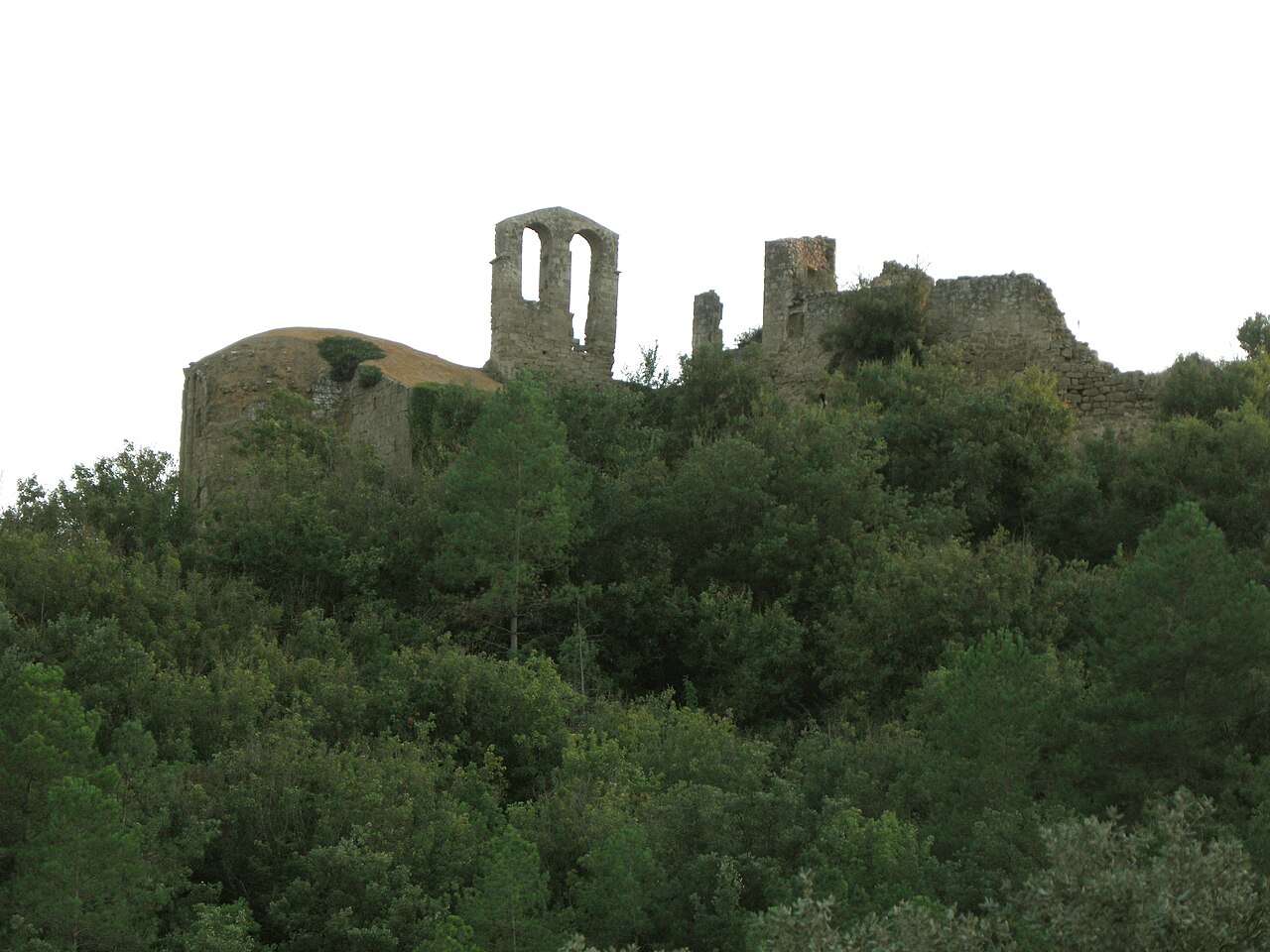
Castell de Ribelles
Castell de Ribelles is a significant hill castle located near the village of Ribelles in the municipality of Vilanova de l’Aguda, Catalonia, Spain. This fortress traces its origins to the Islamic period, marking it as an early medieval military site that later evolved through various historical phases. Its strategic position atop a hill allowed it to serve as a defensive stronghold during the turbulent times of the Christian reconquest and subsequent regional conflicts.
The castle’s earliest documentary mention dates from the mid-11th century, between 1042 and 1075, in records related to a territorial dispute overseen by Viscount Miró of Urgell. At this time, Castell de Ribelles, alongside the fortress of Figuera de l’Aguda, formed part of the eastern defensive line for the castle of l’Aguda. The surrounding barony, which included Ribelles, l’Alzina, Guardiola, and Vilalta, was held by the noble Ribelles family. This family, documented since the 11th century, acted as vassals to the counts of Cerdanya and played a notable role in the Christian conquest campaigns and repopulation efforts initiated by the counts of Urgell.
Historical significance and noble lineage
The Ribelles family rose in prominence during the 12th and 13th centuries. Members of the family participated in the 1149 conquest of Lleida under Count Ermengol VI of Urgell, receiving land grants as a reward. The family’s influence extended through involvement in the conquest of the Valencian region under King James I of Aragon and military expeditions to Sicily. By the early 15th century, a branch of the Ribelles family had established itself in Sardinia, reflecting their expanding reach within the Crown of Aragon’s territories.
Ownership of the castle and barony shifted several times from the 15th century onward. It passed to the convent of Santa Clara of Balaguer, then to the Ponts family, the marquises of Tamarit, and later the Duran family. In 1872, Josep de Bofarull i Rafart secured royal confirmation of his noble title related to Ribelles. The Llabrés family later acquired the castle, undertaking restoration works and maintaining ownership to the present day.
Architectural features and construction phases
The defensive tower
At the heart of Castell de Ribelles stands a robust square tower, the oldest surviving structure, with origins likely predating the year 1000. This tower, compact in size with interior sides just over five meters, was constructed in three main phases. The base, rising to about nine meters, consists of large ashlar blocks measuring approximately 60 by 35 centimeters, forming sturdy walls about 1.75 meters thick. These lower walls include narrow vertical openings, or loopholes, originally designed for defense, although some present loopholes may be modern additions.
The middle section, between nine and thirteen meters high, features thinner walls (about 1.65 meters thick) built with rougher, more irregular stones on both faces, indicating a 12th-century construction phase. At around eleven meters high, the tower’s original entrance remains visible—a west-facing door with a semicircular arch approximately 1.2 meters wide. Inside this entrance is a smaller, now sealed, secondary door that likely served defensive or storage purposes.
The tower’s uppermost portion was added in the 17th century, converting it into a bell tower. This section is narrower and constructed with finely cut stones laid in regular courses. It includes three bell openings on the south side and single windows on the other faces, reflecting a shift from military to religious and community functions.
The romanque church of santa maria de ribelles
Attached to the tower is the Romanesque church of Santa Maria de Ribelles, dating mainly from the 11th century. The church features a single nave with vaulted ceilings. The current four-point vaults replaced the original barrel vault, traces of which remain visible. The nave ends eastward with a semicircular apse marked by a narrow rounded arch leading to the presbytery.
Externally, the church has several windows: two double-splayed windows on the south side, one centrally placed on the apse, and a heavily altered window on the west façade, which also serves as the main entrance though it is not original. The apse’s exterior wall is notable for its Lombard style decoration, featuring paired arches resting on flat vertical strips called lesenes. This ornamentation sits on a high stone base shaped to the underlying rock, constructed from well-cut ashlar stones laid in even courses, characteristic of 11th-century Lombard architecture.
Restoration and artistic heritage
In the early 20th century, restoration efforts sought to unify the castle, its cemetery, and the church into a coherent complex. These restorations were inspired by medieval architectural models and led to a neo-Romanesque reinterpretation of some elements. During this work, fragments of 14th-century painted decoration were discovered inside the apse, revealing the site’s medieval artistic heritage.
The castle complex today reflects a layered history, evolving from an early medieval military outpost to a religious and noble stronghold. Its continuous adaptations over centuries illustrate changing defensive needs and community roles, embodied in the surviving tower, church, and ancillary structures.
Religious and territorial influence
The castle and its surroundings maintained close ties to religious institutions. The parish church of Ribelles is documented as early as 1141, when Bishop Pere of Urgell assigned it to the canonry of Santa Maria de la Seu. Subsequent disputes over parish revenues between the castle’s lords and the Urgell church led to mediation by Archbishop Berenguer de Vilademuls in 1187. This agreement confirmed the church’s permanent possession of Ribelles and associated tithes, securing its spiritual and economic influence through the 13th and 14th centuries. Records from 1391 mention rectors such as Guillem de Castellar, underscoring the church’s enduring presence in the area.
Geographical and strategic context
Situated in Catalonia, Castell de Ribelles occupies a commanding position on a hill, which provided natural defensive advantages. Its location allowed control over surrounding territories and routes, making it a key point in the network of fortifications during the Christian reconquest of the Iberian Peninsula. The castle’s role in territorial defense and administration reflects the broader historical dynamics of medieval Spain, where military, noble, and religious powers intersected.
Frequently asked questions (FAQ)
- How do I get to Castell de Ribelles?
- Castell de Ribelles is located near the village of Ribelles in the municipality of Vilanova de l’Aguda, Catalonia, Spain. Visitors typically reach it by car or local roads connecting to nearby towns in the region.
- What is the historical significance of Castell de Ribelles?
- Castell de Ribelles dates back to the Islamic period and played a key role in the Christian reconquest campaigns. It was held by the noble Ribelles family, who were vassals to the counts of Cerdanya and participated in major regional conflicts and conquests.
- Can I visit the Romanesque church of Santa Maria de Ribelles?
- Yes, the Romanesque church of Santa Maria de Ribelles is part of the castle complex and can be visited. It features distinctive architectural elements such as a semicircular apse with Lombard decoration and vaulted ceilings.
- What architectural styles are visible at Castell de Ribelles?
- The castle complex displays primarily Romanesque architecture, especially in the church and the original tower base. Later additions include a 17th-century bell tower section reflecting changes in function over time.
- Is Castell de Ribelles well preserved?
- The castle is partially preserved, with the main square tower and the Romanesque church remaining intact. Some restoration work has been done, but the complex reflects its long history with layered construction phases.
Information
Website
Visit websiteSources & official resources
Verify the information above using these authoritative references.
Loading map...
Visitor reviews
No reviews yet. Been here? Write the first review and help other travelers!
Write the first reviewVisited this castle? Share your experience
Your review helps other travelers and adds first-hand knowledge to our encyclopedia.