Torigoe Castle
Torigoe Castle (鳥越城, Torigoe-jō) is a significant Sengoku period yamashiro-style castle located in the Torigoe area of modern-day Hakusan city, in Ishikawa Prefecture, part of the Hokuriku region on Honshu island, Japan. Constructed in the 16th century, this castle played a pivotal role during the turbulent era of the Sengoku period, serving as a defensive stronghold for the Kaga Ikkō-Ikki movement. Its ruins have been protected as a National Historic Site since 1985, reflecting its cultural and historical importance.
Strategic location and dual fortifications
Torigoe Castle was strategically built on a mountainous terrain, characteristic of yamashiro or mountain castles, which utilized natural topography for defense. The site actually comprises the ruins of two separate castles: Torigoe Castle itself and Futoge Castle, positioned on two adjacent mountaintops. These were separated by the Dainichi River, creating a natural defensive barrier between the two fortresses.
The two castles were constructed in 1573 as the final bastions for the Kaga Ikkō-Ikki, a militant Buddhist sectarian group that controlled the Kaga Province during the late Sengoku period. This dual castle system allowed for mutual defense and control over the surrounding region, which was critical during the era's frequent conflicts.
Architectural features and defensive design
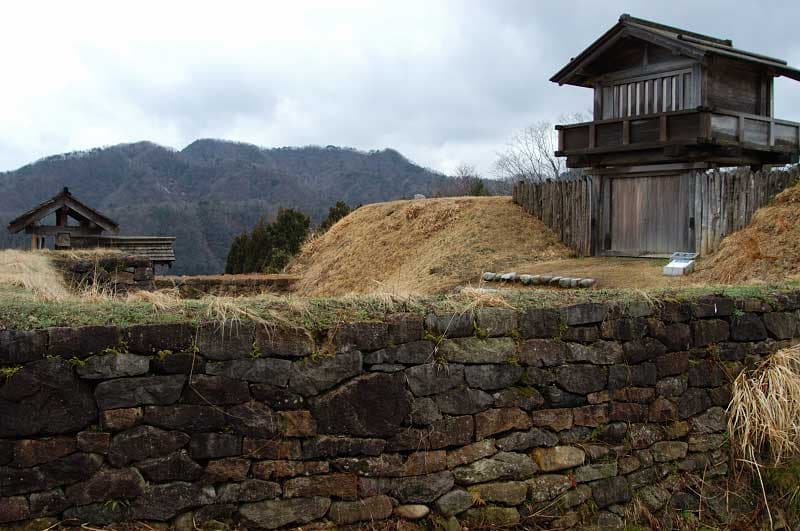
As a yamashiro-style castle, Torigoe Castle's design took full advantage of the mountainous landscape. The castle's defenses included steep slopes, terraced enclosures, and earthen ramparts reinforced by wooden palisades. These features were intended to slow and expose attackers, making direct assaults difficult.
The castle complex likely included multiple baileys (courtyards) arranged along the ridges, connected by narrow pathways and gates. The use of natural cliffs and the river enhanced its defensive capabilities. Although much of the original wooden structures have not survived, archaeological excavations have revealed foundation stones, earthworks, and remnants of defensive walls.
Integration with Futoge Castle
Futoge Castle, the companion fortress across the Dainichi River, complemented Torigoe Castle's defenses. Together, they formed a network of fortifications that controlled key access routes in the region. This setup was typical of Sengoku period fortresses designed to withstand sieges and provide refuge for allied forces.
Historical context and the Kaga Ikkō-Ikki movement
The Kaga Ikkō-Ikki was a powerful religious and military movement composed mainly of followers of the Jōdo Shinshū sect of Buddhism. They established a semi-autonomous domain in Kaga Province, resisting samurai rule and external military forces. Torigoe Castle was among their last strongholds during the late 16th century as they faced increasing pressure from Oda Nobunaga and his successors.
The castle's construction in 1573 coincided with the height of the Ikkō-Ikki's resistance. The dual castles were intended to serve as a refuge and a base for military operations. However, the Ikkō-Ikki were eventually defeated, and their castles fell into ruin.
Archaeological significance and preservation
Today, Torigoe Castle and Futoge Castle remain as archaeological ruins, providing valuable insight into Sengoku period mountain castle construction and the socio-political dynamics of the era. Excavations have uncovered artifacts such as ceramics, weaponry fragments, and structural remains that help historians understand the daily life and military strategies of the Ikkō-Ikki.
The site is protected as a National Historic Site of Japan, ensuring its preservation and public accessibility. Visitors can explore the ruins, which include walking trails along the former castle grounds, earthworks, and scenic views of the surrounding mountains and river valleys.
Visiting Torigoe Castle ruins
While no original buildings remain, the ruins of Torigoe Castle offer a compelling glimpse into Japan's 16th-century military architecture and the unique history of the Kaga Ikkō-Ikki. The site is accessible to the public, with informational signage explaining the castle's layout and historical background.
The rugged terrain requires visitors to be prepared for hiking along uneven paths. The best time to visit is during the spring and autumn months, when the weather is mild and the natural scenery is particularly striking.
Frequently asked questions (FAQ)
- How do I get to Torigoe Castle ruins?
- Torigoe Castle ruins are located in Hakusan city, Ishikawa Prefecture. Visitors can reach the site by car or local bus services from nearby urban centers, followed by a hike to the mountaintop ruins.
- What is the historical significance of Torigoe Castle?
- Torigoe Castle was a key defensive stronghold for the Kaga Ikkō-Ikki during the Sengoku period, representing the militant Buddhist sect's resistance against samurai rule.
- Are there any original structures still standing at Torigoe Castle?
- No original wooden structures remain at Torigoe Castle; only archaeological ruins such as foundation stones and earthworks are visible today.
- Can I hike around the castle ruins?
- Yes, visitors can hike the trails around the ruins, which traverse the mountainous terrain and offer views of the Dainichi River and surrounding landscape.
- When is the best time to visit Torigoe Castle?
- Spring and autumn are ideal for visiting Torigoe Castle ruins due to mild weather and vibrant natural scenery.
Photo gallery

Information
Current owner
National Historic Site
Loading map...
Visitor reviews
No reviews yet. Been here? Write the first review and help other travelers!
Write the first reviewVisited this castle? Share your experience
Your review helps other travelers and adds first-hand knowledge to our encyclopedia.