Tønsberg Castle Ruins — Norway castle

Tønsberg Castle Ruins

Tonsberg castle ruins: medieval fortress and historic site in norway
Tønsberg, Vestfold og Telemark, Norway
Ruins

Tønsberg Castle Ruins stand as a significant historical and archaeological site in Tønsberg, Norway, representing one of the oldest fortified locations in the country. The origins of the site date back to 871 AD, making it closely linked to the early formation of the Norwegian kingdom. According to the medieval historian Snorri Sturluson, Tønsberg was established prior to the Battle of Hafrsfjord, a pivotal event in which King Harald I of Norway united the country under a single rule. This early foundation underscores Tønsberg's importance as a center of power and governance in Norway's formative years.

The town of Tønsberg itself is often regarded as Norway's oldest town, serving as a vital trading hub during the Viking Age and Middle Ages. It was also the site of the Haugathing, the regional assembly or Thing for Vestfold, which was one of Norway's most important places for the proclamation and legitimation of kings. This political and commercial significance contributed to the decision by King Haakon Haakonson in 1253 to establish a formidable castle known as Tunsberghus on the site of the modern municipality of Tønsberg.

Historical development of tonsberg castle

The Tunsberghus fortress was constructed during the 13th century under the reign of King Haakon IV of Norway, the grandson of King Sverre. It was the largest castle in Norway at the time, reflecting the kingdom's growing need for fortified royal residences and military strongholds. The castle's strategic location on a hill overlooking the town and the Oslofjord allowed it to control important trade routes and defend against potential invaders.

Throughout the Middle Ages, Tønsberg Castle played a crucial role in Norway's political and military history. It was a symbol of royal authority and a center for administration in the region. However, the castle's fortunes declined following the collapse of the Kalmar Union in the early 16th century. In 1503, during a period of unrest and rebellion against Danish rule, the fortress was attacked and destroyed by Swedish forces allied with disloyal local peasants. This event marked the end of the castle's active military use, and it gradually fell into ruin.

Architectural features and ruins

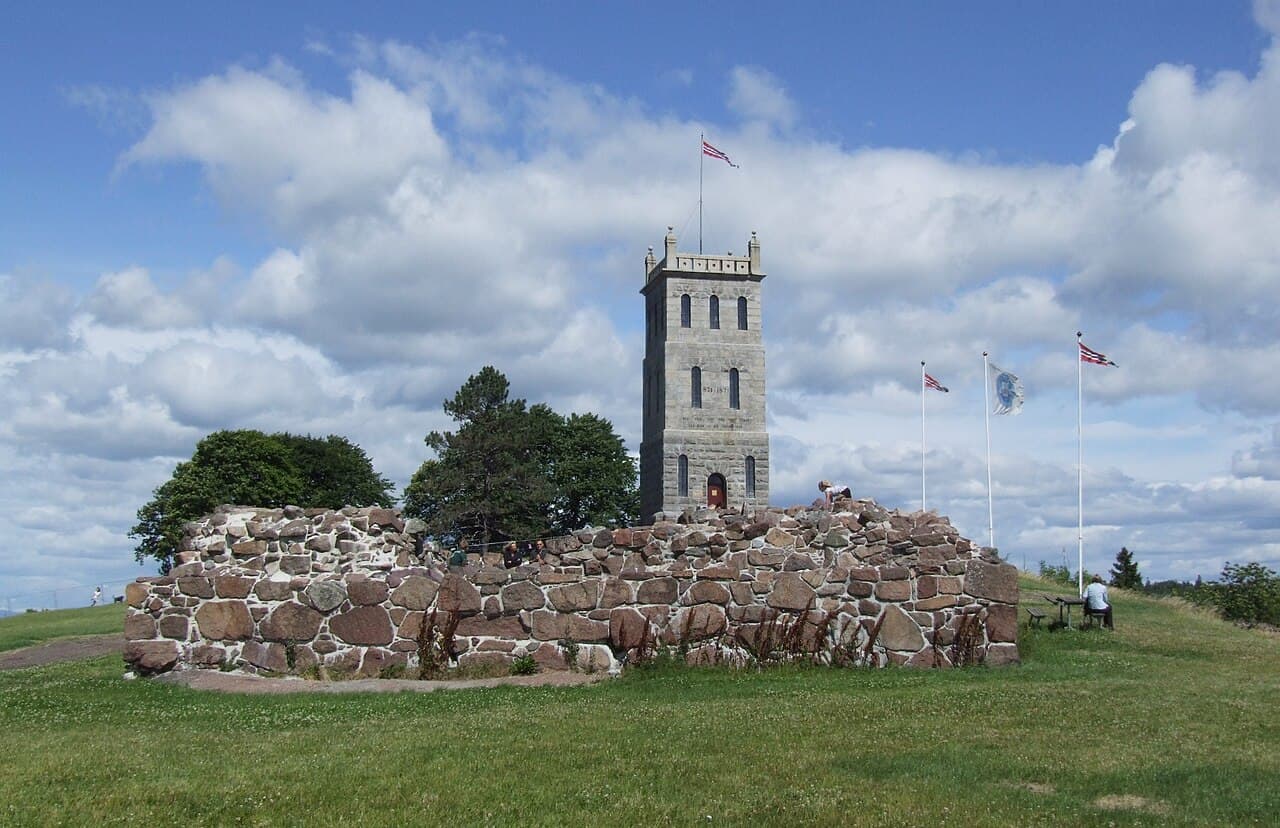
Today, the Tønsberg Castle Ruins consist of remnants of the medieval fortress, including sections of stone walls and foundations that reveal the scale and layout of the original structure. The castle was built primarily from local stone and featured typical medieval defensive elements such as battlements, towers, and a keep. Its design reflects the medieval fortress architecture of Scandinavia, adapted to the local terrain and strategic needs.

The castle's location on Slottsfjellet (Castle Hill) provides panoramic views of the surrounding landscape and the Oslofjord, underscoring its strategic importance. The ruins serve as a tangible connection to Norway's medieval past and are a focus for archaeological study and heritage preservation.

Slottsfjellet tower and memorial

In 1888, a prominent memorial tower was erected on Slottsfjellet to commemorate the historic fortress. This tower, often referred to simply as the Slottsfjellet Tower, was built as a symbol of local pride and historical awareness. It stands near the ruins and serves as a landmark visible from much of Tønsberg.

The tower underwent improvements in 1971, including enhanced insulation and the addition of commemorative plaques inside. Notably, the tower bears the gilded signatures of two Norwegian monarchs: King Haakon VII (dated 1 August 1906) and King Olav V (dated 1 July 1958), linking the modern Norwegian monarchy with its medieval heritage.

Cultural significance and visitor experience

Tønsberg Castle Ruins are an important cultural heritage site, attracting visitors interested in Norway's medieval history, Viking Age origins, and royal lineage. The site offers educational opportunities through archaeological exhibitions and guided tours that explore the castle's history and architecture.

The ruins and the memorial tower are accessible to the public, providing a scenic and historically rich destination. Visitors can explore the remains of the fortress walls, enjoy views from the hilltop, and learn about the castle's role in the broader context of Norwegian and Scandinavian history.

Nearby, the town of Tønsberg features museums, historic buildings, and cultural events that complement the castle experience, making it a key destination for those interested in medieval and Viking heritage.

Frequently asked questions (FAQ)

How do I get to Tønsberg Castle Ruins?
Tønsberg Castle Ruins is located in Tønsberg, Norway, and is easily accessible by public transportation. You can take a bus or train to Tønsberg and then enjoy a short walk to the ruins, which are situated on a hill offering scenic views of the surrounding area.
What is the historical significance of Tønsberg Castle Ruins?
Tønsberg Castle Ruins are remnants of one of the oldest towns in Norway, dating back to the Viking Age. The castle was built in the late 13th century and has played a crucial role in Norway's history, serving as a royal stronghold and a symbol of power during medieval times.
When was Tønsberg Castle Ruins built?
The castle was constructed around the year 1280 during the reign of King Magnus VI of Norway. It has seen various renovations and expansions over the centuries, reflecting the evolving architectural styles and the castle's importance in Norwegian history.
Can I access Tønsberg Castle Ruins year-round?
Yes, Tønsberg Castle Ruins are open to the public year-round, allowing visitors to explore the historical site at their leisure. However, it's advisable to check for any seasonal events or maintenance work that may temporarily affect accessibility.
Why is Tønsberg Castle Ruins a popular destination for tourists?
Tønsberg Castle Ruins attract visitors due to their rich history, stunning panoramic views, and the opportunity to explore Norway's medieval past. The site also offers a picturesque setting for photography and is often included in walking tours of Tønsberg.
Is it possible to find guided tours of Tønsberg Castle Ruins?
Yes, guided tours are available, providing in-depth insights into the history and architecture of the castle ruins. These tours are often led by knowledgeable guides who can share fascinating stories about the site and its significance in Norwegian culture.
What are the opening hours for Tønsberg Castle Ruins?
Tønsberg Castle Ruins are typically open from dawn until dusk, allowing visitors ample time to explore. It's recommended to check the official website or local tourism information for any updates on hours or special openings.
Are there any nearby attractions to visit while in Tønsberg?
Absolutely! While visiting Tønsberg Castle Ruins, you can also explore the nearby historical sites, such as the Tønsberg Fortress and the Slottsfjell Museum. The charming harbor area and various cafes and shops in Tønsberg make for a delightful day out.
What are the ticket prices for visiting Tønsberg Castle Ruins?
Entry to Tønsberg Castle Ruins is free of charge, making it an accessible destination for all visitors. This allows you to enjoy the historical site without any financial barrier, encouraging exploration and appreciation of Norwegian heritage.

Photo gallery

Tønsberg Castle Ruins
Click to view

Photo by Pudelek (Marcin Szala)•CC BY-SA 4.0

1 photo • Click any image to view in full screen

Information

Archaeological Site / Ruins

Loading map...

Visitor reviews

No reviews yet. Been here? Write the first review and help other travelers!

Write the first review

Visited this castle? Share your experience

Your review helps other travelers and adds first-hand knowledge to our encyclopedia.

Write a review

(5/5)

0/2000 characters

Your review will be visible after admin approval

Nearby castles

19.7 km

Norske Løve Fortress

Horten, Norway

Norske Løve fortress is a significant military fortification located in Horten, Norway, constructed between 1852 and 1859 to defend the strategically important Karljohansvern naval station. Named after the Coat of Arms of Norway, which features a lion, the fortress reflects the national symbolism and military priorities of Norway during the mid-19th century. It was designed and built under the direction of Balzar Nicolai Garben, a notable military engineer of the era.The fortress was constructed as a modern military installation with defensive features typical of mid-19th century fortifications. It includes a moat capable of being filled with water to enhance its defensive capabilities, surrounding the main structure to deter enemy assault. The fort's primary defensive element was a circular envelope consisting of 22 open casemates, each designed to hold a 3-ton cannon. These casemates allowed for a broad range of artillery coverage, providing overlapping fields of fire to protect the naval base effectively.Architectural design and defensive featuresThe fortress is a prime example of 19th-century military architecture with a focus on artillery defense. The open casemates were built to house heavy cannons, enabling the garrison to repel naval and land attacks. Originally, the fort was designed to accommodate a complement of 500 men, reflecting its role as a significant defensive installation rather than just a small outpost.The moat surrounding the fortress could be flooded with water, serving as a physical barrier to infantry and siege equipment. The design of the moat and walls was intended to delay or prevent enemy forces from reaching the fortress walls, allowing defenders to maintain control of the surrounding area.World War II modificationsDuring World War II, the fortress was occupied by German forces who made specific alterations to its defensive structures. The open casemates were walled up by the Germans to adapt the fort for their own defensive needs, possibly to protect against aerial attack or to reinforce the fortifications. Despite these changes, the fortress has remained largely in its original form, preserving its historical integrity.Historical significance and current useNorske Løve fortress played a key role in protecting the Karljohansvern naval station, which was Norway's main naval base during the 19th and early 20th centuries. The fort's strategic location in Horten allowed it to guard the Oslofjord and control naval access to the capital region.Today, the fortress remains a military area but no longer serves as an active defensive installation. It is currently used as an administration building for the Norwegian naval officers training school. This continued military function preserves the site's connection to Norway's naval heritage while adapting its facilities for modern training purposes.Structural and preservation statusThe fortress is well preserved, retaining much of its original structure and layout. The moat, walls, and casemates remain intact, offering visitors and historians a clear view of mid-19th century military engineering. Its preservation allows for study and appreciation of Norway's coastal defense strategies during a period of significant military evolution.While the fortress is primarily a military site and not generally open to the public, its historical and architectural value makes it an important cultural landmark within the region of Vestfold og Telemark.

Modern (19th–20th c.)
Details
31.8 km

Isegran Fortress Ruins

Fredrikstad, Norway

Isegran fortress ruins in Fredrikstad, Norway, represent a significant historical site with origins dating back to the 13th century. This location is notable as the earliest recorded site in Fredrikstad's history, initially established as a small fortress by the Earl of Borgarsyssel, Alv Erlingsson, also known as MindreAlv, during the High Medieval period. The fortress served a strategic role in controlling the river and surrounding waterways, which were vital for defense and trade. Medieval origins and early fortifications The original fortress on Isegran was a modest stronghold constructed in the late 1200s. It was part of the network of fortifications used by Norwegian nobility to assert control over their territories. The site’s location on an island in the river made it a natural defensive position, providing a vantage point to monitor naval traffic and protect the surrounding region. 17th-century expansions and military significance In the 1670s, Isegran underwent significant military enhancements. A large battery platform was constructed to house artillery, along with the building of the Isegran tower. These additions transformed the site from a small fortress into a more formidable defensive installation. Subsequently, a small fort was erected to further secure the river approach, reflecting the strategic importance of this location in controlling naval access. Role as a royal shipyard Until 1685, Isegran served as the royal shipyard for the Danish-Norwegian fleet. This function underscores the island’s maritime importance during the period when Norway was in union with Denmark. The shipyard was essential for the maintenance and construction of naval vessels, supporting military operations and protecting Norwegian waters. Naval base during the Great Northern War During the Great Northern War (1700–1721), the island was used as a naval base by the famed naval commander Peter Wessel Tordenskiold. His use of Isegran as a base highlights the continued military relevance of the site well into the early 18th century. The fortifications and shipyard facilities supported naval campaigns in the region. Architectural features and current condition The remains on Isegran include ruins of the medieval fortress and later 17th-century fortifications such as the battery platform and tower foundations. The site’s layout reflects typical High Medieval military architecture adapted over time to include artillery defenses. The ruins offer insight into the evolution of coastal fortifications in Norway from the medieval period through the early modern era. Access and visitor information Today, Isegran island is accessible to visitors via the Kråkerøy bridge or by the city ferry, making it an attractive historical destination in Fredrikstad. The site offers a tangible connection to Norway’s medieval and naval history, with its ruins providing a glimpse into the strategic importance of river and coastal defenses. Historical significance and legacy Isegran fortress ruins stand as a testament to the region’s military and naval heritage. From its origins as a noble fortress to its role as a royal shipyard and naval base, the site encapsulates centuries of Norwegian defensive architecture and maritime history. Its preservation as ruins allows for ongoing study and public appreciation of Norway’s historical landscape.

High Medieval (11th–13th c.)
Details
32.1 km
Fredrikstad Fortress — Norway castle

Fredrikstad Fortress

Fredrikstad, Norway

Fredrikstad fortress stands as a remarkable example of Renaissance military architecture in Norway. Constructed between 1663 and 1666 under the direction of the officer Willem Coucheron and his son Anthony Coucheron, it was commissioned by the Dano-Norwegian King Frederick II. This fortress was strategically built following a temporary fortification erected during the Torstenson War (1644-1645), a conflict between Sweden and Denmark-Norway, underscoring its importance in regional defense and control. Historical background and military significance The fortress was established to secure the town of Fredrikstad and the surrounding region against Swedish incursions, reflecting the turbulent geopolitical climate of Scandinavia in the 17th century. The first commander, Lieutenant Colonel Johan Eberhard Speckhan, took charge in early 1662, overseeing not only the fortress itself but also the associated prison works, highlighting the multifaceted role of the fortress as both a military and penal institution. One of the most notable moments in the fortress's history came in 1716 during the Great Northern War when the celebrated naval hero Peder Tordenskjold used Fredrikstad fortress as a strategic base to launch an attack against the Swedish fleet during the Battle of Dynekilen. This event underscores the fortress's ongoing military relevance well into the 18th century. The fortress's only direct assault occurred during the Swedish-Norwegian War of 1814. Under the command of Nils Christian Frederik Hals, the fortress capitulated on August 4, 1814, marking a significant episode in Norway's struggle for sovereignty. Despite this, Fredrikstad fortress continued to serve military purposes until its official closure as a fortress in 1903, after which it remained an active garrison for nearly a century more. Architectural features and design Fredrikstad fortress is classified as a Renaissance period fortress, showcasing the era's characteristic emphasis on geometric design and bastioned fortifications intended to withstand artillery sieges. The fortress is a prime example of a star fort layout, featuring angular bastions that provide overlapping fields of fire, a design innovation that was widespread in Europe during the 16th and 17th centuries. The fortress complex includes several key components: the main fortress itself, along with subsidiary fortifications such as Kongsten fort, Isegran fort, Cicignon fort, Huth fort, Akerøya fort, and the Slevik battery. These outlying forts and batteries formed an integrated defensive network that protected the approaches to Fredrikstad and controlled access to the Oslofjord. Notably, Fredrikstad fortress is unique in Norway for being preserved in its original form, allowing visitors to experience the authentic layout and construction techniques of a 17th-century military fortification. The walls, bastions, and internal buildings remain largely intact, offering valuable insight into Renaissance military engineering. Preservation and current use After the fortress was officially closed in 1903, it continued to function as a military garrison until 2002, when all remaining military installations in Fredrikstad were decommissioned. Since then, the fortress has been maintained as a cultural and historical site, attracting visitors interested in military history, architecture, and Norwegian heritage. Today, Fredrikstad fortress hosts a variety of art exhibitions and cultural events, blending its historical ambiance with contemporary uses. The site’s well-preserved condition makes it a popular destination for tourists and scholars alike, offering guided tours that explore its rich history and architectural significance. Visitor information and surrounding attractions Fredrikstad fortress is located in the city of Fredrikstad, in the Østfold region of Norway. Visitors can explore the extensive fortress grounds, including the main bastions and outlying forts. The fortress is accessible year-round, with seasonal variations in opening hours and guided tour availability. Nearby attractions include the charming old town of Fredrikstad, known for its well-preserved wooden buildings and vibrant cultural scene. The combination of historical architecture and natural beauty in the surrounding area enhances the visitor experience.

Renaissance (15th–17th c.)
Details