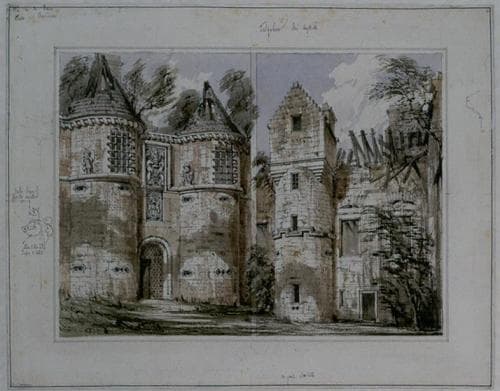
Tolquhon Castle
Tolquhon Castle, also known as Tolquhoun and pronounced "toh-hon," is a striking example of Renaissance architecture located about 20 kilometers northwest of Aberdeen in Aberdeenshire, Scotland. This castle stands as a testament to the evolution of Scottish noble residences during the late 16th century, blending the defensive features of earlier medieval fortifications with the refined aesthetics and comfort of Renaissance design. Its rich history, architectural significance, and picturesque ruins make it a prominent heritage site under the care of Historic Scotland.
The origins and early history of Tolquhon Castle
The lands of Tolquhon were held by the Preston family from at least the early 13th century, with the Prestons recognized as the royal Thanes of Formartine—the district lying between the rivers Don and Ythan—since the late 12th century. The Prestons also owned lands near Edinburgh, including Craigmillar. The early castle structure on the site was a tower house, known as "Preston's Tower," built by either Henry Preston or his son-in-law John Forbes, who inherited the property through marriage after Henry Preston's death in 1420 without a male heir.
This medieval tower house served as the family's residence for over a century, reflecting the typical Scottish fortified home of the period, designed primarily for defense and habitation rather than grand display.
William Forbes and the Renaissance transformation (1584–1589)
The most significant architectural development at Tolquhon Castle began under William Forbes, 7th Laird of Tolquhon, who embarked on an ambitious renovation and expansion project from 1584 to 1589. He retained the original Preston's Tower, integrating it into a larger, more elaborate castle complex that reflected the Renaissance ideals spreading through Scotland at the time.
The castle was transformed into a quadrangular plan with ranges enclosing a central courtyard. The north range includes the main entrance and the preserved Preston Tower forming the north-east corner. The west range houses a notable gallery on the first floor, an architectural feature uncommon in Scottish castles of the period, emphasizing the shift towards comfort and display. The south range contains the main hall, accessed by a stair from the courtyard, designed for social and ceremonial functions rather than defense alone.
The castle also includes defensive elements such as a prison in the south-east tower and a walled outer courtyard to the north, which contains the remains of a doocot (dovecote), an essential feature for food supply and status symbolism in Scottish noble estates.
William Forbes proudly documented the completion of his "house, tower, and place of Tolquhone" in 1589, marking the castle as a distinguished example of the Scots Renaissance style.
Architectural features and Renaissance influences
Tolquhon Castle is often described as the most characteristic château of the Scots Renaissance. Its design combines traditional defensive elements with Renaissance aesthetics and domestic comfort. The castle's layout features a harmonious quadrangle with ranges of buildings around a central courtyard, a layout influenced by contemporary European châteaux rather than purely medieval fortifications.
The integration of the older Preston Tower into the new structure illustrates the transitional nature of castle building in late 16th-century Scotland. The inclusion of a gallery, large windows, and decorative stonework are hallmarks of Renaissance influence, emphasizing light, space, and ornamentation.
The castle's battlements, turrets, and crow-stepped gables contribute to its imposing silhouette, while the internal spaces were designed to accommodate the social and domestic needs of a noble family rather than purely military purposes.
Decline and later history
Following William Forbes' death, Tolquhon Castle remained in the Forbes family until the early 18th century. However, the family's fortunes declined, and the castle was gradually abandoned as a primary residence. The 11th Laird of Tolquhon was wounded in 1718 and forcibly removed from the castle by his comrades, never to return. The family moved to other estates, reflecting a broader trend among Scottish nobility to abandon older fortified homes in favor of more modern and comfortable residences.
After the Forbes family left, the castle was taken over by the Earl of Aberdeen and repurposed as a farmstead. It remained inhabited in some capacity until the mid-19th century, after which it fell into further disrepair.
The castle's decline continued until 1929 when it was placed under state care by the then owner, the Marquess of Aberdeen and Temair, also known as the Earl of Haddo. Since then, Tolquhon Castle has been preserved as a historic ruin, open to the public and managed by Historic Scotland.
Visiting Tolquhon Castle today
Today, visitors to Tolquhon Castle can explore the evocative ruins that reveal the castle's Renaissance grandeur and medieval origins. The castle's courtyard, towers, gallery, and outer courtyard remain accessible, offering insight into the architectural and social history of late 16th-century Scotland.
The site is an important cultural landmark in Aberdeenshire, attracting historians, architects, and tourists interested in Scotland's noble past and Renaissance heritage. Its preservation allows for study and appreciation of the transitional period in Scottish castle architecture, blending defense with elegance.
Nearby attractions and context
Aberdeenshire is home to numerous castles and historic sites, making Tolquhon Castle a valuable part of Scotland's rich tapestry of heritage. Visitors often combine a trip to Tolquhon with visits to other nearby castles and landmarks, enjoying the scenic landscapes and cultural depth of the region.
Frequently asked questions (FAQ)
- When was Tolquhon Castle built and by whom?
- Tolquhon Castle was built between 1584 and 1589 by William Forbes, 7th Laird of Tolquhon, who expanded upon an earlier tower house known as Preston's Tower.
- What architectural style characterizes Tolquhon Castle?
- Tolquhon Castle is a prime example of Scots Renaissance architecture, combining traditional defensive features with Renaissance aesthetics and domestic comfort.
- Is Tolquhon Castle open to the public?
- Yes, Tolquhon Castle is managed by Historic Scotland and is open to the public as a historic ruin, allowing visitors to explore its courtyard, towers, and gallery.
- What led to the decline of Tolquhon Castle?
- The castle declined after the early 18th century when the Forbes family moved out due to financial difficulties and changing residential preferences, leading to its eventual abandonment and decay.
- What notable features can visitors see at Tolquhon Castle?
- Visitors can see the preserved Preston Tower, the main hall in the south range, the gallery in the west range, a prison in the south-east tower, and the remains of a doocot in the outer courtyard.
Photo gallery

Photo by Robert William Billings•Public domain
Information
Current owner
Historic Scotland
Loading map...
Visitor reviews
No reviews yet. Been here? Write the first review and help other travelers!
Write the first reviewVisited this castle? Share your experience
Your review helps other travelers and adds first-hand knowledge to our encyclopedia.



