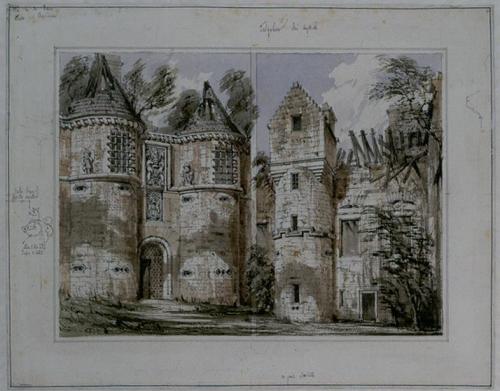
Esslemont Castle Ruins
Esslemont Castle stands as a significant example of a 16th-century Scottish L-plan tower house, located near Ellon in Aberdeenshire, Scotland. The earliest record of the site dates back to the 14th century when it was known as the "manor of Eislemont." The estate initially belonged to the Mareschal family before passing through marriage to the Cheyne family, a powerful noble lineage in northeast Scotland. This castle's history is intertwined with the turbulent clan and noble feuds of the Renaissance period in Scotland.
The origins and early ownership
The lands of Esslemont were first documented in the 14th century, with the estate passing by marriage from the Mareschal family to Francis le Chen of Straloch through his union with Janet, the heiress of Esslemont. This transfer marked the beginning of the Cheyne family's long association with the castle and its surrounding lands. The Cheynes were influential in the region, and their presence at Esslemont helped shape the castle's development and historical significance.
Destruction and rebuilding in the early 16th century
In 1493, Esslemont Castle was burnt down, an event that necessitated substantial rebuilding. Henry Cheyne, a prominent member of the family, secured a royal licence in 1500 to undertake reconstruction. This rebuilding phase established much of the castle's surviving architectural form, particularly its characteristic L-plan layout with a staircase turret and a round tower at the southeast angle. The castle was designed both as a residence and a defensive stronghold, reflecting the volatile political climate of Renaissance Scotland.
Architecture and layout
The castle's structure is typical of Scottish tower houses of the period, with three stories evident in the ruins. The ground floor likely housed the kitchen, identifiable by a large fireplace in the north gable, with remnants of the flue visible high on the wall. The castle's walls, now largely roofless and partially collapsed, reveal the robust stonework and defensive features characteristic of the era. Notably, the dressed stones of the windows have been removed, likely repurposed for other local building projects.
The exterior of the castle features the Gordon family arms, reflecting later ownership and the heraldic traditions of Scottish nobility. The castle's fortalice and tower were recorded in documents from 1575–1576, underscoring its continued importance as a noble residence and defensive site during the 16th century.
Historical significance and notable events
In 1564, Patrick Cheyne was created baron of Esslemont by Queen Mary, who herself stayed at the castle during her campaign against the Earl of Huntly. This royal connection highlights Esslemont's strategic and political significance during a turbulent period in Scottish history. However, the castle's fortunes declined following a violent feud between the Cheyne family and the rival Hays, which led to its destruction.
By 1609, the estate name appears as "Essilmounthe" in Scottish records, but the castle ceased to be regularly occupied by 1625 when the estate passed to the Errol family. Later, in 1728, Robert Gordon acquired the property. Although the castle may have seen some partial occupation until 1769, the construction of the nearby Esslemont House marked the transition away from the medieval fortress as a residence.
The ruins and preservation
Today, Esslemont Castle remains a roofless ruin with significant sections of its walls missing. The removal of dressed stones and other materials for nearby construction has contributed to its fragmented state. Despite this, the ruins clearly display the castle's original three-story height and distinctive architectural elements such as the staircase turret and the round tower. The castle is a valuable historical site that offers insight into the architectural and social history of Renaissance Scotland.
Visitors can observe the rugged remains of the large kitchen fireplace and the heraldic carvings on the exterior walls, which serve as tangible links to the castle's noble past. Esslemont Castle's ruins stand as a testament to the region's complex feudal history and the architectural evolution of Scottish tower houses during the Renaissance.
Frequently asked questions (FAQ)
- When was Esslemont Castle originally built and by whom?
- Esslemont Castle was rebuilt in 1500 by Henry Cheyne after it was burnt down in 1493. The estate originally belonged to the Mareschal family before passing to the Cheynes in the 14th century.
- What architectural style characterizes Esslemont Castle?
- Esslemont Castle features a mixed architectural style typical of Scottish Renaissance tower houses, notably its L-plan layout with a staircase turret and a round tower.
- Can visitors see any heraldic symbols at Esslemont Castle?
- Yes, the exterior walls of Esslemont Castle display the Gordon family arms, reflecting later ownership and noble heraldry.
- Why is Esslemont Castle in ruins today?
- The castle was destroyed during a feud between the Cheyne and Hay families and later fell out of use, with stones removed for other building projects, leaving it roofless and partially collapsed.
- Did Queen Mary have any connection to Esslemont Castle?
- Queen Mary stayed at Esslemont Castle during her campaign against the Earl of Huntly and created Patrick Cheyne baron of Esslemont in 1564.
Information
Loading map...
Visitor reviews
No reviews yet. Been here? Write the first review and help other travelers!
Write the first reviewVisited this castle? Share your experience
Your review helps other travelers and adds first-hand knowledge to our encyclopedia.