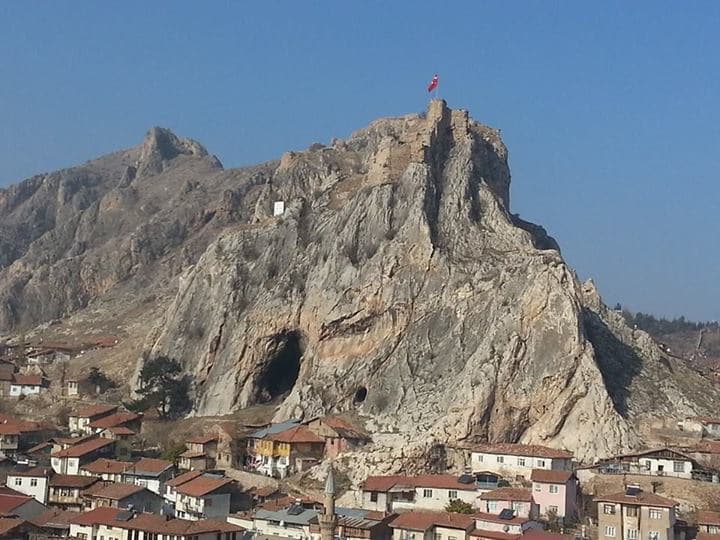
Tokat Castle
Tokat Castle, locally known as Tokat Kalesi, stands prominently on a rocky hill in the heart of Tokat city, Turkey. This ancient hill castle commands strategic views over the confluence of the Tokat and Yeşilırmak rivers and the vital Kızıliniş Pass. Its origins trace back to the early medieval period, with archaeological evidence confirming construction as early as the 5th century AD. The castle's long and layered history reflects the complex cultural and military dynamics of Anatolia through Byzantine, Seljuk, and Ottoman eras.
Early history and foundation
The precise date of Tokat Castle's foundation remains uncertain, though the oldest archaeological traces date from the 5th century, placing its origins firmly in the early medieval period when Anatolia was part of the Byzantine Empire. The city of Tokat itself predates the castle by millennia, with roots extending to the Hittite era and prominence as a stronghold in the Kingdom of Pontus during the 1st century BC. Some historical accounts suggest that the initial inhabitants of the castle were Christian groups migrating from Comana Pontica, an ancient regional center known for its religious significance.
Medieval transitions and military significance
In 1074, Tokat Castle was captured by the Danishmends, a Turkish dynasty that played a pivotal role in Anatolia's post-Byzantine power struggles. Subsequently, the fortress came under the control of the Seljuk Empire, which reinforced its military capabilities. The Eretnids later governed the castle before it was finally incorporated into the Ottoman Empire in 1392. Both the Seljuks and Ottomans undertook significant restorations, adapting the castle for purely military purposes while also using it as a prison.
One of the castle's more infamous historical associations is its reputed use as a prison for Vlad the Impaler (Vlad III), the 15th-century ruler often linked to the Dracula legend. Although details of his imprisonment remain debated, local tradition holds that he was briefly held within Tokat Castle during Ottoman rule under Sultan Murad II.
Architectural features and layout
Tokat Castle is constructed on a natural rocky outcrop, utilizing the terrain's defensive advantages. Its layout is predominantly pentagonal, reinforced by eight surviving towers (burç), though historical records indicate the fortress once boasted up to 28 towers. The castle's walls combine cut stone and rubble masonry, rising in terraces that conform to the contours of the hill.
The main entrance is notable for a tunnel carved directly into the rock on the northern side, a unique feature enhancing the fortress's defensibility. Myths speak of subterranean tunnels connecting Tokat Castle to nearby fortresses such as Turhal and Niksar, though no archaeological evidence has confirmed these passages.
Within the castle, remnants of battlements, embrasures (mazgallar) for archers and artillery, and vaulted chambers reveal a complex internal structure. Key functional spaces include a cistern (sarnıç) for water storage and an armory (cephanelik) for weapons. The castle also contains rooms that served both residential and military functions, illustrating its dual role as a fortress and administrative center.
Historical significance and cultural legacy
Throughout its history, Tokat Castle served as a vital military stronghold controlling access through the Kızıliniş Pass and overseeing the surrounding region. Its role evolved from Byzantine defense to a key fortress in the Turkish-Islamic world under the Seljuks and Ottomans. The castle's use as a prison added a darker dimension to its legacy, symbolizing political control and repression.
During the Ottoman period, the fortress was an important site for regional governance. The famous 17th-century traveler Evliya Çelebi documented Tokat Castle in his Seyahatnâme, providing valuable contemporary descriptions that enhance our understanding of its condition and significance at that time.
With the establishment of the Turkish Republic, Tokat Castle ceased military functions and gained recognition as a cultural and historical monument. Restoration projects, including a notable campaign in 2010, have aimed to preserve its remaining structures and uncover hidden features, promoting heritage tourism and scholarly research.
Current condition and visitor experience
Today, Tokat Castle stands as a partially preserved fortress with significant ruins visible. The northern and southern walls have suffered considerable damage due to earthquakes and natural decay, leaving mostly foundational remains and vaulted structures. The natural rocky walls continue to provide a formidable defensive backdrop, testament to the castle's original strategic design.
Access to the castle is generally free, though restoration work may occasionally restrict entry. Visitors can explore the surrounding old town of Tokat, which offers additional historical and cultural attractions. The castle's commanding position and evocative ruins make it a compelling destination for those interested in Anatolian history and medieval military architecture.
Exploring the castle's myths and mysteries
Local legends about secret tunnels connecting Tokat Castle to other fortresses add an aura of mystery, though archaeological investigations have yet to substantiate these claims. The castle's association with Vlad the Impaler further enhances its intrigue, attracting visitors fascinated by medieval history and folklore.
Architectural adaptations to terrain
The castle's design skillfully integrates natural rock formations into its defensive structures, using the steep cliffs and rugged landscape as natural barriers. This approach minimized construction efforts while maximizing defensive strength, a common strategy in hill castles of the region.
Significance in regional history
Tokat Castle's strategic location near river confluences and mountain passes made it a focal point in controlling trade routes and military movements. Its succession through Byzantine, Danishmend, Seljuk, Eretnid, and Ottoman hands reflects the broader historical shifts in Anatolia from antiquity through the medieval period.
Frequently asked questions (FAQ)
- How do I get to Tokat Castle?
- Tokat Castle is located on a hill in the city of Tokat, accessible via Tokat Kalesi Yolu. It is reachable by car or local transport from the city center.
- What is the best time to visit Tokat Castle?
- The best time to visit Tokat Castle is during spring and autumn when the weather is mild and suitable for exploring the outdoor ruins.
- Is Tokat Castle open to visitors year-round?
- Tokat Castle is generally open to visitors, but access may be restricted during restoration periods. It's advisable to check local information before planning a visit.
- What historical periods does Tokat Castle represent?
- Tokat Castle represents multiple historical periods, including the Byzantine era, Danishmend rule, Seljuk and Eretnid governance, and Ottoman control.
- Can I explore the interior ruins of Tokat Castle?
- Visitors can explore the castle's remaining walls, towers, and vaulted chambers, though some areas may be unsafe or closed due to preservation efforts.
Photo gallery

Information
Address
Tokat Kalesi Yolu, Turkey
Loading map...
Visitor reviews
No reviews yet. Been here? Write the first review and help other travelers!
Write the first reviewVisited this castle? Share your experience
Your review helps other travelers and adds first-hand knowledge to our encyclopedia.



