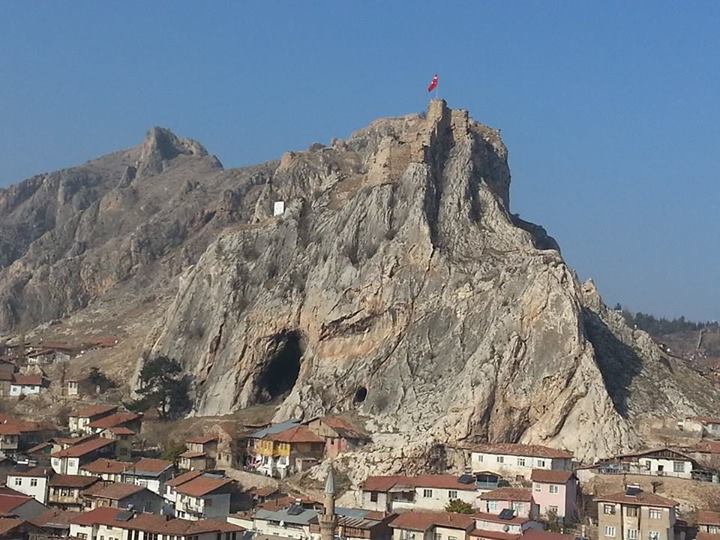
Boğazkesen Castle
Boğazkesen Castle, also known locally as Boğazkesen Kalesi, is a historic fortress located northwest of the village of Kaleköy in the Tokat province of Turkey. This castle occupies a strategic hilltop position overlooking the valley of the Yeşilırmak River (ancient Iris) and its tributary stream, commanding views of an important ancient route that connected the Erbaa Plain to the Black Sea coast. Despite the scarcity of detailed historical records, the castle's architectural remains strongly suggest a medieval Byzantine origin, placing it within the context of the Byzantine Empire's defensive network in northern Anatolia.
Geographical and strategic importance
The castle's location on a rocky hill provides natural defensive advantages, with its north and east walls conforming to the rocky outcrop's contours. The hill overlooks a valley opening where the Yeşilırmak River joins with the Kelkis River (ancient Lykos), near the site of the ancient city of Eupatoria, later renamed Magnopolis by the Roman general Pompey. Although Magnopolis disappeared during the Byzantine era, the proximity to this historically significant city highlights the strategic importance of the area and likely influenced the choice of location for the castle.
Architectural features and layout
The castle's plan is roughly a skewed rectangle, with the north and east walls adapting to the natural rock formations, enhancing its defensive capabilities. The west wall is a straight line reinforced by two bastions centrally positioned, which would have served as strongpoints for defense and observation. The main entrance was located on the south wall, protected by a barbican—a fortified outwork designed to defend the gate. Historical accounts from the early 20th century mention a standing gate topped by a lintel with a relief, which was later deliberately destroyed and its stones removed.
Inside, the castle's interior is largely in ruins, with limited surviving structures. Visitors should exercise caution due to the steep cliffs on the east side and several open cisterns, which once collected and stored water for the castle's inhabitants. The castle now overlooks a village graveyard, adding to the somber atmosphere of the site.
Historical context and significance
While direct historical documentation of Boğazkesen Castle is lacking, its architectural style and strategic location strongly associate it with the Byzantine period. It was likely part of a network of fortifications designed to control important routes and river crossings in the region. The nearby ancient city of Eupatoria/Magnopolis, with its ancient bridge ruins, indicates the long-standing importance of this corridor for trade and military movements.
Boğazkesen Castle's survival into the modern era, albeit in a ruined state, provides valuable insight into medieval fortification strategies in northern Anatolia. The castle's design reflects typical Byzantine military architecture, emphasizing natural topography and strong defensive walls with bastions and barbicans.
Visiting Boğazkesen Castle
The castle is freely accessible to visitors, offering a unique opportunity to explore a lesser-known medieval fortress in a scenic setting. Its elevated position provides panoramic views of the surrounding valleys and the distant Erbaa Plain. Although the interior lacks extensive surviving structures, the site is appreciated for its location and historical ambiance. Visitors should be cautious of the cliffs and open cisterns while exploring.
Nearby historical sites
Close to Boğazkesen Castle lies the ancient river crossing guarded by the ruins of an ancient bridge, and the site of the former city of Eupatoria/Magnopolis. These nearby archaeological remains complement the castle's historical narrative, illustrating the continuity of settlement and strategic importance of this region from antiquity through the medieval period.
Frequently asked questions (FAQ)
- How do I get to Boğazkesen Castle from Kaleköy?
- Boğazkesen Castle is located northwest of Kaleköy village. Visitors can reach the castle by hiking up the hill from the village, following local paths. It is advisable to wear sturdy footwear due to uneven terrain.
- What is the historical significance of Boğazkesen Castle?
- Boğazkesen Castle likely dates back to the Byzantine period and served as a strategic fortification overlooking important river valleys and ancient routes in northern Anatolia. It guarded the approaches to the Erbaa Plain and nearby ancient cities.
- Is Boğazkesen Castle accessible to visitors year-round?
- Yes, the castle is freely accessible throughout the year. However, visitors should be cautious of natural hazards such as cliffs and open cisterns, especially in wet or icy conditions.
- Are there guided tours available at Boğazkesen Castle?
- There are no official guided tours at Boğazkesen Castle, so visitors explore the site independently. Local guides may be available in nearby towns for broader historical tours of the region.
- What architectural features are notable at Boğazkesen Castle?
- The castle features a skewed rectangular plan with walls adapted to rocky terrain, two bastions on the west wall, and a barbican protecting the southern entrance. These elements reflect Byzantine military architectural principles.
Information
Loading map...
Visitor reviews
No reviews yet. Been here? Write the first review and help other travelers!
Write the first reviewVisited this castle? Share your experience
Your review helps other travelers and adds first-hand knowledge to our encyclopedia.