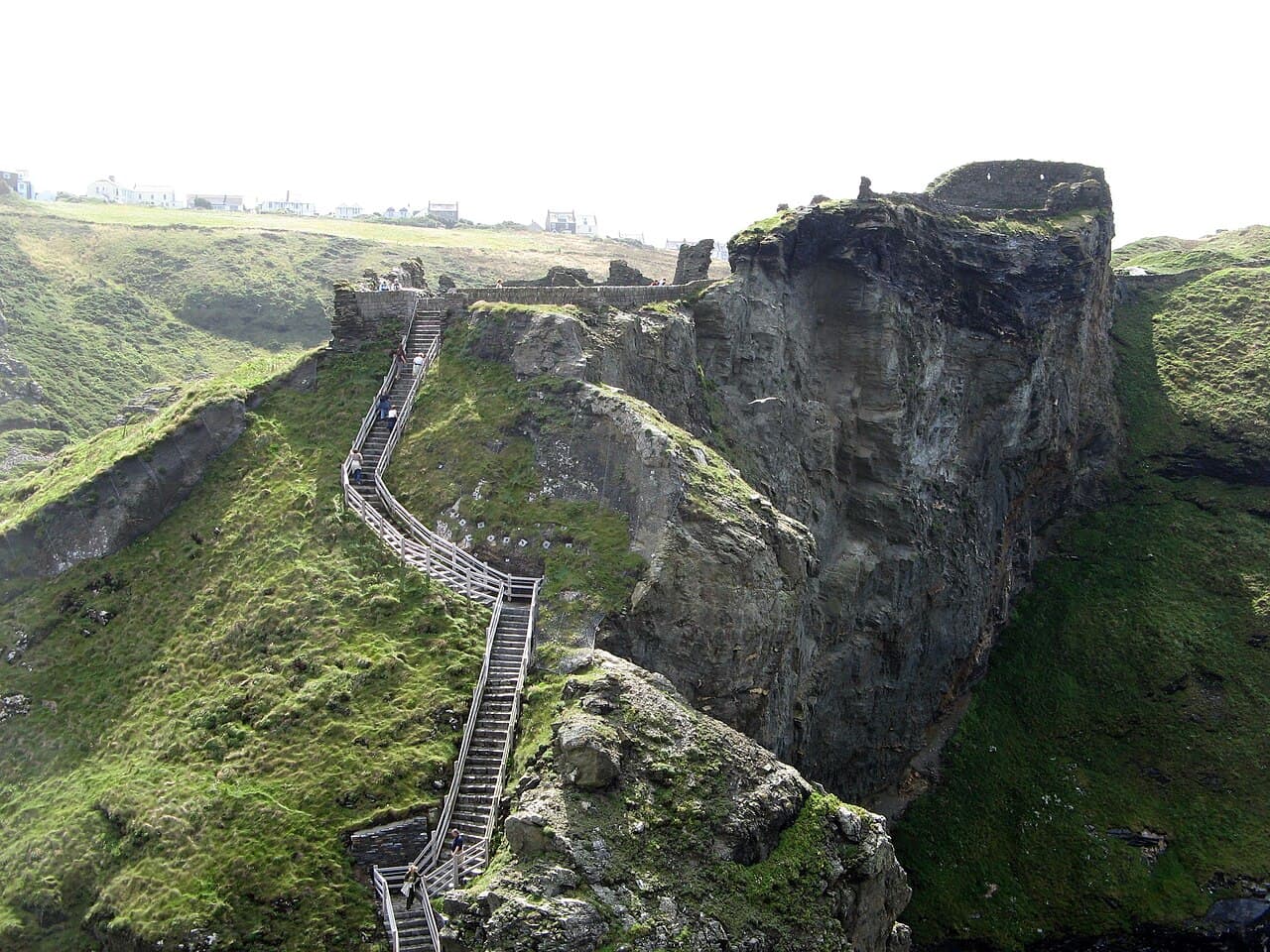
Tintagel Castle
Tintagel Castle is a remarkable medieval fortification located on the rugged peninsula of Tintagel Island, adjacent to the village of Tintagel in North Cornwall, England. This iconic hill castle is renowned not only for its dramatic ruins perched on a rocky promontory but also for its deep-rooted connections to Arthurian legend and its significant archaeological heritage spanning from the Romano-British era through the High Medieval period.
The site of Tintagel Castle has a rich history of occupation beginning in the Romano-British period, with numerous artefacts uncovered that attest to activity during the 3rd and 4th centuries AD. Although no Roman-built structures have been definitively identified, finds such as Roman coins and imported pottery suggest that the peninsula was a place of some importance, possibly linked to the tin-streaming industry that attracted Roman interest in the region. This early occupation set the stage for Tintagel's later prominence.
Early medieval settlement and royal connections
Following the collapse of Roman authority in Britain in the early 5th century, Tintagel became an elite settlement during the early medieval period, likely serving as a seasonal residence for the kings of Dumnonia, a kingdom in southwestern Britain. Excavations have revealed the foundations of a substantial palace complex dating to the 5th or early 6th century, featuring refined stone constructions with slate flooring and steps, indicative of high-status occupation.
This early medieval site is notable for its extensive trade links with the Mediterranean world, evidenced by the discovery of imported luxury items such as Phocaean red slip pottery from modern-day Turkey, amphorae from southern Turkey or Cyprus, and fine glassware from Spain and North Africa. These finds highlight Tintagel's role as a trading hub and a center of cultural exchange during a period often characterized as the Dark Ages.
Defensive measures from this period include a large ditch that restricted access to the peninsula, enhancing its defensibility. The presence of inscribed slates bearing a mixture of Latin, Greek, and Celtic symbols further emphasizes the site's cultural complexity and literacy among its elite inhabitants.
The medieval castle of richard, earl of cornwall
In 1233, Richard, 1st Earl of Cornwall, brother of King Henry III, commissioned the construction of the castle that now dominates the site. Built deliberately in a style that evoked antiquity, the castle was intended to reinforce the area's legendary associations with King Arthur and to assert the historical status of Cornwall as a royal territory.
The castle's layout includes key medieval architectural features such as a great hall, multiple courtyards, gatehouses on both the mainland and island sections, and a fortified Iron Gate protecting access from the sea. Residential quarters, service buildings, a chapel, and a walled garden were also part of Richard's complex, reflecting the castle's dual role as a defensive stronghold and a noble residence.
Over the centuries, Tintagel Castle fell into disrepair. The roof of the great hall was removed in the 14th century, and by the 16th century, the castle was largely ruinous. Parts of the castle were repurposed as a prison, and the surrounding land was used for grazing sheep. Coastal erosion has further contributed to the loss of some structures.
Arthurian legends and cultural significance
Tintagel Castle is famously linked to the legends of King Arthur, first popularized by Geoffrey of Monmouth in the 12th century. Geoffrey's Historia Regum Britanniae describes Tintagel as the place where Arthur was conceived, through the magical disguise of Uther Pendragon by Merlin. This narrative has cemented Tintagel's place in British cultural history as a symbol of Arthurian myth.
While the medieval castle itself postdates the legendary Arthurian period, the site's earlier occupation and royal connections provide a plausible historical backdrop for the myths. The castle and its surroundings have inspired numerous literary and artistic works, including poems by Alfred, Lord Tennyson and plays by Thomas Hardy, as well as modern sculptures and installations that celebrate its mythical heritage.
Archaeological excavations and discoveries
Archaeological interest in Tintagel Castle began in the 19th century, with major excavations in the 1930s led by Courtenay Arthur Ralegh Radford. Initial interpretations suggested a monastic site, but later research has established the presence of an elite royal settlement.
Recent excavations in 2016 and 2017 uncovered substantial remains of early medieval buildings, luxury imported goods, and inscribed slates, providing insight into the site's significance during the Dark Ages. The discovery of the "Artognou stone," inscribed with Latin text, has fueled debate about Tintagel's historical connections to Arthurian figures, though definitive proof remains elusive.
Modern conservation efforts include the installation of a cantilevered steel footbridge designed to evoke Arthur's sword, improving access between the mainland and the island. Artistic additions such as the "Gallos" statue and a carved face of Merlin near Merlin's Cave enhance the visitor experience and celebrate the site's legendary past.
Visitor experience and heritage management
Today, Tintagel Castle is managed by English Heritage and is one of their top attractions, drawing around 200,000 visitors annually. The castle's dramatic coastal setting, combined with its rich archaeological and legendary significance, makes it a compelling destination for history enthusiasts and tourists alike.
Visitors can explore the extensive ruins, including the medieval gatehouses, great hall, and early medieval palace remains. The site also offers scenic views of the Atlantic Ocean and access to Merlin's Cave, a natural sea cave linked to Arthurian legend. Educational signage and guided tours provide context for the site's complex history.
Access was improved in 2019 with the opening of the new footbridge, enhancing safety and connectivity. The castle's location on a rugged peninsula means visitors should be prepared for uneven terrain and variable weather conditions.
Frequently asked questions (FAQ)
- How do I get to Tintagel Castle?
- Tintagel Castle is located in the village of Tintagel in North Cornwall, England. It is accessible by car and public transport, with parking available nearby. The castle sits on a rocky peninsula connected to the mainland by a footbridge.
- What is the historical significance of Tintagel Castle?
- Tintagel Castle is historically significant for its early medieval royal settlement linked to the kings of Dumnonia and its 13th-century castle built by Richard, Earl of Cornwall. It is also famous for its association with King Arthur legends.
- When was Tintagel Castle built?
- The medieval castle at Tintagel was constructed in the 13th century by Richard, 1st Earl of Cornwall, although the site has earlier occupation dating back to the Romano-British and early medieval periods.
- Can I visit Merlin's Cave at Tintagel Castle?
- Yes, Merlin's Cave is accessible during low tide and is located beneath the castle on the sea-facing side of the peninsula. Visitors should check tide times and exercise caution due to slippery rocks.
- Why is Tintagel Castle associated with King Arthur?
- Tintagel Castle is linked to King Arthur primarily through Geoffrey of Monmouth's 12th-century account, which describes it as the place of Arthur's conception. This legend has been central to the castle's cultural identity and tourism appeal.
- Is Tintagel Castle suitable for families and children?
- Yes, Tintagel Castle is family-friendly with engaging history and scenic views. However, the terrain is rugged and involves steep steps, so supervision and caution are advised for young children.
- What are the opening hours and ticket prices for Tintagel Castle?
- The castle is generally open daily from 10:00 to 17:00, with seasonal variations. Ticket prices are approximately £12 for adults, £6 for children, and £30 for families, with discounts for English Heritage members.
Photo gallery

Information
Opening hours
10:00-17:00, daily (seasonal variations)
Ticket prices
£12 adult, £6 child, £30 family
Current owner
Duchy of Cornwall
Website
Visit websiteSources & official resources
Verify the information above using these authoritative references.
Loading map...
Visitor reviews
No reviews yet. Been here? Write the first review and help other travelers!
Write the first reviewVisited this castle? Share your experience
Your review helps other travelers and adds first-hand knowledge to our encyclopedia.



