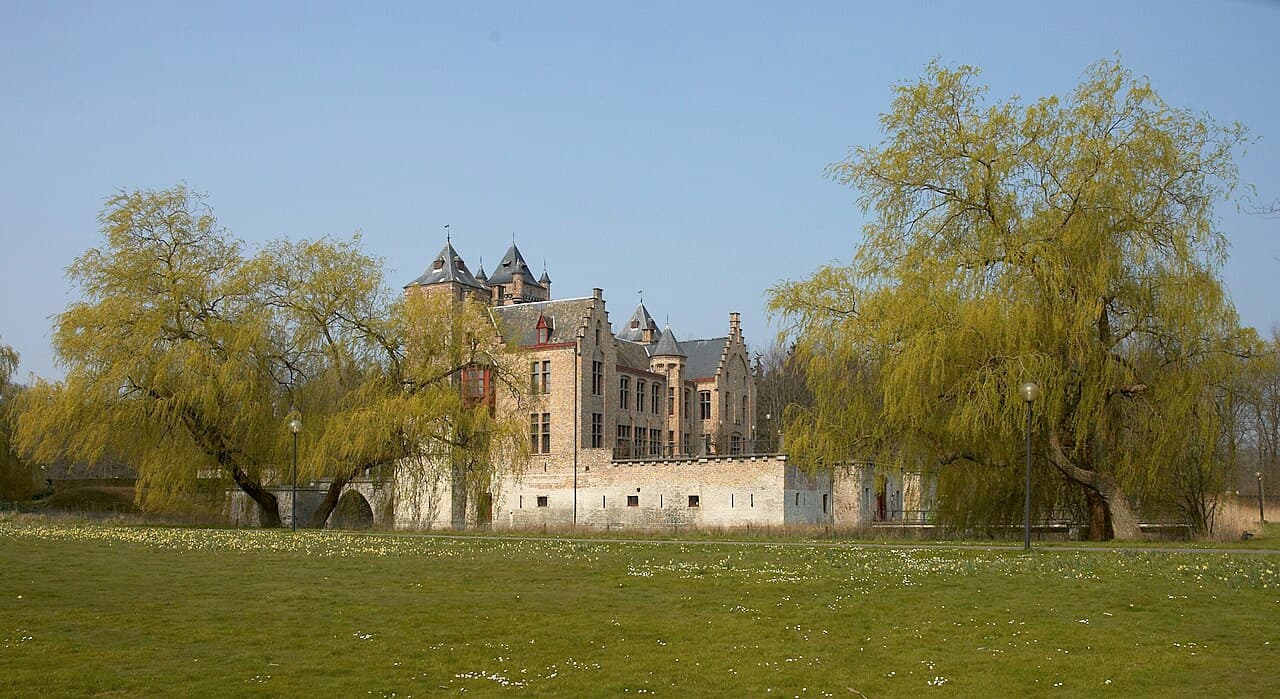
Tillegem Castle
Tillegem Castle, locally known as Kasteel van Tillegem, is a remarkable example of a moated castle located just south of the historic city of Bruges in the province of West Flanders, within the Flemish region of Belgium. While local tradition suggests a predecessor structure may have existed as early as the 9th century, the current castle's origins are firmly rooted in the 12th or 13th century, a period marking the height of medieval fortification construction in this region.
Medieval origins and architectural design
The castle was originally constructed as a square moated fortress, a common defensive design of the high medieval period. It featured square corner towers that provided vantage points for surveillance and defense, indicative of the military architecture of the time. The first known owner was Lord Jan van Voormezele, a noble figure associated with the castle's early history. The moat surrounding the castle not only served as a defensive barrier but also enhanced its imposing presence within the landscape.
Ownership and transformations through the centuries
Over the subsequent centuries, Tillegem Castle passed through the hands of various wealthy families from Bruges. These owners undertook multiple renovations and reconstructions, motivated both by the need to repair wartime damages and to adapt the castle to more comfortable residential standards as the medieval fortress evolved into a noble residence. These modifications reflect the broader European trend of castles transitioning from purely military strongholds to stately homes.
The 19th-century revival and restoration
In 1879, the castle entered a significant phase of restoration and stylistic transformation when it was acquired by Baron Eugène Charles de Peñaranda de Franchimont. Under his patronage, the castle was rebuilt in the distinctive Flemish Gothic Revival style, a 19th-century architectural movement that sought to revive medieval Gothic design elements with romantic and nationalistic undertones. The renowned architect Jean-Baptiste de Béthune was commissioned for this project, and his work gave the castle its present-day appearance. Béthune's design emphasized pointed arches, ornate brickwork, and decorative gables, all characteristic of the Flemish Gothic Revival aesthetic.
Modern usage and preservation
Tillegem Castle remained a private residence until 1980, after which it was transferred to the provincial government. Recognizing its cultural and architectural value, the government undertook restoration efforts to preserve the castle's integrity while adapting it for modern use. Today, the castle serves as office space for provincial government functions, a practical reuse that has helped maintain the building's upkeep and relevance.
Access and surroundings
While the castle itself is not open to public tours due to its current administrative function, visitors can enjoy the castle's surrounding park, which remains freely accessible. The park offers a scenic environment that complements the castle's historic atmosphere, providing a glimpse into the estate's grandeur and its integration with the natural landscape.
Architectural significance and heritage value
Tillegem Castle stands as a significant example of the evolution of medieval castles in Belgium, illustrating the transition from a fortified moated structure to a romanticized Gothic Revival residence. Its preservation and adaptive reuse demonstrate a successful balance between heritage conservation and contemporary functionality. The castle's Flemish Gothic Revival style is particularly notable for its regional expression of 19th-century architectural revivalism, making it an important cultural landmark in West Flanders.
Key architectural features
- Square moat surrounding the castle, a defensive feature from its medieval origins.
- Square corner towers that define the castle's original layout and fortification strategy.
- Flemish Gothic Revival elements such as pointed arches, intricate brickwork, and decorative gables added during the 19th-century restoration.
- Integration of modern amenities during the 20th-century restoration to accommodate office use.
Historical context within the region
The castle's location near Bruges places it within a historically rich area known for its medieval trade, political significance, and architectural heritage. Bruges itself was a major center of commerce and culture during the Middle Ages, and estates like Tillegem Castle played a role in the rural landscape surrounding the city, serving as seats of local power and noble residence.
Tillegem Castle's history reflects the broader patterns of feudal ownership, architectural adaptation, and heritage preservation that characterize many historic castles in Belgium and Western Europe. Its ongoing use and maintenance ensure that it remains a living part of the region's cultural fabric.
Frequently asked questions (FAQ)
- Can I visit Tillegem Castle's interior?
- Tillegem Castle is currently used as offices for the provincial government and is not open to public tours. However, visitors can freely access and enjoy the surrounding park area.
- What architectural style characterizes Tillegem Castle?
- The castle is primarily known for its Flemish Gothic Revival style, a 19th-century architectural movement that restored and enhanced its medieval features with romantic Gothic elements.
- When was Tillegem Castle originally built?
- The present Tillegem Castle dates back to the 12th or 13th century, although there may have been a predecessor structure on the site as early as the 9th century.
- Who was responsible for the 19th-century restoration of Tillegem Castle?
- Baron Eugène Charles de Peñaranda de Franchimont acquired the castle in 1879 and commissioned architect Jean-Baptiste de Béthune to rebuild it in the Flemish Gothic Revival style.
- Is the castle surrounded by a moat?
- Yes, Tillegem Castle is a moated castle, featuring a square moat that was originally designed for defense during the medieval period.
Photo gallery

Photo by Wouter Hagens•Public domain
Information
Current owner
Provincial government
Address
Tillegemstraat 81, Belgium
Loading map...
Visitor reviews
No reviews yet. Been here? Write the first review and help other travelers!
Write the first reviewVisited this castle? Share your experience
Your review helps other travelers and adds first-hand knowledge to our encyclopedia.



