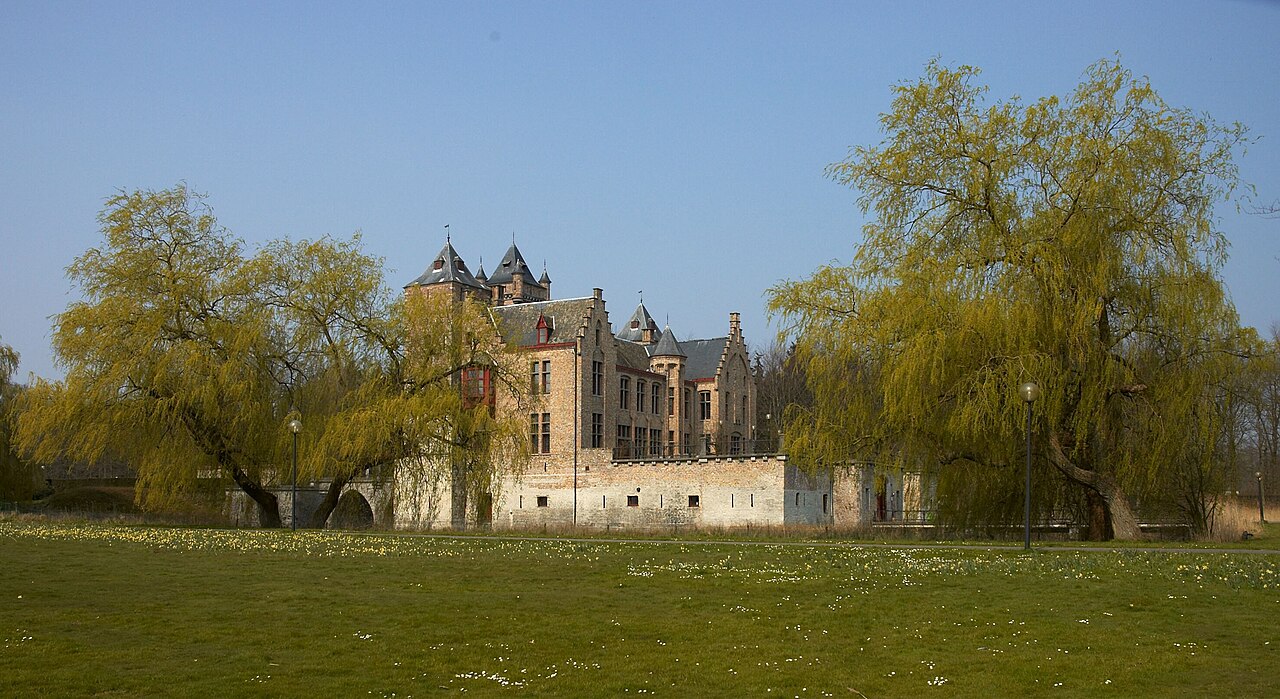
Male Castle
Male Castle, known locally as Kasteel van Male, is a significant medieval fortress located in the village of Male, within the province of West Flanders in the Flemish region of Belgium. The castle's origins trace back to the 9th century, when it began as a moated wooden tower designed as a refuge against Viking incursions, reflecting the turbulent early medieval period in this region.
Early medieval origins and initial construction
The earliest structure at the site was a simple wooden tower surrounded by a moat, typical of early medieval defensive architecture. This initial fortification served as a protective refuge during the frequent Viking raids that threatened the coastal and riverine territories around Bruges. The strategic location of Male Castle near Bruges made it an important defensive outpost in the region.
Transition to stone and the high medieval period
In the 12th century, the wooden fortification was replaced by a more durable stone castle under the direction of Philip I, Count of Flanders. This transition marked a significant evolution in the castle's architecture and defensive capabilities. The stone castle included a chapel, which according to tradition was consecrated in 1166 by Thomas Becket, the exiled Archbishop of Canterbury. This consecration highlights the castle's dual role as both a military stronghold and a noble residence.
Role as a residence and court
During the Middle Ages, Male Castle served primarily as a residence and administrative court for the Counts of Flanders. It was a center of regional power and governance, reflecting the political importance of the Counts in medieval Flanders. Notably, in 1329, it was the birthplace of Count Louis II of Flanders, also known as Louis of Male, underscoring its status as a noble residence.
Conflicts and destruction in the late medieval period
Male Castle's history is marked by repeated sieges and destruction due to the region's volatile political landscape. During the French occupation, the castle was garrisoned by French troops but was retaken by the forces of Bruges in 1302 during a local uprising. Later, the castle was captured and destroyed by the citizens of Ghent in 1382, reflecting the intense urban-rural conflicts in Flanders.
The castle was rebuilt but again suffered attacks by Ghent's townspeople in 1453. It was burned down in 1472 and rebuilt once more, with the current keep dating from this period. This keep, which now functions as a gate tower, is notable for its foundations directly in the moat and is flanked by symmetrical wings added during the rebuilding phase.
In 1490, the castle was looted by the troops of the Count of Nassau, adding to its turbulent history of conflict and reconstruction.
Spanish period and decline
During the Spanish occupation of the Low Countries, Male Castle was sold in 1558 by Philip II to the Spanish knight Juan Lopez Gallo. Following this sale, the castle gradually lost its military and political significance and passed through the hands of various noble families. It became somewhat neglected and faded from prominence over the centuries.
Modern history and restoration
Male Castle was occupied by German forces during both World War I and World War II. The castle suffered significant damage during these occupations, leaving it in a ruinous state by the end of the Second World War.
In 1953, the last noble owner, Baron Gillès de Pélichy, transferred ownership of the castle to the St. Trudo convent in Bruges. The nuns moved into the castle in 1954, and a comprehensive restoration project was undertaken, lasting until 1972. This restoration aimed to preserve the castle's historical architecture while adapting it for use as a convent.
In the 21st century, the castle was purchased by a Belgian businessman in 2011. The nuns vacated the premises in 2013, and since then, the businessman's daughter has resided on the castle grounds. Plans have been announced to convert Male Castle into a luxury suite hotel, although it is currently not open to the public.
Architectural features and significance
Male Castle is an example of a medieval moated castle that evolved over several centuries. The surviving keep, dating from the late 15th century rebuilding, is a key feature, notable for its placement directly in the moat and its function as a gate tower. The castle's wings, added during the same period, give it a symmetrical appearance uncommon in earlier medieval fortifications.
The castle's architecture reflects the transition from early wooden fortifications to stone castles designed for both defense and noble residence. Its repeated destruction and rebuilding demonstrate the turbulent history of Flanders during the Middle Ages, marked by conflicts between local cities, foreign occupiers, and noble families.
Cultural and historical context
Male Castle's history is closely intertwined with the political and military struggles of Flanders. It served as a residence for the Counts of Flanders, a defensive stronghold against Viking raids, and a contested site during urban uprisings and foreign occupations. The castle's survival and restoration contribute to the understanding of medieval and early modern history in the region.
Although currently not accessible to visitors, Male Castle remains an important heritage site that illustrates the architectural and historical developments of Flemish castles. Its preservation and planned future use as a luxury hotel may offer new opportunities for public engagement with this significant monument.
Frequently asked questions (FAQ)
- When was Male Castle originally built?
- Male Castle's origins date back to the 9th century, starting as a wooden tower to defend against Viking raids.
- Can visitors tour Male Castle today?
- Currently, Male Castle is not open to the public as it is privately owned and undergoing plans for conversion to a luxury hotel.
- What architectural styles are visible in Male Castle?
- Male Castle features a mix of architectural styles, including early medieval wooden fortifications and later stone elements from the 12th and 15th centuries.
- Who consecrated the chapel at Male Castle?
- The castle's chapel was reportedly consecrated in 1166 by Thomas Becket, the exiled Archbishop of Canterbury.
- What role did Male Castle play in regional conflicts?
- Male Castle was a strategic stronghold during various conflicts, including sieges by French forces, uprisings by Bruges and Ghent, and attacks during the Spanish occupation.
Information
Current owner
Private owner
Address
Lodewijk van Malestraat, Belgium
Loading map...
Visitor reviews
No reviews yet. Been here? Write the first review and help other travelers!
Write the first reviewVisited this castle? Share your experience
Your review helps other travelers and adds first-hand knowledge to our encyclopedia.