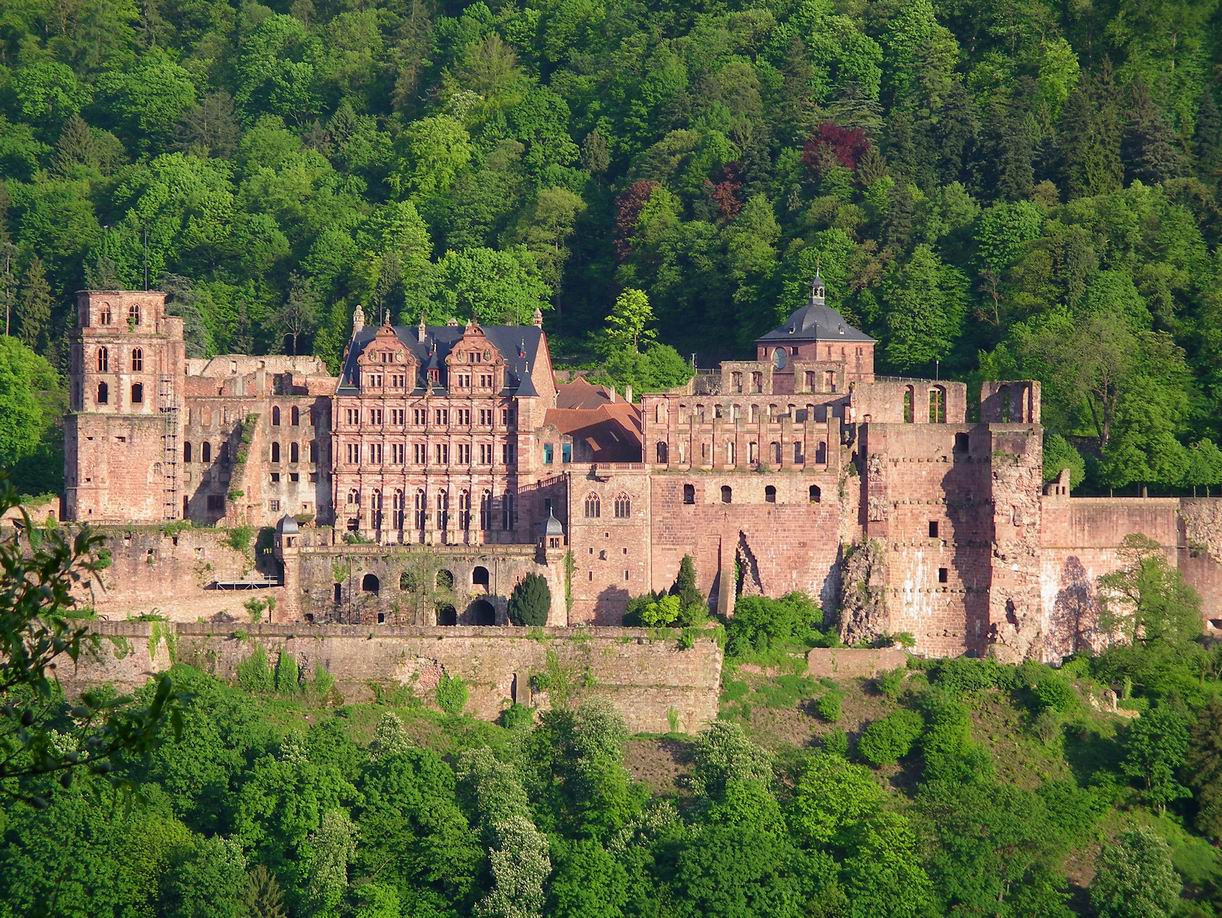
Tiefburg Castle Ruins

Tiefburg castle ruins in heidelberg
Heidelberg, Germany
High Medieval (11th–13th c.)
Partially Preserved

Tiefburg Castle is a notable medieval ruin located in Heidelberg, Germany, with origins that trace back to the 12th century. While the exact date of construction and the original builder remain uncertain, historical evidence suggests that the castle was likely established either by the Abbey of Lorsch or the Count Palatinates of the Rhine, who later became known as the Prince Electors of the Palatinate. This period marked significant territorial and political developments in the region, with Heidelberg emerging as a prominent seat of power.

The castle's strategic location and fortified structure indicate its importance as a defensive stronghold and residence. It may have originated as a fortified estate before evolving into a full-fledged castle complex. The knights of Handschuhsheim, initially unfree knights or ministeriales serving the Abbey of Lorsch, later became vassals of the Prince Electors. This social status reflects the feudal hierarchy and military obligations tied to the castle's function.

Historical background and ownership

The lineage of the Handschuhsheim knights ended with the death of Johannes (Hans) V. in 1600, who died at the young age of 16 due to injuries from a duel. Following this, the castle passed through inheritance to the barons of Helmstatt, a noble family that attained the title of counts in the 18th century. The Helmstatts played a crucial role in the later history of Tiefburg, including its restoration efforts in the early 20th century.

Architectural features and castle layout

Although much of the original structure is now in ruins, the Tiefburg would have featured typical medieval castle elements such as defensive walls, gatehouses, and residential quarters. The castle's design likely incorporated a keep or main tower, which served as the last line of defense and the lord's residence. The proximity of the new Helmstatt residence, built after Tiefburg became uninhabitable, indicates the castle's original site remained significant for local nobility.

Damage and decline

Tiefburg Castle suffered extensive damage during the Thirty Years' War (1618–1648), a devastating conflict that affected much of Central Europe. Later, in 1689, it was further damaged during the War of the Palatine Succession, which led to its abandonment as a residence. The destruction rendered the castle uninhabitable, prompting the Helmstatt family to construct a new residence nearby. The original gate of this successor residence still stands east of the square in front of the Tiefburg ruins, serving as a historical marker.

20th-century restoration and current status

In the early 20th century, Count Raban von Helmstatt undertook restoration efforts from 1910 to 1913 to preserve the castle ruins. These works aimed to stabilize the remaining structures and maintain the site's historical significance. Today, Tiefburg Castle remains a partially preserved ruin that attracts visitors interested in medieval architecture and history.

Cultural significance and tourism

The ruins of Tiefburg Castle offer valuable insight into the feudal and military history of the Heidelberg region. Visitors can explore the remnants of the castle's fortifications and imagine the lives of the knights and noble families who once inhabited the site. The castle's connection to prominent historical figures and events enriches its appeal as a heritage site.

While the castle is not fully intact, its ruins are accessible to the public and provide a tangible link to the High Medieval period in Germany. The site is an important cultural asset within Heidelberg, contributing to the understanding of medieval fortifications and noble residences in the Palatinate region.

Frequently asked questions (FAQ)

How do I get to Tiefburg Castle Ruins?
Tiefburg Castle Ruins are located in Heidelberg, Germany, and can be accessed by foot from the city center. Visitors can enjoy a scenic hike up the hill, which offers beautiful views of the surrounding area. Public transportation options are also available, including local buses that can take you closer to the entrance.
What is the historical significance of Tiefburg Castle?
Tiefburg Castle, dating back to the late 12th century, played a crucial role in the defense of Heidelberg during the Middle Ages. It is one of the oldest fortifications in the region and provides insight into medieval architecture and military history. Today, it stands as a testament to the rich heritage of the area.
When was Tiefburg Castle built?
Construction of Tiefburg Castle began in the late 12th century, around 1180. It was strategically positioned to oversee trade routes and protect the town of Heidelberg. Over the centuries, the castle underwent several renovations and expansions, reflecting the changing architectural styles of the time.
Can I explore the ruins of Tiefburg Castle?
Yes, visitors are welcome to explore the ruins of Tiefburg Castle. While some areas may be restricted for safety reasons, there are ample opportunities to walk around and appreciate the historical architecture. Guided tours are also available, providing deeper insights into the castle's history.
Why is Tiefburg Castle a popular tourist destination?
Tiefburg Castle is popular due to its stunning views of Heidelberg and its historical significance. The picturesque ruins offer a glimpse into the past while also serving as a beautiful backdrop for photography. Additionally, the surrounding natural landscape makes it an ideal spot for hiking and outdoor activities.
Is it possible to visit Tiefburg Castle year-round?
Yes, Tiefburg Castle is open to visitors year-round, although hours may vary seasonally. It's recommended to check local resources for specific opening hours, especially during winter months when accessibility may be affected by weather conditions. The castle's serene ambiance can be enjoyed in every season.
What are the ticket prices for visiting Tiefburg Castle?
Admission to Tiefburg Castle is typically free, allowing visitors to explore the ruins without any cost. However, if you choose to participate in guided tours, there may be a small fee involved. It's best to check the official website for any updates on pricing or special events.
What is the best time to visit Tiefburg Castle?
The best time to visit Tiefburg Castle is during the spring and early autumn months when the weather is mild and the surrounding nature is vibrant. This period allows for comfortable hiking and exploration of the ruins. Additionally, the views can be particularly stunning during these seasons, making for memorable experiences.
Are there any nearby attractions to visit after Tiefburg Castle?
Yes, there are several attractions near Tiefburg Castle, including the famous Heidelberg Castle and the picturesque Old Town (Altstadt). Visitors can also explore the Philosopher's Walk, which offers breathtaking views of the city and the Neckar River. These nearby sites enhance the overall experience of visiting the area.

Information

Hill Castle

Loading map...

Visitor reviews

No reviews yet. Been here? Write the first review and help other travelers!

Write the first review

Visited this castle? Share your experience

Your review helps other travelers and adds first-hand knowledge to our encyclopedia.

Write a review

(5/5)

0/2000 characters

Your review will be visible after admin approval

Nearby castles

3.5 km

Schauenburg Castle Ruins

Dossenheim, Germany

Schauenburg Castle was constructed in the first half of the 12th century by the noble family known as the Edelfreien of Schauenburg. This high medieval fortress was strategically positioned near the town of Dossenheim in what is now Germany, serving both as a residence and a defensive stronghold during a period marked by feudal conflicts and territorial disputes. Early history and founding family The Edelfreien of Schauenburg, a family of free nobles, established the castle as a symbol of their power and influence. Despite their prominence, the family line became extinct by the late 13th century, which led to changes in the castle’s ownership and function. The early construction likely focused on a robust stone keep and a curtain wall to protect the inner ward, typical of high medieval castle architecture. Architectural features and expansions Although the original builders were no longer present, the castle continued to be of strategic importance. In the mid-14th century, significant expansions and renovations were undertaken. These likely included strengthening the existing fortifications and possibly enlarging the living quarters to accommodate new occupants or garrisons. The surviving curtain wall and keep are key remnants from these phases, showcasing the medieval defensive design with thick stone walls and narrow windows for archers. The keep and curtain wall The keep served as the last line of defense and the residence of the lord or castellan. Its construction emphasized verticality and defensibility, with limited entrances and elevated positions. The curtain wall enclosed the castle’s inner buildings and courtyard, providing a formidable barrier against attackers. These structures were built using locally sourced stone and demonstrate the masonry skills of the period. Siege and destruction in 1460 In 1460, during the Baden-Palatinate War, Schauenburg Castle was besieged for five days by forces led by Friedrich I, Elector Palatine. The siege ended with the castle being razed, a common fate for fortifications caught in regional conflicts during the late medieval period. The destruction marked the end of Schauenburg Castle as a functional military stronghold. Current condition and historical significance Today, Schauenburg Castle stands as ruins, with the curtain wall and keep partially preserved. These ruins offer valuable insights into high medieval fortification techniques and the feudal history of the region. The site attracts historians, archaeologists, and visitors interested in medieval architecture and the turbulent history of southwestern Germany. Visiting Schauenburg Castle ruins The castle ruins are accessible to the public and provide a scenic view of the surrounding landscape. Visitors can explore the remaining structures and imagine the castle’s former grandeur. The site is an important cultural landmark in Dossenheim and contributes to the understanding of medieval castle construction and regional history.

High Medieval (11th–13th c.)
Details
3.8 km
Heidelberg Castle — Germany castle

Heidelberg Castle

Heidelberg, Germany

Heidelberg Castle stands as one of the most iconic and historically significant castle ruins in Germany, renowned for its striking Renaissance architecture and commanding position on the northern slope of the Königstuhl hillside. Positioned approximately 80 meters above the Neckar valley, the castle overlooks the old town of Heidelberg, offering panoramic views that have captivated visitors for centuries. Its red sandstone ruins, blending late Gothic and Renaissance architectural styles, embody the evolution of a medieval fortress into a grand princely residence. Originally constructed in the early 13th century, Heidelberg Castle was initially a defensive stronghold before becoming the principal residence of the Electors Palatine, powerful princes within the Holy Roman Empire. Over the centuries, the castle complex expanded and transformed through multiple building phases, reflecting the shifting political, cultural, and religious landscape of the region. Despite suffering extensive damage from wars, fires, and lightning strikes, the castle's ruins remain a symbol of German Romanticism and a testament to its rich heritage. Early beginnings and medieval expansion The first documented mention of Heidelberg Castle dates back to 1225, when Ludwig I received it as a fief from the Bishop of Worms. The initial structure was a fortified hill castle designed to secure the territory and assert control over the Neckar valley. By the late 13th century, the castle had grown into two separate sections, known as the upper and lower castles, connected by walls and defensive features. In the early 15th century, Elector Ruprecht III undertook significant expansions, constructing the Ruprechtsbau, which remains one of the oldest surviving parts of the complex. This building features a notable Renaissance fireplace and a portal adorned with heraldic and angelic motifs. These enhancements reflected the castle’s dual role as a military fortress and a princely residence. Renaissance transformation and architectural highlights The 16th century marked a period of extensive architectural development under the patronage of successive Electors Palatine. Elector Ludwig V expanded the residential quarters and reinforced fortifications, while Elector Ottheinrich initiated the construction of the Ottheinrichsbau between 1556 and 1559. This building is historically significant as Germany’s first fully Renaissance-style structure, featuring an ornate facade with sixteen allegorical figures representing governance, virtues, and classical symbolism. Between 1601 and 1607, the Friedrichsbau was constructed under Elector Friedrich IV, designed by architect Johannes Schoch. This wing is distinguished by its richly decorated facade, featuring a gallery of ancestral statues and a still-functioning palace chapel. The Friedrichsbau is the best-preserved part of the castle, having undergone a neo-Renaissance restoration around 1900 led by Carl Schäfer. The castle also included the Ludwigsbau, originally built in 1524, and the Bibliotheksbau, a late Gothic structure used as a vault and court office. The Fassbau houses the famous Great Heidelberg Wine Barrel (Großes Fass), with a capacity of approximately 127,000 liters, crowned by a statue of the court jester Perkeo. Fortifications and defensive structures Heidelberg Castle was heavily fortified to withstand military threats. Its defensive features included massive towers such as the Dicker Turm (Thick Tower), which once stood about 40 meters tall with walls up to seven meters thick. This tower was even converted into a theater modeled after London’s Globe Theatre in 1613 before being partially destroyed in the late 17th century. The castle’s main entrance was guarded by the Torturm (Gate Tower), featuring a portcullis and oak gates, flanked by knight statues. Other towers like the Krautturm and the Apothekerturm (Pharmacy Tower) served various defensive and residential purposes. The Apothekerturm now houses the German Pharmacy Museum, preserving the site’s cultural legacy. Destruction, decline, and romantic revival The castle endured significant damage during the Thirty Years’ War (1618–1648), changing hands multiple times and suffering from sieges and bombardments. The War of the Palatine Succession (1688–1697) was even more devastating, with French troops deliberately destroying key buildings and fortifications in 1689 and 1693, leaving the castle largely in ruins. After the court relocated to Mannheim in 1720, Heidelberg Castle ceased to function as a royal residence. A lightning strike in 1764 caused a major fire that further damaged the remaining structures, halting restoration efforts. From the 19th century onwards, the castle ruins became emblematic of the German Romantic movement, inspiring poets, artists, and historians. The preservation efforts led by individuals such as Charles de Graimberg helped safeguard the ruins. The late 19th-century Heidelberg Castle Dispute concluded with a decision to preserve the ruins rather than fully rebuild. The Friedrichsbau underwent restoration between 1897 and 1900, receiving a historicist neo-Renaissance makeover. Gardens and landscape design The castle grounds once featured extensive gardens blending leisure and symbolism. The Hortus Palatinus, commissioned by Elector Friedrich V and designed by architect Salomon de Caus, was an ambitious Renaissance garden project celebrated as the "eighth wonder of the world" but never completed due to political upheaval. Other garden areas include the Stückgarten, initially a cannon terrace later transformed into a pleasure garden, and the Schlossgarten terraces. The Scheffelterrasse on the nearby Friesenberg hill offers views over the castle gardens and contains memorials to notable figures such as Goethe. Cultural significance and visitor experience Today, Heidelberg Castle is a major tourist attraction, drawing over three million visitors annually. Its ruins, gardens, and museums—including the German Pharmacy Museum—offer a multifaceted experience combining history, architecture, and culture. Guided tours, such as "The court life," provide insights into the lives of the Electors and the castle’s past. The castle’s dramatic setting and evocative ruins have made it a symbol of German heritage and Romanticism. The nearby Philosopher's Path hiking trail offers peaceful views of the castle and the city, enhancing the visitor experience. Heidelberg Castle remains a testament to centuries of architectural innovation, political power, and cultural memory on a prominent hilltop overlooking the Neckar valley.

High Medieval (11th–13th c.)
Details
4 km

Neuburg Abbey

Heidelberg, Germany

Neuburg Abbey, located near Heidelberg in Germany, is a historic monastic complex with origins dating back to the high medieval period. Founded in 1130 by Anshelm, a monk from the Benedictine Lorsch Abbey, Neuburg began as a priory under Lorsch's authority. Despite its auspicious beginnings, the priory struggled to thrive in its early decades. In 1195, under the direction of Conrad of Hohenstaufen, Count Palatine of the Rhine, Neuburg was converted into a nunnery and elevated to the status of an abbey. However, this change did not immediately improve its fortunes. The abbey faced continued challenges until the suppression of Lorsch Abbey in 1232, when Neuburg came under the jurisdiction of the Bishop of Mainz and subsequently the Bishop of Worms. The latter was a proponent of the Cistercian reforms, which brought new spiritual and financial vitality to Neuburg. With assistance from the nearby Schönau Abbey, a Cistercian monastery, Neuburg was reformed as a Cistercian nunnery. This affiliation initiated a period of significant growth and construction during the 14th century, marked by lively building activity that enhanced the abbey's architectural and cultural stature. The Cistercian influence is evident in the austere yet functional design elements typical of the order, emphasizing simplicity and harmony with the surrounding landscape. Despite this resurgence, Neuburg experienced another decline, leading to a reversion to the Benedictine observance in 1462, instigated by Frederick I, Elector Palatine. The abbey's religious community was suppressed during the Reformation in 1562, and the property subsequently became the possession of the Electors Palatine. In the following century, the site served various functions, including as a Frauenstift in the 1660s and 1670s, a collegiate institution for unmarried noblewomen. This period was short-lived but left a lasting legacy in the name "Stift Neuburg," by which the site is still commonly known. Jesuit period and architectural transformation In 1706, Johann Wilhelm II, Elector Palatine, granted the premises to the Jesuits of Heidelberg. The Jesuits undertook substantial construction, shaping much of the current visible architecture. Their buildings reflect the Baroque architectural style, characterized by grandeur, dynamic forms, and decorative richness, which marked a significant departure from the earlier medieval austerity. The Jesuit presence lasted until their suppression in 1773, after which the abbey reverted to the Elector's control. By 1799, the property was mortgaged to Heidelberg University and later passed into private ownership in 1804. In 1825, it became the residence of Johann Friedrich Heinrich Schlosser, a notable figure connected to the poet Goethe, and subsequently passed to the von Bernus family. 20th-century revival and modern status In 1926, Neuburg was reacquired for the Benedictine order by the poet and mystic Alexander von Bernus. The community was resettled by monks from Beuron Archabbey and elevated to abbey status in 1928. The early years of the new foundation were challenging, with the first abbot, Adalbert von Neipperg, resigning in 1934. The abbey was then overseen by an administrative board. During World War II, the abbey avoided dissolution by serving as a refuge for displaced elderly from the Ruhrgebiet, preserving its monastic presence. Post-war development accelerated under the second abbot, Dr. Albert Ohlmeyer, who led restoration and expansion efforts culminating in the dedication of the restored church in 1960. Following his death in 1976, leadership passed to Dom Maurus Berve and later to the current abbot, Dom Franziskus Heereman, from the Trappist Mariawald Abbey. Architectural features and layout Neuburg Abbey's architecture embodies a blend of high medieval monastic structures and Baroque renovations from the Jesuit period. The site includes a church with restored interiors, monastic living quarters, and ancillary buildings arranged around courtyards typical of Benedictine and Cistercian monasteries. The 14th-century building activity introduced Gothic elements, visible in window tracery and vaulting, while the Jesuit constructions added ornate facades and grand halls. The abbey's location near Heidelberg places it within a region rich in medieval religious architecture, contributing to its historical significance. Its survival through religious reforms, wars, and secularization reflects the adaptability and enduring cultural importance of monastic institutions in Germany. Significance in monastic reform movements Neuburg Abbey's history reflects broader religious trends, including the transition from Benedictine to Cistercian observance and back, illustrating the impact of reform movements on monastic life. The Cistercian emphasis on austerity and economic self-sufficiency contrasted with later Baroque embellishments introduced by the Jesuits, highlighting shifts in spiritual and architectural priorities over centuries. Current status and cultural heritage Today, Neuburg Abbey remains an active Benedictine community and a site of historical and architectural interest. Its well-preserved structures and layered history attract visitors interested in medieval monasticism, Baroque architecture, and the complex religious history of the Rhineland. The abbey also serves as a cultural landmark within Heidelberg's rich heritage landscape.

High Medieval (11th–13th c.)
Details