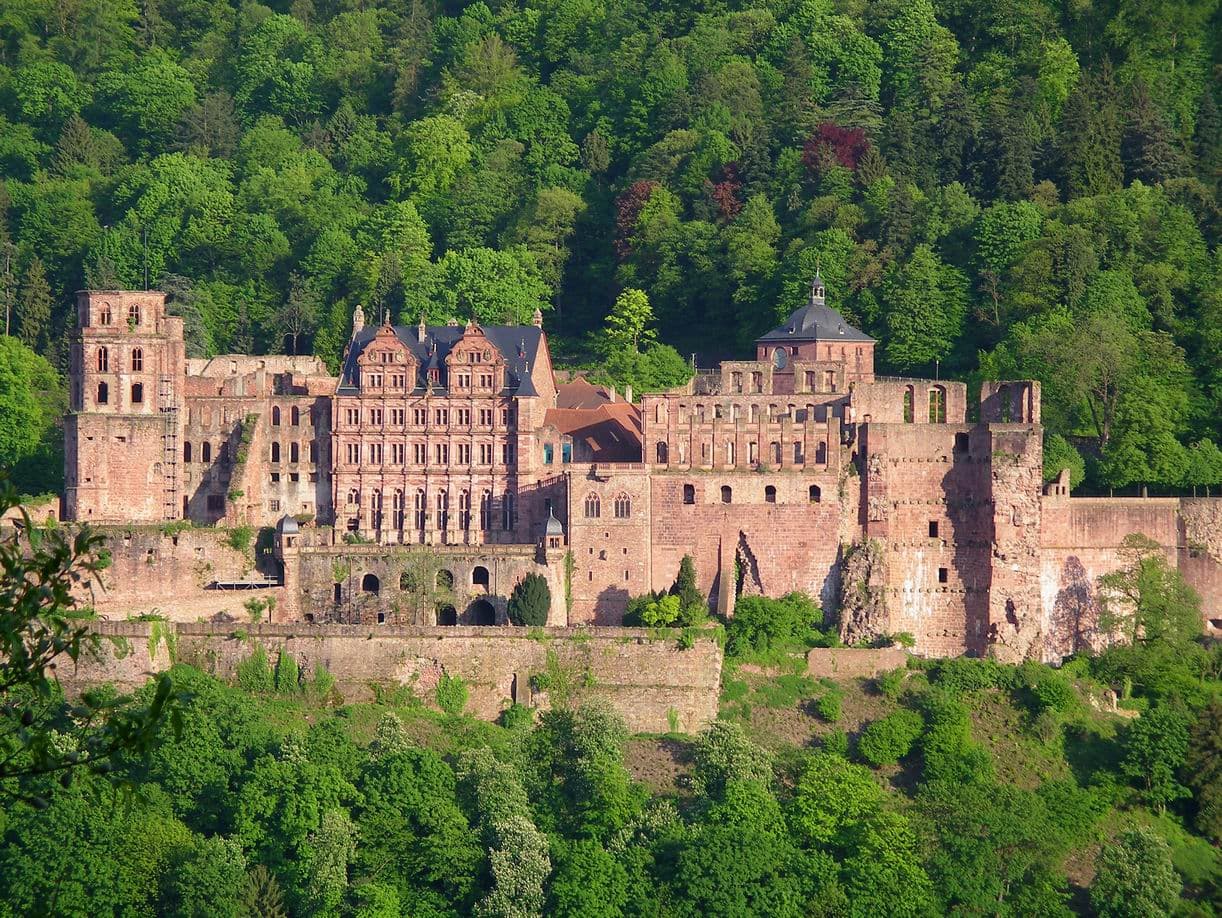
Heidelberg Castle
Heidelberg Castle stands as one of the most iconic and historically significant castle ruins in Germany, renowned for its striking Renaissance architecture and commanding position on the northern slope of the Königstuhl hillside. Positioned approximately 80 meters above the Neckar valley, the castle overlooks the old town of Heidelberg, offering panoramic views that have captivated visitors for centuries. Its red sandstone ruins, blending late Gothic and Renaissance architectural styles, embody the evolution of a medieval fortress into a grand princely residence.
Originally constructed in the early 13th century, Heidelberg Castle was initially a defensive stronghold before becoming the principal residence of the Electors Palatine, powerful princes within the Holy Roman Empire. Over the centuries, the castle complex expanded and transformed through multiple building phases, reflecting the shifting political, cultural, and religious landscape of the region. Despite suffering extensive damage from wars, fires, and lightning strikes, the castle's ruins remain a symbol of German Romanticism and a testament to its rich heritage.
Early beginnings and medieval expansion
The first documented mention of Heidelberg Castle dates back to 1225, when Ludwig I received it as a fief from the Bishop of Worms. The initial structure was a fortified hill castle designed to secure the territory and assert control over the Neckar valley. By the late 13th century, the castle had grown into two separate sections, known as the upper and lower castles, connected by walls and defensive features.
In the early 15th century, Elector Ruprecht III undertook significant expansions, constructing the Ruprechtsbau, which remains one of the oldest surviving parts of the complex. This building features a notable Renaissance fireplace and a portal adorned with heraldic and angelic motifs. These enhancements reflected the castle’s dual role as a military fortress and a princely residence.
Renaissance transformation and architectural highlights
The 16th century marked a period of extensive architectural development under the patronage of successive Electors Palatine. Elector Ludwig V expanded the residential quarters and reinforced fortifications, while Elector Ottheinrich initiated the construction of the Ottheinrichsbau between 1556 and 1559. This building is historically significant as Germany’s first fully Renaissance-style structure, featuring an ornate facade with sixteen allegorical figures representing governance, virtues, and classical symbolism.
Between 1601 and 1607, the Friedrichsbau was constructed under Elector Friedrich IV, designed by architect Johannes Schoch. This wing is distinguished by its richly decorated facade, featuring a gallery of ancestral statues and a still-functioning palace chapel. The Friedrichsbau is the best-preserved part of the castle, having undergone a neo-Renaissance restoration around 1900 led by Carl Schäfer.
The castle also included the Ludwigsbau, originally built in 1524, and the Bibliotheksbau, a late Gothic structure used as a vault and court office. The Fassbau houses the famous Great Heidelberg Wine Barrel (Großes Fass), with a capacity of approximately 127,000 liters, crowned by a statue of the court jester Perkeo.
Fortifications and defensive structures
Heidelberg Castle was heavily fortified to withstand military threats. Its defensive features included massive towers such as the Dicker Turm (Thick Tower), which once stood about 40 meters tall with walls up to seven meters thick. This tower was even converted into a theater modeled after London’s Globe Theatre in 1613 before being partially destroyed in the late 17th century.
The castle’s main entrance was guarded by the Torturm (Gate Tower), featuring a portcullis and oak gates, flanked by knight statues. Other towers like the Krautturm and the Apothekerturm (Pharmacy Tower) served various defensive and residential purposes. The Apothekerturm now houses the German Pharmacy Museum, preserving the site’s cultural legacy.
Destruction, decline, and romantic revival
The castle endured significant damage during the Thirty Years’ War (1618–1648), changing hands multiple times and suffering from sieges and bombardments. The War of the Palatine Succession (1688–1697) was even more devastating, with French troops deliberately destroying key buildings and fortifications in 1689 and 1693, leaving the castle largely in ruins.
After the court relocated to Mannheim in 1720, Heidelberg Castle ceased to function as a royal residence. A lightning strike in 1764 caused a major fire that further damaged the remaining structures, halting restoration efforts. From the 19th century onwards, the castle ruins became emblematic of the German Romantic movement, inspiring poets, artists, and historians.
The preservation efforts led by individuals such as Charles de Graimberg helped safeguard the ruins. The late 19th-century Heidelberg Castle Dispute concluded with a decision to preserve the ruins rather than fully rebuild. The Friedrichsbau underwent restoration between 1897 and 1900, receiving a historicist neo-Renaissance makeover.
Gardens and landscape design
The castle grounds once featured extensive gardens blending leisure and symbolism. The Hortus Palatinus, commissioned by Elector Friedrich V and designed by architect Salomon de Caus, was an ambitious Renaissance garden project celebrated as the "eighth wonder of the world" but never completed due to political upheaval.
Other garden areas include the Stückgarten, initially a cannon terrace later transformed into a pleasure garden, and the Schlossgarten terraces. The Scheffelterrasse on the nearby Friesenberg hill offers views over the castle gardens and contains memorials to notable figures such as Goethe.
Cultural significance and visitor experience
Today, Heidelberg Castle is a major tourist attraction, drawing over three million visitors annually. Its ruins, gardens, and museums—including the German Pharmacy Museum—offer a multifaceted experience combining history, architecture, and culture. Guided tours, such as "The court life," provide insights into the lives of the Electors and the castle’s past.
The castle’s dramatic setting and evocative ruins have made it a symbol of German heritage and Romanticism. The nearby Philosopher's Path hiking trail offers peaceful views of the castle and the city, enhancing the visitor experience. Heidelberg Castle remains a testament to centuries of architectural innovation, political power, and cultural memory on a prominent hilltop overlooking the Neckar valley.
Frequently asked questions (FAQ)
- What is the historical significance of Heidelberg Castle?
- Heidelberg Castle is one of the most important Renaissance structures in Germany, showcasing the architectural evolution from the Middle Ages to the Renaissance. It served as the residence of the Electors Palatine and played a significant role in the political history of the region. Today, it stands as a symbol of German Romanticism and attracts millions of visitors each year.
- When was Heidelberg Castle built?
- Construction of Heidelberg Castle began in the 13th century, with various additions and renovations occurring until the 17th century. The castle has witnessed numerous historical events, including wars and fires, which have shaped its current appearance. Its rich history is reflected in the diverse architectural styles found throughout the complex.
- Can I visit Heidelberg Castle year-round?
- Yes, Heidelberg Castle is open to visitors year-round, but operating hours may vary by season. During peak tourist season, typically from April to October, the castle remains open longer hours to accommodate visitors. It's recommended to check the official website for the most current information on opening times.
- What are the ticket prices for visiting Heidelberg Castle?
- Ticket prices for Heidelberg Castle vary depending on the type of tour and access you choose. General admission to the castle grounds is often free, but guided tours and access to specific areas may require a fee. Discounts are available for students and children, so be sure to check for the latest pricing details.
- Is it possible to access Heidelberg Castle by public transportation?
- Yes, Heidelberg Castle is easily accessible by public transportation, including trams and buses. The city has a reliable public transit system that can take you close to the castle. Additionally, there is a funicular railway that provides a scenic ride up to the castle from the valley below.
- When is the best time to visit Heidelberg Castle?
- The best time to visit Heidelberg Castle is during the spring and early autumn months, when the weather is mild, and the surrounding gardens are in full bloom. These seasons tend to be less crowded than the summer, allowing for a more enjoyable experience. However, the castle's charm during winter, especially with holiday decorations, can also be quite magical.
- What nearby attractions should I consider visiting?
- While visiting Heidelberg Castle, don't miss the charming Old Town (Altstadt) nearby, known for its historic buildings and vibrant atmosphere. The Philosopher's Walk offers stunning views of the castle and the Neckar River. Additionally, the Heidelberg University, one of the oldest universities in Germany, is also worth exploring.
- Is Heidelberg Castle wheelchair accessible?
- Heidelberg Castle has made efforts to improve accessibility, but some areas may be challenging for visitors with mobility impairments. The main pathways are generally accessible, but certain sections, particularly the castle’s interior, may involve stairs. It's advisable to contact the visitor center ahead of your visit for specific accessibility information and assistance.
Photo gallery

Information
Website
Visit websiteSources & official resources
Verify the information above using these authoritative references.
Loading map...
Visitor reviews
No reviews yet. Been here? Write the first review and help other travelers!
Write the first reviewVisited this castle? Share your experience
Your review helps other travelers and adds first-hand knowledge to our encyclopedia.



